Walking the Seismogenic Zone: A Field Geology Perspective on Earthquakes - Francis Birch Lecture
Explores earthquake cycles through field geology, examining ancient fault rocks to understand seismic behavior, transient conditions, and persistent changes that control fault deformation and slip patterns.
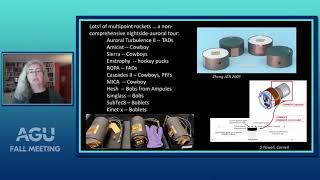
Exploring Near Earth Space with Sounding Rockets - Marcel Nicolet Lecture
Exploring near-Earth space using sounding rockets: innovative techniques, multi-payload campaigns, and groundbreaking discoveries in auroral ionospheric research, fostering new perspectives on Earth's environment.
Cassini's Chronicle of Carbon in the Saturn System - Eugene Shoemaker Lecture
Explore Saturn's carbon cycle through Cassini mission findings, revealing insights into the planet's atmosphere, rings, and moons in this AGU lecture honoring planetary scientist Eugene Shoemaker.
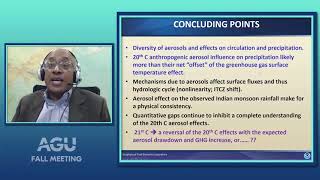
Aerosols and Their Gaming of the Climate System: Microscale Presence to Macroscopic Impacts
Exploring aerosols' impact on climate: from microscopic presence to macroscopic effects. Delves into how these tiny particles influence global climate systems and atmospheric dynamics.
Beno Gutenberg Lecture - Seismology and Earth's Structure
Explore seismology's frontiers in this annual AGU lecture honoring Beno Gutenberg, featuring cutting-edge research and insights from leading experts in the field.
COVID-19 and the Earth System
Explore the impacts of COVID-19 mitigation strategies on emissions, the Earth System, and virus dynamics. Learn about research efforts examining these complex interactions.
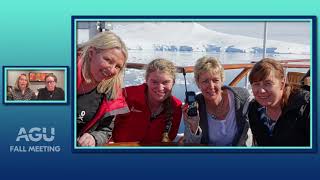
Hearts in the Ice - Climate Change Engagement Project in Spitzbergen
Explore the Hearts in the Ice project, connecting global efforts to address climate change through on-site research in Spitzbergen and engaging diverse stakeholders in Earth science communication.
Seeing the Forest for the Trees: Forests, Climate Change, and Our Future
Explores the complex relationship between forests and climate change, tracing historical perspectives and advocating for an interdisciplinary approach to understand and address forest-climate interactions.
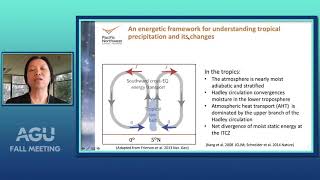
A Quest to Understand and Model Regional Precipitation and Their Future Changes
Explores precipitation from weather and climate perspectives, examining energetic frameworks, aerosol impacts, and extreme events to advance understanding and modeling of regional rainfall patterns and future changes.
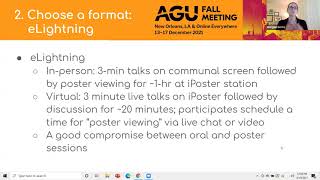
Proposing and Convening a Session at AGU - Early Career Webinar
Learn how to propose and convene a session at AGU Fall Meeting. Gain insights from experienced scientists on the process, timeline, and best practices for early career researchers to organize successful conference sessions.
Satellite Technology for Ocean Study - Storied Careers in Marine Research
Satellite technology reveals ocean secrets through color sensors, studying phytoplankton blooms and their impact on global photosynthesis. Scientist Charles McClain discusses his pioneering research since the 1970s.
Storied Careers: From Ocean Sensors to Dog Scenters
Oceanographer Tommy Dickey's journey from developing ocean monitoring technologies to training therapy dogs and studying scent detection in retirement, highlighting diverse career paths in science.
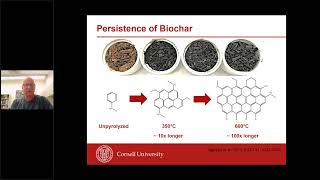
What Are the Soil Carbon Sequestration Potentials of Biochar and Enhanced Weathering?
Explore the potential of biochar and enhanced weathering for soil carbon sequestration, examining their effectiveness, implementation methods, and environmental impacts.
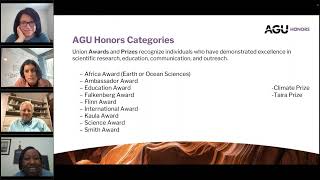
Demystifying the Honors Nomination Process - AGU Honors Program Background
Explore the AGU Honors Program nomination process, gaining insights into its background and procedures for recognizing outstanding contributions in Earth and space sciences.
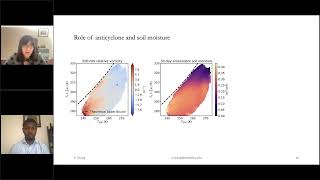
Early-Career Science Seminar Series - Physics and Dynamics
Explore cutting-edge physics and dynamics research in this seminar series designed for early-career scientists, featuring expert presentations and discussions on current topics.
Ice: Shells of an Ice-Less Past - Tracking Climate Change Through Foraminifera Fossils
Explore Earth's ice-free past through fossil evidence, uncovering climate changes and their implications for our future with Smithsonian climate detective Brian Huber.
Ice: Birds Foretelling Climate Change
Explore how climate change impacts snow petrels in Antarctica through Indian researcher Anant Pande's work, revealing the delicate balance between melting ice and extreme weather on these unique birds' nesting habits.
Extinctions: The Cambrian Explosion Revisited
Geoscientist Rachel Wood challenges the traditional view of the Cambrian explosion, offering new insights into the emergence of animals on Earth and redefining our understanding of this pivotal period in evolutionary history.
Extinctions: Oddballs of the Triassic
Explore the unique vertebrates of the Triassic era and their extinctions with Smithsonian paleontologist Hans Sues. Discover strange animals, extinction events, and the challenges of fossil fieldwork.
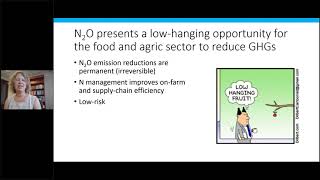
Managing N2O - Quantifying and Reducing Agricultural N2O Emissions at Scale
Explore strategies for quantifying and reducing agricultural N2O emissions, focusing on large-scale accounting and improved water management in the U.S. corn belt.
Who Dr. Marshall Shepherd Is in 21 Pictures - AGU LANDInG Inclusive Webinar Series
Renowned climate expert Dr. J. Marshall Shepherd shares his personal journey and insights on diversity, equity, and inclusion in STEM fields through 21 impactful images.