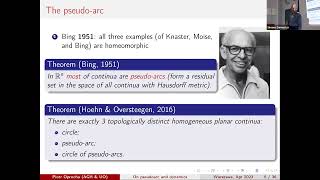
On Pseudoarc and Dynamics
Explore the fascinating world of pseudoarc, its topological significance, and its connections to dynamical systems in this insightful lecture by Piotr Oprocha.
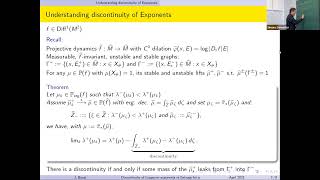
Continuity Properties of Lyapunov Exponents - Lectures 3 and 4
Delve into the continuity properties of Lyapunov exponents in smooth surface diffeomorphisms, exploring entropy control and the impact of near homoclinic tangencies on unstable curve expansion.
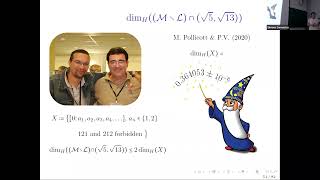
Rigorous Computer Algorithms for Chaotic Dynamics - Lecture 2
Dive into rigorous computer algorithms for chaotic dynamics, exploring transfer operators, spectral radius computation, and estimating key parameters in hyperbolic systems.
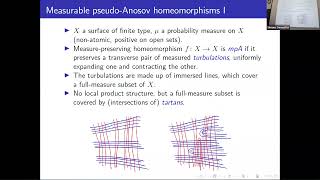
Measurable Pseudo-Anosovs in Surface Homeomorphisms
Explore the dynamics of measurable pseudo-Anosov homeomorphisms, their origins in inverse limits of tent maps, and their role in surface homeomorphism dynamics.
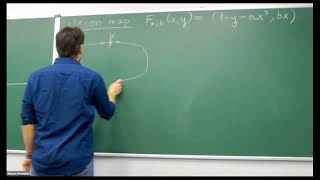
The Pruning Front Conjecture, Wandering Domains and Classification of Hénon Maps - Strange Attractors
Dive into topological dynamics of Hénon maps, exploring kneading theory, strange attractors, and wandering domains within the Wang-Young parameter set.
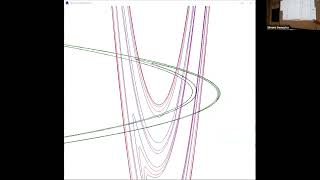
Models for Dynamical Systems in Dimensions 1 and 2 - Lecture 1
Explore dynamical systems in 1D and 2D, focusing on Milnor-Thurston's theorem and its potential 2D analog for surface diffeomorphisms. Delve into connections with Teichmüller Theory and 3-manifold topology.
Counting Periodic Orbits of One-Dimensional Maps - Lecture 2
Delve into the mathematics of counting periodic orbits in one-dimensional maps. Explore connections to number theory and thermodynamic formalism, focusing on interval and complex rational maps.
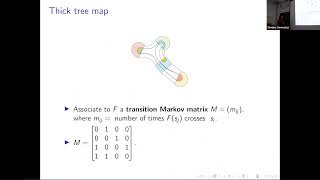
Generalized Pseudo-Anosov Maps from Holomorphic Dynamics
Explore the connection between quadratic polynomial dynamics and surface homeomorphisms, focusing on generalized pseudo-Anosov extensions of Hubbard tree dynamics.
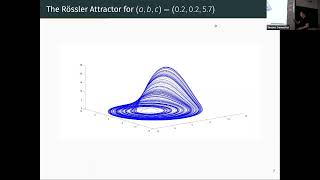
Dynamical Complexity in the Rössler System
Uncover the analytical connection between Rössler equations and the logistic family. Explore periodic orbits, topologies, and complex dynamics in this mathematical exploration of chaotic attractors.
Monotonicity of Entropy in Families of Interval Maps - Lecture 1
Explore the transfer operator, holomorphic motions, and entropy monotonicity in interval maps. Gain insights into applications in rational dynamics and quadratic families.
Equilibrium States Through Potential Theory - Lecture 2
Dive into equilibrium states for rational maps and endomorphisms, exploring their construction through potential theory and their statistical properties in thermodynamic formalism.
Models for Dynamical Systems in Dimensions 1 and 2 - Lecture 3
Explore dynamical systems in 1D and 2D, focusing on Milnor-Thurston's theorem and its potential 2D analogue for surface diffeomorphisms. Delve into connections with Teichmüller Theory and 3-manifold topology.
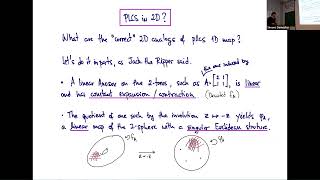
Models for Dynamical Systems in Dimensions 1 and 2 - Lecture 2
Explore models for dynamical systems in 1D and 2D, focusing on Milnor-Thurston's theorem and its potential 2D analogue for surface diffeomorphisms.
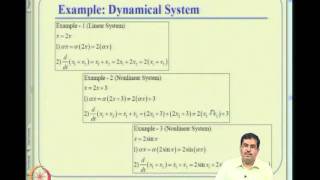
Advanced Control System Design for Aerospace Vehicles
Comprehensive exploration of advanced control systems for aerospace vehicles, covering classical and modern techniques, flight dynamics, optimization, and adaptive designs for enhanced aircraft performance.
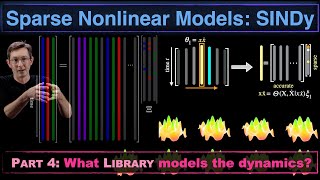
Sparse Nonlinear Dynamics Models with SINDy - The Library of Candidate Nonlinearities
Explores advanced techniques for SINDy algorithm, including control variables, bifurcation parameters, rational functions, dimensionality reduction, and symmetry constraints in nonlinear dynamics modeling.
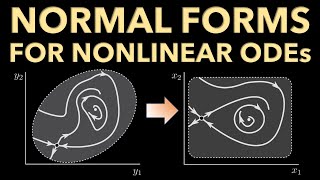
Normal Forms for Vector Fields
Introduction to normal forms for vector fields, focusing on simplifying nonlinear terms and determining topological equivalence. Covers theory, examples, and applications in dynamical systems analysis.
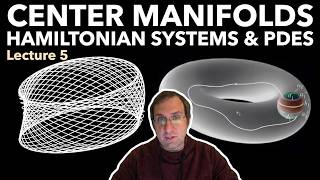
Center Manifolds for Hamiltonian Systems and PDEs - Lorenz System Bifurcation, Part 2
Explore center manifolds in Hamiltonian systems and PDEs, including Lorenz system bifurcation, unstable directions, and applications to flame front evolution and celestial mechanics.
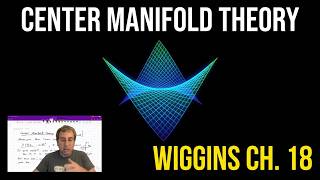
Center Manifold Theory - Computing Center Manifolds
Explore center manifold theory for dynamical systems, focusing on computing and approximating center manifolds. Learn to analyze stability and dynamics near equilibrium points using Taylor series expansions and tangency conditions.
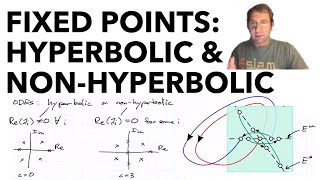
Hyperbolic vs Non-Hyperbolic Fixed Points - Computing Their Invariant Manifolds via Taylor Series
Explore hyperbolic and non-hyperbolic fixed points, their invariant manifolds, and computational methods using Taylor series expansion in dynamical systems and nonlinear dynamics.
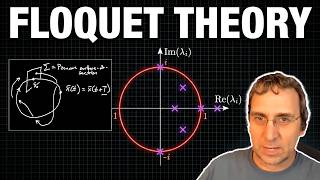
Stability of Periodic Orbits - Floquet Theory - Stable and Unstable Invariant Manifolds
Explore stability of periodic orbits using Floquet theory. Learn about monodromy matrices, Floquet multipliers, and invariant manifolds in Hamiltonian systems. Understand the foundations of chaos in dynamical systems.
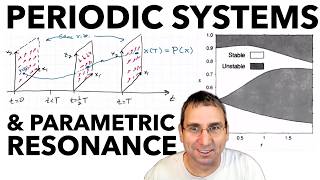
Periodic Systems and Periodic Motion - Parametric Resonance Tongues of Instability, Mathieu Equation
Explore periodic systems, parametric resonance, and the Mathieu equation. Learn about resonance tongues, stability analysis, and the fascinating Kapitza pendulum phenomenon in nonlinear dynamics.