
Plain, Old, but Mighty: Leveraging POROs in Greenfield and Legacy Code
Explore strategies to leverage Plain Old Ruby Objects (POROs) in new and legacy code for improved flexibility, readability, and testability in Rails applications.
Riffing on Rails: Sketch Your Way to Better Designed Code
Explore rapid code sketching techniques to improve Rails app design. Learn to plan objects, name components, and define relationships through interactive Ruby experimentation.

Introduction to Axon Framework with CQRS Pattern
Explore Axon Framework's event-driven microservices using CQRS and DDD principles. Learn key components, architecture, and implementation with hands-on examples.

Domain Driven Design in Practice
Explore Domain Driven Design principles to model complex business problems and create adaptable, goal-oriented software solutions.

Domain Driven Design in Practice - Part Two: Modeling Complex Business Problems
Explore Domain Driven Design principles for complex business modeling, focusing on linguistic boundaries, tactical design, and aggregate design guidelines.

Data Mesh: Architecture and Implementation on GCP and Databricks
Explore Data Mesh principles for decentralized data management, empowering teams and ensuring data quality across organizations. Learn implementation on GCP and Databricks.

Master Software Architecture - Exploring Evolution and Complexities
Explore software architecture evolution, from early programming to advanced design. Gain insights on self-publishing, consulting, and avoiding pitfalls. Examine trends critically and discover recommended readings for effective practices.
How Building a Portable Escape Room Made Me a Better Microservices Developer
Discover how creating a portable IoT escape room enhances microservice development skills. Explore parallels in puzzle design and architecture for resilient, scalable systems using DDD principles.
Stabilising Eccentric Systems
Explore techniques for stabilizing legacy systems, including testing, monitoring, re-architecting, and documenting. Learn to prioritize urgent tasks and gain buy-in for system improvements.
Exploring Domain-Driven Design in Go
Discover how to effectively apply Domain-Driven Design principles to Go applications, leveraging language-specific features and maintaining idiomatic code through tactical and strategic patterns.

Tackling Property Data with Readable Code - NDC Oslo 2024
Explore domain modeling with F# for property data, using Event Sourcing and pattern matching to achieve readable, maintainable code in complex real-world applications.
EventStorming - Collaborative Learning for Complex Domains
Explore EventStorming, a collaborative modeling technique for complex business problems. Learn how to quickly generate shared understanding and insights for effective software development.

Modularizing the Monolith - Patterns and Techniques for Evolutionary Design
Explore modular monolith architecture: preserving single-app benefits while isolating data and behavior. Learn to define modules, draw boundaries, and evolve existing systems for potential microservice success.
Domain-Driven Refactoring
Explore techniques to transform existing code into a more cohesive, domain-driven design. Learn to identify code smells, apply design patterns, and safely refactor towards an improved model.
Effective Testing in Microservice Systems
Explore effective testing strategies for microservice architectures, focusing on DDD techniques, service-level tests, and continuous delivery to optimize test coverage and confidence.
Domain-Driven Refactoring
Explore techniques to transform existing code into a more cohesive, domain-driven design. Learn to identify code smells, apply design patterns, and safely refactor towards an improved model.

CUPID - for Joyful Coding
Explore CUPID: Composable, Unix philosophy, Predictable, Idiomatic, Domain-based - a new approach to joyful coding that challenges SOLID principles and aims to create more enjoyable codebases.

Domain-Driven Design Principles and Patterns - CodeCamp
Explore principles and patterns for crafting elegant object systems in software development through Domain Driven Design concepts.

Practical Implementation of Domain-Driven Design
Explore practical implementation of Domain Driven Design, focusing on tools and approaches for microservices in both monolith breakdowns and greenfield projects.

Best Practices in Domain Driven Design
Explore key concepts and best practices in Domain Driven Design, including Ubiquitous Language, Bounded Context, Aggregates, and more.
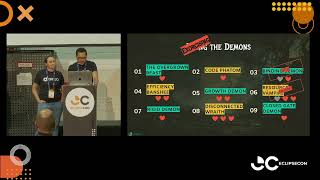
From Monolith to Modulith - The Evolution of Sirius Web's Architecture
Discover how to transform monolithic systems into modular architectures using Domain-Driven Design principles, with practical insights from Sirius Web's evolution to a hexagonal architecture for improved scalability.