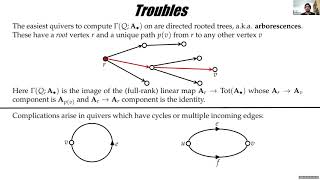
Vidit Nanda - Principal Components Along Quiver Representations
Principal components analysis for quiver representations: dimensionality reduction, comparison, and optimization techniques for vector-space valued representations across pure and applied mathematics.
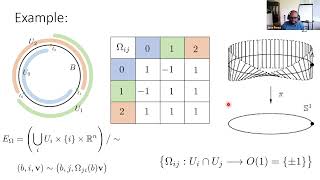
Vector Bundles for Data Alignment and Dimensionality Reduction
Explore vector bundles in data science, focusing on synchronization problems and topology-preserving dimensionality reduction. Applications in computational chemistry and dynamical systems are presented.
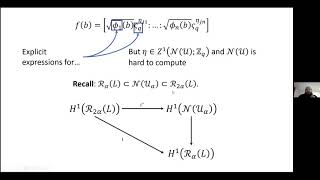
Data Driven Torsion Coordinates and Wasserstein Stability
Explore data-driven torsion coordinates in finite Lens spaces, LPCA dimensionality reduction, and Wasserstein stability for topological data analysis and nonlinear dimensionality reduction.
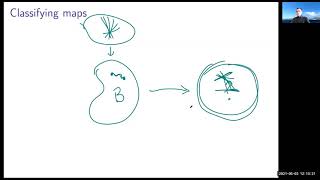
Approximate and Discrete Vector Bundles
Explore synchronization problems and dimensionality reduction through vector bundles. Learn how characteristic classes provide insights into global synchronization and data analysis challenges.
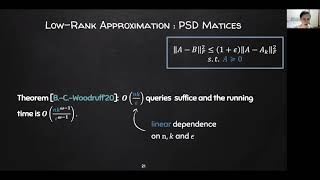
Robust and Sample Optimal Algorithms for PSD Low-Rank Approximation
Explore efficient algorithms for positive semidefinite low-rank approximation, focusing on robustness and sample optimality in matrix computations.
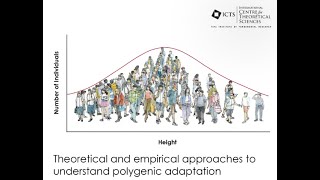
Tools of High Dimensional Data - Lecture 3
Explore high-dimensional data analysis techniques with Bruce Walsh, focusing on advanced tools and methods for complex datasets in biological evolution and genetics.

Sketching and Randomized Linear Algebra
Explore advanced techniques in randomized linear algebra, focusing on sketching methods for efficient data analysis and algorithm design in high-dimensional spaces.
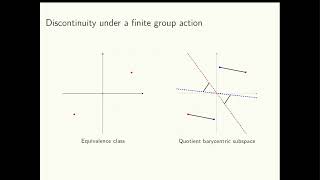
Towards Quotient Barycentric Subspaces
Explore advanced mathematical concepts of quotient barycentric subspaces, delving into their properties and applications in geometric data analysis.
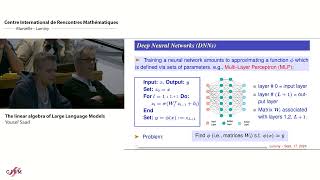
The Linear Algebra of Large Language Models
Explorez les fondements mathématiques des modèles de langage à grande échelle et leur lien avec l'algèbre linéaire avancée.
Randomized Least Squares Optimization and its Incredible Utility for Large-Scale Tensor Decomposition
Explore randomized least squares optimization techniques for large-scale tensor decomposition, focusing on sublinear algorithms and their applications in data analysis.
Sketching Techniques for Data Structures and Optimization - Part 2
Explore advanced sketching techniques for data structures and optimization in fast algorithms, focusing on practical applications and theoretical foundations.

Sketching Techniques for Data Structures and Optimization - Part 1
Explore data structure optimization techniques for fast algorithms, focusing on sketching methods to enhance computational efficiency and performance.

Cortical Areas Interact through a Communication Subspace
Explore how cortical areas communicate through subspaces, examining neural population dynamics and inter-area interactions in visual processing using advanced data analysis techniques.
Projection Methods for Neurobiological Networks
Explore projection techniques for analyzing complex neurobiological networks, focusing on applications in neuroscience research and computational modeling.
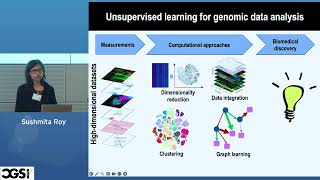
Matrix Factorization and Applications to Bulk and Single Cell Omic Datasets
Explore matrix factorization techniques for analyzing bulk and single-cell omic datasets, with applications in computational genomics and bioinformatics.
Data Science with GPT-4 Code Interpreter: From Problem to Visualization - A Complete Project Demo
Explore how GPT-4's Code Interpreter automates data science workflows, from cleaning 5000+ EU project descriptions to implementing clustering algorithms and 3D visualizations.
Dimensional Reduction Using PaCMAP: From High-Dimensional Data to Vector Spaces - MNIST Case Study
Explore dimensional reduction using PaCMAP algorithm, from basic implementation to advanced applications with MNIST datasets, featuring hands-on Python coding in Colab notebooks.
Principal Component Analysis and Singular Value Decomposition - Spring 2023
Master dimensionality reduction techniques through PCA and SVD, exploring multicollinearity, vector basis, and practical applications with hands-on demonstrations for effective data analysis.
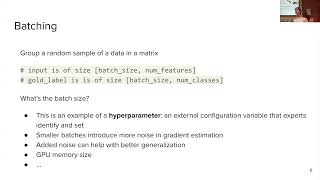
Vector Semantics and Word Embeddings in Data Science
Dive into the mathematical foundations of vector semantics and word embeddings, exploring how words are represented as numerical vectors for natural language processing applications.

Principal Component Analysis - PCA Clearly Explained - 2015
Clear explanation of Principal Component Analysis, covering dimensions, variance, loading scores, and key concepts for interpreting PCA plots in RNA-seq data analysis.
Principal Component Analysis for Hip Hop Songs With Tidymodels
Implement PCA using recipes to analyze the best hip hop songs of all time, exploring Spotify data and visualizing results with tidymodels.