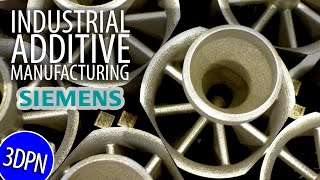
3D Printing for Industrial with Siemens Additive Manufacturing
Explore Siemens' advanced industrial 3D printing solutions, from digital twins and simulations to machine learning optimization and multi-axis robotic printing, revolutionizing additive manufacturing.
From Flatland to Spaceland
Explore the transition from 2D to 3D digital content, focusing on AR technologies, spatial anchoring, and digital twins. Learn how tech giants are bridging the gap between digital and physical worlds.

Architectural Visualization for Design Strategies on a 120 Year-Old Building
Discover how HOK uses Unreal Engine to create photorealistic visualizations for Canada's Parliament Centre Block restoration, combining historical architecture with modern technical workflows for precise conservation planning.
How Reality Capture, Twinmotion, and Unreal Engine Work Together - Using Multiple Tools for 3D Projects
Discover how RealityCapture, Twinmotion, and Unreal Engine complement each other, when to use each tool, and how to leverage their combined capabilities for enhanced 3D content creation and visualization.

Use Cases for Digital Twin Technology in Multi-Cloud and Hybrid Environments
Discover how network digital twins enable multi-cloud visibility, service assurance, and automated compliance while enhancing vulnerability management and end-to-end network control.

Securing Critical Versions of Your Reality - Extended Reality in Critical Infrastructure
Explore how Extended Reality (XR) technology impacts critical infrastructure security and operations through expert insights on implementation, risks, and protective measures.
Digital Twinning with Extended Reality for Signal Analysis
Explore how Idaho National Labs leverages XR technologies and digital twinning to revolutionize data visualization, signal analysis, and autonomous operations in nuclear and security missions.
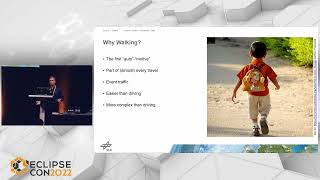
Simulating Pedestrians and Vehicle Traffic Integration Using SUMO and JuPedSim
Discover how to simulate integrated traffic scenarios combining pedestrian and vehicle movements using SUMO and JuPedSim tools for enhanced road safety and event planning analysis.
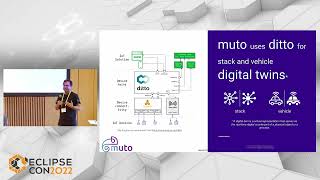
Eclipse Muto - Adaptive Framework for Model-Driven ROS Software Stacks
Discover how Eclipse Muto enables dynamic composition and management of ROS-based software stacks for autonomous vehicles through adaptive frameworks and IoT integration with Eclipse Ditto.
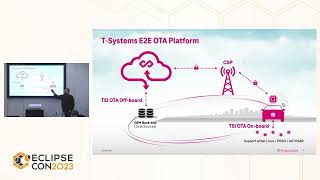
Eclipse SDV Developer Console and T-Systems Hypercube - Connected Car Services in Action
Discover how T-Systems Hypercube revolutionizes automotive software management through DevOps principles, enabling data-driven development and fleet operations using Eclipse projects for connected vehicles.
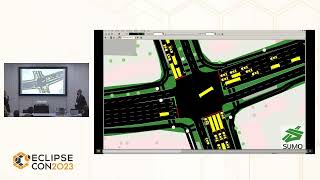
Create Detailed Traffic Models and Simulations with Open Source Tools and Open Data
Discover how to build digital twins for traffic systems using open-source tools like Eclipse SUMO and TAPAS, enabling data-driven decisions for urban mobility optimization and planning.
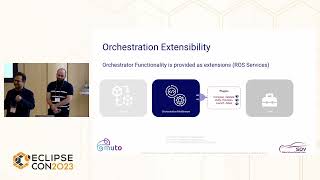
Eclipse Muto in Action - Dynamic ROS Software Stack Orchestration for Autonomous Vehicles
Discover how Eclipse Muto orchestrates ROS software stacks for autonomous vehicles, featuring ROS2 support, dynamic reconfiguration capabilities, and practical implementation in logistics vehicle management.
Standards in AI, IoT, and Digital Twin Development - Current Progress and Roadmaps
Discover the standardization process for AI, IoT, and digital twin technologies, focusing on ISO frameworks, cybersecurity requirements, and implementation roadmaps for emerging standards.
Seeing is Believing - Transportation Simulation and Research
Explore cutting-edge transportation research and simulation techniques at the Alabama Transportation Institute, focusing on human-centered innovations and international collaborative efforts.
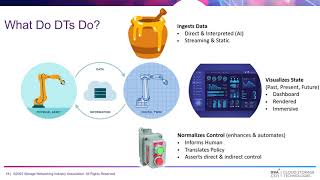
Digital Twins - Journey to the Center of Massive Data
Explore digital twin technology's role in Industry 4.0, understanding how virtual representations of physical systems enable AI-driven decision-making and real-time data processing for smart factories and cities.

Quantum Doodle: Digital Twins for Everyday Activities
Explore digital twins for everyday activities, enhancing situational awareness while preserving human decision-making. Learn about quantum doodles and their implementation in Elixir.
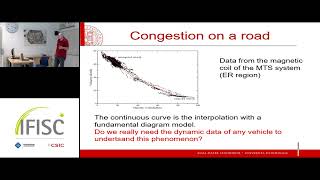
A City Digital Twin for Sustainable Mobility: Big Data Analytics and Predictive Models
Explore big data analytics and predictive models for sustainable urban mobility using digital twin technology.
The Next Phase - Information and Visualization with Digital Twins
Explore digital twins in IoT: benefits, standards, tech stacks, hardware, visualizations, and implementation strategies. Learn to plan, coordinate, and execute digital twin projects effectively.

Learning In-the-Wild Sensor Simulation for Autonomous Driving
Explore cutting-edge sensor simulation techniques for autonomous driving. Learn to create digital twins, manipulate scenarios, and generate realistic multi-sensor simulations to enhance self-driving vehicle development.
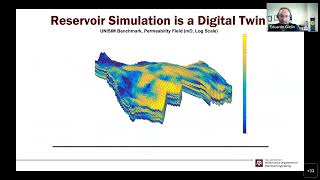
Guided Deep Learning Manifold Linearization of Porous Media Flow Equations for Digital Twins Operations
Explore advanced techniques in Digital Twin operations for reservoir management, focusing on physics-aware machine learning methods to enhance simulation accuracy and efficiency.

Reimagining Infrastructure Management Without Infrastructure as Code
Explore alternative solutions to infrastructure management by reimagining a world without Infrastructure as Code. Gain fresh perspectives on addressing technological challenges.