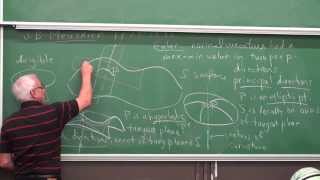
Meusnier, Monge and Dupin - Differential Geometry - Lecture 1
Explores the contributions of French geometer Meusnier to differential geometry, focusing on curvature, asymptotic directions, and umbilic points, with applications of Rational Trigonometry.
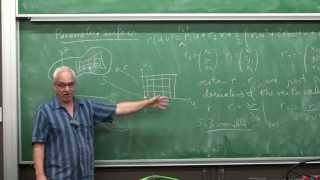
Examples of Curvatures of Surfaces - Differential Geometry Lecture 30
Explore curvature formulas for surfaces through examples like spheres, ellipsoids, and cubic surfaces. Learn to calculate mean and Gaussian curvatures using linear algebra and characteristic coefficients.
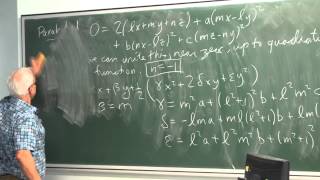
Curvature for General Algebraic Surfaces - Differential Geometry Lecture 29
Explore curvature formulas for general algebraic surfaces, extending from paraboloids to general quadrics. Learn to compute curvatures for hypersurfaces in affine space.
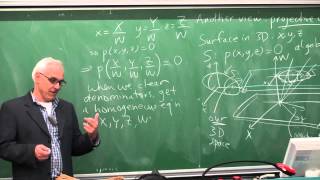
More General Surfaces in Differential Geometry - Lecture 22
Explores advanced surface types in differential geometry, including ruled and developable surfaces, minimal surfaces, algebraic surfaces, and projective constructions, with historical context and mathematical insights.
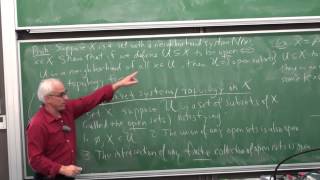
Topological Spaces and Manifolds - Differential Geometry Lecture 24
Explore topological spaces and manifolds through neighborhood systems and open sets. Learn key concepts, solve problems, and understand the foundations of continuous space theory in modern mathematics.
Differential Geometry Problems Tutorial - Lecture 21
Detailed solutions for three differential geometry problems: rational parametrization of cissoid, parametrization of a specific conic, and finding the evolute of y=x^n. Enhances problem-solving skills in advanced geometry.
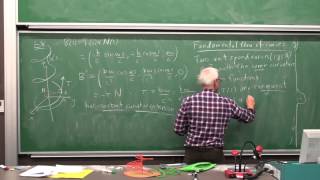
The Frenet-Serret Equations - Example of a Helix - Differential Geometry Lecture 19
Detailed exploration of a helix as an example of Frenet Serret equations, discussing curvature, torsion, and the Fundamental theorem of curves. Introduces osculating, normal, and rectifying planes.
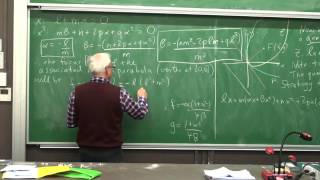
Quadratic Curvature for Algebraic Curves - Differential Geometry Lecture 14
Explores quadratic curvature for algebraic curves, extending from parabolas to general conics. Discusses connections between curvature and foci, emphasizing the power of formulas in differential geometry.
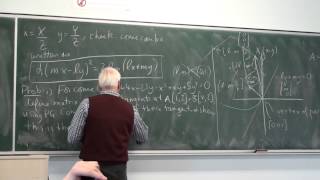
Curvature for the General Parabola - Differential Geometry Lecture 13
Explores curvature of general parabolas using projective geometry, focus-directrix definition, and local behavior. Introduces formulas for parabola curvature as a foundation for understanding curvature of general curves.
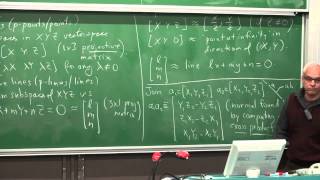
Duality, Polarity and Projective Linear Algebra in Differential Geometry - Lecture 10
Explore projective geometry's impact on differential geometry, focusing on conics, projective linear algebra, and duality between points and lines in the projective plane.
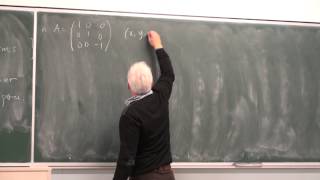
Duality, Polarity and Projective Linear Algebra - Differential Geometry Lecture 11
Explores projective geometry, quadratic forms, and pole-polar duality in relation to the unit circle. Connects these concepts to Lorentz/Einstein/Minkowski geometry and Apollonius' work.
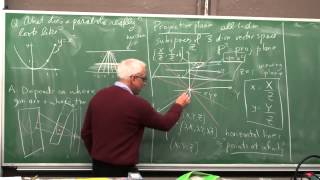
Projective View of Conics and Quadrics - Differential Geometry Lecture 9
Explore projective geometry's application to conics and quadrics, using homogeneous coordinates to unify the study of algebraic curves and surfaces in plane and space.
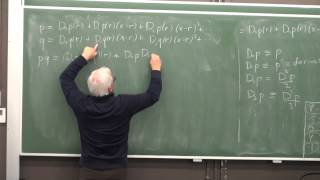
The Differential Calculus for Curves - Lagrange's Algebraic Approach - Lecture 4
Explore Lagrange's algebraic approach to differential calculus, focusing on polynomial functions and Taylor approximations. Learn about tangent lines, conics, and sub-derivatives without limits or real numbers.
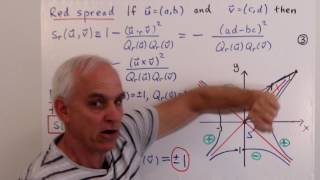
Colored Spreads and Generalizations in Rational Trigonometry - Lecture 2
Explore colored spreads in planar geometries, visualizing red and green spreads using cross products and determinants. Learn about generalized dot products and Pythagoras' theorem in different geometries.
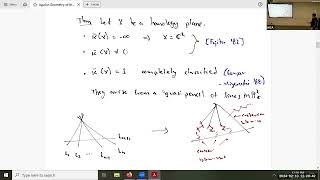
Bridging the Gap Between Homology Planes and Mazur Manifolds
Explore the connection between homology planes and Mazur manifolds, focusing on Kirby-Ramanujam spheres and their implications in complex surfaces and 4-manifolds.
Hodge Structures in 8-Dimensional Homotopy Hopf Manifolds
Explore Hodge structures on 8-dimensional homotopy Hopf manifolds, examining connections between these structures and K3 surfaces, with implications for Homological Mirror Symmetry.
Lower Dimensional Betti Numbers of Homogeneous Spaces of Lie Groups
Exploration of lower dimensional Betti numbers in homogeneous spaces of Lie groups, discussing mathematical techniques and applications in algebraic topology and differential geometry.
Property (T) for Fiber and Semidirect Products - Lecture by Arghya Mondal
Explore Property (T) for fiber and semidirect products in this mathematical lecture, delving into advanced concepts in group theory and their applications.
Uniform Stability of Higher-rank Arithmetic Groups - Lecture 1
Explore uniform stability in higher-rank arithmetic groups. Delve into advanced mathematical concepts and their applications in algebraic and differential geometry.
Rigidity and Stiffness of Arithmetic Groups
Explore rigidity and stiffness properties of arithmetic groups, examining recent advancements in Zariski-dense subgroup theory and its applications to geometry and number theory.
Sum of Squares, Positivity and Property (T) - Lecture 1
Explore sum of squares, positivity, and Property (T) in this lecture by Marek Kaluba. Gain insights into advanced mathematical concepts and their applications in group theory and geometry.