
Building Industry 4.0 Logistics Applications with MicroPython and ESP32 MCUs
Explore how MicroPython and ESP32 MCUs can create innovative Industry 4.0 logistics solutions, focusing on a forklift hailing application. Learn about prototyping, deployment, and live demonstration.
Deploy Python to the Cloud Faster with Azure Serverless
Learn to deploy and scale Python workloads using Azure Functions, with seamless integration in Visual Studio Code for local development, debugging, and cloud deployment. Explore serverless computing benefits and management tools.
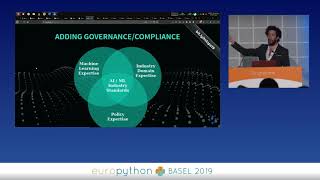
The State of Machine Learning Operations in 2019
Overview of key challenges and trends in machine learning productization, covering reproducibility, explainability, and orchestration. Includes insights on open-source tools and frameworks for tackling these issues in ML operations.
Building Data Workflows with Luigi and Kubernetes
Learn to build complex data pipelines using Luigi, package them as Docker images, and deploy on Kubernetes for scalable Big Data workflows with on-demand scaling and cost reduction.
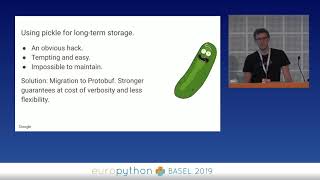
Evolving a Helper Script into a 180,000-Lines-of-Python-Code Project
Explore the evolution of a Python project from a simple script to a complex incident response framework, covering design decisions, challenges, and best practices in software development.
How We Run GraphQL APIs in Production on Our Kubernetes Cluster
Explore deploying and operating GraphQL APIs on Kubernetes, covering workflow, tools, and lessons learned from transitioning from REST APIs to containerized GraphQL services.
How We Run GraphQL APIs in Production on Our Kubernetes Cluster
Discover the workflow and tools for building, deploying, and operating GraphQL APIs on Kubernetes. Learn from Numberly's transition experience and gain insights into cluster design and developer processes.
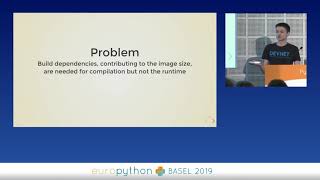
Optimizing Docker Builds for Python Applications
Discover techniques to optimize Docker builds for Python apps, focusing on speeding up the process and reducing image size for both development and production environments.
Modern Continuous Delivery for Python Developers
Explore modern deployment techniques for Python, focusing on avoiding vendor lock-in and creating flexible, future-proof setups for seamless transitions between cloud platforms.
Moving Big Projects to Python 3
Strategies for transitioning large Python projects to version 3, focusing on process management, team coordination, and overcoming common challenges in legacy codebases.
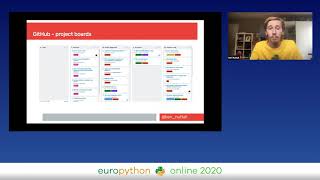
Tools for Maintaining an Open Source Python Project
Discover essential tools for open source Python project maintenance, covering packaging, testing, documentation, and community management. Enhance your development workflow and project sustainability.
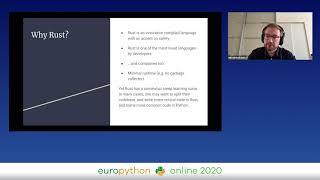
Extending Python with Rust
Explore integrating Rust with Python for enhanced performance. Learn about libraries, demos, benchmarks, Docker setup, and CI/CD for mixed Rust/Python projects.
Train, Serve, Deploy - Story of a NLP Model ft. PyTorch, Docker, Uwsgi and Nginx
Learn to build, train, and deploy NLP translation models using PyTorch, Flask, Docker, uWSGI, and Nginx. Covers data preprocessing, model training, web app creation, containerization, and production serving techniques.
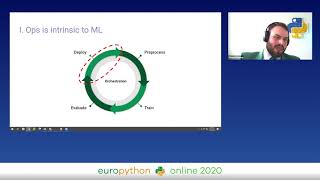
Painless Machine Learning in Production
Discover strategies for efficient machine learning deployment, covering infrastructure, tooling, and best practices for managing the ML lifecycle in production environments.
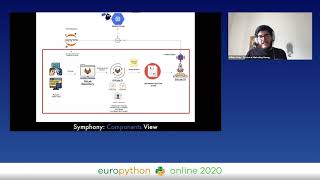
Deploy Your Machine Learning Bots Like a Boss with CI/CD
Learn to deploy machine learning chatbots using CI/CD, covering load balancing, testing, and model retraining. Gain practical insights for taking prototypes to production and iterating faster.
Docker and Python - Making Them Play Nicely and Securely for Data Science and ML
Learn Docker best practices for data-intensive Python applications, covering image optimization, security, automation, and efficient deployment workflows in Data Science and Machine Learning contexts.
Can We Deploy Yet?
Prepare your Python project for production deployment with essential checklist, Docker image optimization, environment differences, and real-world strategies for handling exceptions, logs, and metrics.
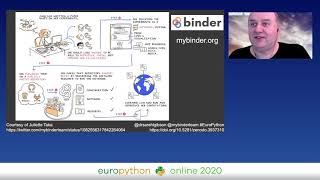
Sharing Reproducible Python Environments with Binder
Learn to share reproducible Python environments using Binder, integrating Jupyter Notebooks and Docker for easy packaging and cloud-based sharing of data science projects without complex setup.
Speak Python with Devices
Explore controlling hardware devices with Python, expanding your skillset beyond data analysis and web development. Learn practical applications for IoT and infrastructure automation.
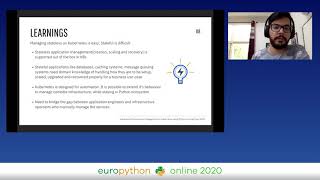
Advanced Infrastructure Management in Kubernetes Using Python
Explore automating Kubernetes infrastructure management using Python, focusing on creating a Celery Operator to streamline cluster setup, configuration, and autoscaling in production environments.
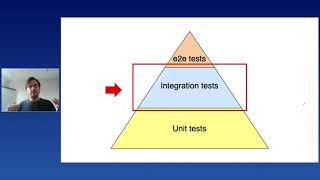
Documentation-Driven Development for Python Web APIs
Explore documentation-driven development for Python web APIs to minimize integration failures, using standards and tools for efficient API lifecycle management and testing.