DAING - A Monitoring Stack for Datacentres
Explore a comprehensive monitoring stack for datacentres using Icinga, Netbox, Ansible, and Grafana. Learn to document, manage, and monitor infrastructure at scale in this hands-on lab session.
Macro Security for Your Microservices
Explore microservices security with Istio, covering traffic encryption, access control, and auditing. Hands-on tutorial on architecture, policy enforcement, and mutual TLS for protecting distributed systems.
Building a Zero Downtime Kubernetes Cluster
Learn to build, implement, and run a self-healing Kubernetes cluster with zero downtime. Discover techniques for auto-scaling, rolling upgrades, and closed-loop automation to maximize efficiency and performance.
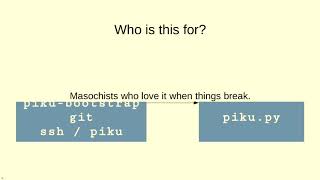
Piku - Git Push Deployments to Your Own Servers
Learn to deploy applications to your own servers using Piku, a lightweight alternative to proprietary PaaS solutions. Discover how to set up and use this open-source tool for easy, secure, and customizable deployments.
No Docs? No Problem! - From Zero to Full Documentation in Less Time than You Think
Practical guide to developing comprehensive technical documentation for mature codebases efficiently, covering strategies, benefits, and lessons learned from the HarfBuzz library project.
Engineer Tested, Manager Approved - Migrating Windows - .NET Services to Linux
Practical guide to migrating Windows/.NET services to Linux using .NET Core, covering project planning, technical challenges, and successful implementation strategies.
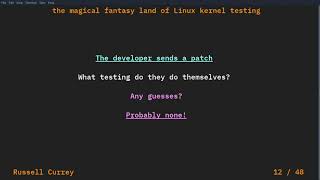
The Magical Fantasy Land of Linux Kernel Testing
Explore automated Linux kernel testing methods, from CI to hardware tests, aiming for a bug-free, efficient development process in this comprehensive overview.
The Life of Open Source Spatial with QGIS - From Hobby to Grown Up, with Bonus Growing Pains
Explore QGIS's evolution from hobby project to leading open-source GIS software. Learn about its growth, challenges, and impact on the spatial community, including governance, stability, and community development.
Write a Single Library to Handle All Input Devices, It'll Be Easy They Said
Explore the evolution of input device handling in Linux, focusing on libinput's unified approach, design choices, and future improvements for mice, touchpads, and more.
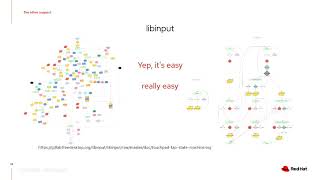
How to Make Kernel and User Space CI for Input Devices
Explore CI techniques for kernel and user space input devices, covering regression testing advancements and strategies to ensure compatibility across various hardware configurations.
Rootless Containers with Podman
Explore rootless containers with Podman, enhancing security and user capabilities. Learn core concepts, benefits, and integration with Systemd, SELinux, and CGroups through real-world home automation examples.
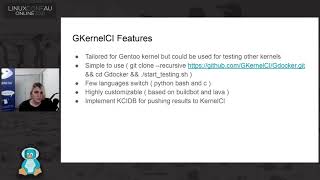
GKernelCI v.2 New Features and KernelCI Compatibility
Explore GKernelCI v.2's new features, including Docker integration, LAVA testing, and KernelCI compatibility via Kcidb, enhancing Gentoo Kernel source testing and stabilization processes.
Containers Are Hideously Undebuggable Black Boxes and We Never Should Have Invented Them
Exploring container debugging challenges in Ceph deployment, offering insights for admins transitioning from traditional software packages to containerized environments.
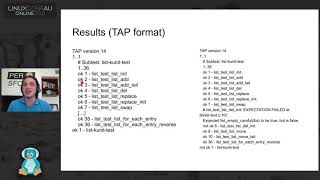
KUnit - Past, Present, and Future
Overview of KUnit in-kernel unit testing framework, its evolution, and future developments. Covers test structure, execution, and integration with Linux kernel development process.
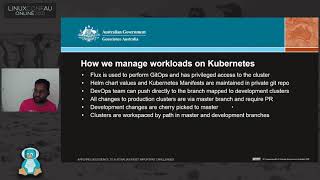
Essential-8 Security in Practice with Kubernetes
Implementing Essential-8 security for large-scale data processing on Kubernetes. Balancing open-access needs with government security requirements. Covers infrastructure, deployments, network filtering, and incident response.
Sacrebleu - PowerShell on Linux
Explore PowerShell's cross-platform capabilities, new features in version 7.1, and its growing adoption among Linux users. Learn about improvements in error handling, security, and community-driven enhancements.
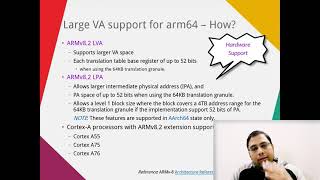
Large Virtual Address Support - 52-bit - in ARM64 Kernel
Explores ARM64 kernel's 52-bit virtual address support, explaining memory layout changes, impact on debugging tools, and how applications can utilize expanded address space.
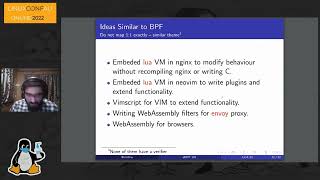
EBPF 101
Explore eBPF: an in-kernel virtual machine for safe, efficient telemetry extraction and kernel programming. Learn its advantages, lifecycle, and applications in network stack and performance optimization.
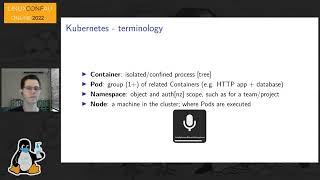
Send in the Chown - Systemd Containers in User Namespaces
Explore systemd containers in user namespaces, focusing on security features for better isolation and deployment of systemd-based workloads in Kubernetes environments.
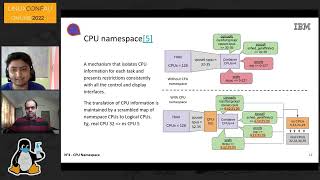
A Mechanism to Isolate CPU Topology Information in the Linux Kernel - CPU Namespace
Proposes a CPU namespace mechanism for isolating CPU topology information in containerized environments, addressing coherency, security, and fair use concerns in multi-tenant systems.
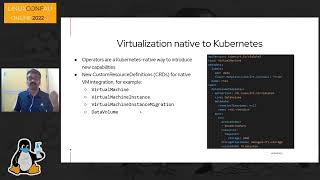
VMs + Containers - The Perfect Wedding
Explore Kubevirt's integration of VMs and containers, enabling seamless modernization of legacy applications alongside cloud-native technologies in Kubernetes environments.