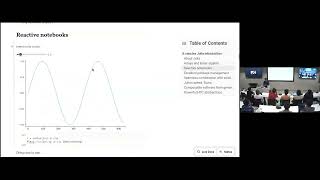
Julia for Materials Modelling
Explore Julia's potential in materials modeling, covering its advantages, ecosystem, and applications in atomistic simulations and density functional theory.
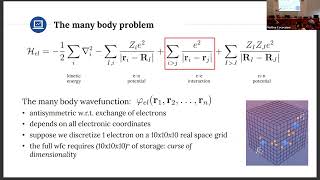
Introduction to Density-Functional Theory - QE School 2023 Lecture 1.2
Explore density-functional theory fundamentals, focusing on Hubbard and Koopmans functionals from linear response in advanced quantum calculations.
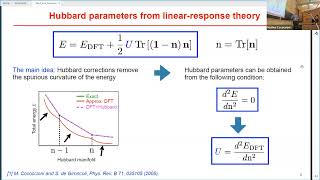
First-Principles Calculation of Hubbard Parameters Using Linear-Response Theory - QE School 2023
Explore first-principles calculation of Hubbard parameters using linear-response theory in advanced Quantum ESPRESSO applications for materials science.
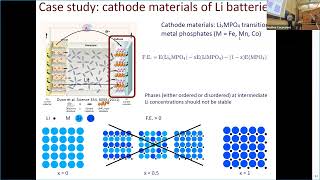
DFT+U and DFT+U+V: Basic Concepts and Applications - Lecture 3.1
Explore Hubbard and Koopmans functionals in Density Functional Theory, focusing on applications in battery materials and addressing limitations of standard DFT methods.
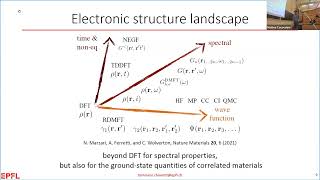
Dynamical Extension of DFT+U: U(ω) - Advanced Quantum ESPRESSO School 2023 - Lecture 3.3
Explore dynamical extensions of DFT+U, focusing on Hubbard and Koopmans functionals from linear response. Learn about spectral properties, Green's functions, and dynamical self-energies.
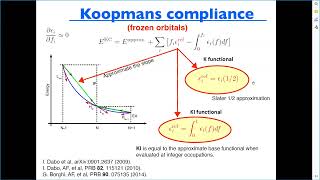
Koopmans Compliance: Towards a Functional Theory of the Spectral Density - Lecture 4.2
Explore Koopmans compliance and its role in developing a functional theory of spectral density, advancing understanding of Hubbard and Koopmans functionals in quantum systems.
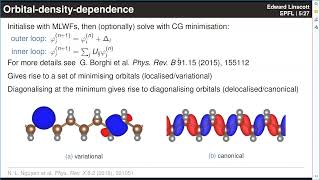
Koopmans Functionals in Practice: Minimisation and Screening Coefficients - Lecture 4.3
Explore Koopmans functionals in quantum calculations: minimization techniques, screening coefficients, and practical applications for advanced materials modeling.
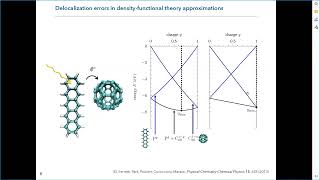
Koopmans Functionals: Basic Concepts - QE School 2023 - Lecture 4.1
Explore Koopmans functionals in quantum mechanics, covering fundamental principles and applications in advanced Quantum ESPRESSO calculations.
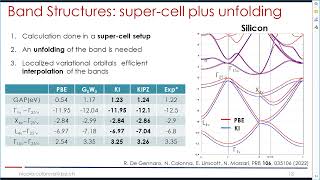
Koopmans Spectral Functionals: Implementation in Periodic Boundary Conditions - QE School 2023
Explore Koopmans spectral functionals implementation in periodic boundary conditions for advanced Quantum ESPRESSO applications.
Expanding the Portfolio of Two-Dimensional Magnetic Materials and Their Applications
Explore high-throughput screening of inorganic materials for novel 2D monolayers, focusing on magnetic properties and potential applications in magnet-semiconductor heterostructures.
Predicting the Magnetic Ground State with VASP
Explore techniques for predicting magnetic ground states using VASP. Learn about cluster multipole expansion, SDFT energy landscapes, and practical tips for first-principles calculations in magnetism.
Molecular Simulations of Ionic Liquid-Based Systems: From Structural to Optoelectronic Properties
Explore molecular simulations of ionic liquid systems, examining structural and optoelectronic properties for advanced applications.
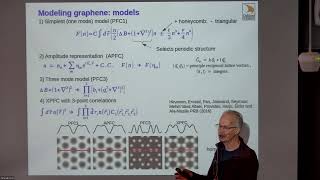
Defect Structures and Patterns in Ultrathin Layers
Explore modeling of out-of-plane deformation in 2D sheets and bilayers, focusing on graphene and hBN. Examine applications to strained sheets, dislocation dipoles, and grain boundaries in flexible layers.
MaZe: A New Approach for Simulating Adiabatic Systems - Lecture
Explore MaZe, a novel approach for simulating adiabatic systems in physics. Learn about its applications in first principles simulations, polarizable systems, and ionic transport studies.
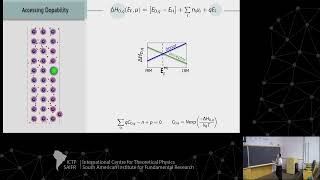
Computationally Guided Control of Carriers in Semiconductors - Density Functional Theory and Phase-Boundary Mapping for Thermoelectrics
Explore computational methods for controlling carriers in semiconductors, focusing on density functional theory and phase-boundary mapping for thermoelectric defect engineering.
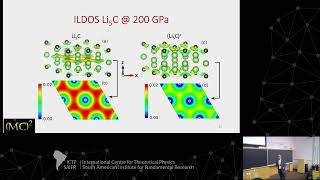
Search for New Electride High Temperature Superconductors
Explore cutting-edge research on electride high-temperature superconductors, focusing on the search for novel materials with potential technological applications.
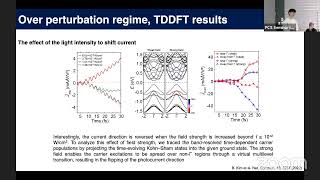
Exploring Light-Induced Phenomena in Condensed Matter Physics within the Framework of Density-Functional Theory
Explore light-matter interactions in condensed matter physics using density-functional theory. Investigate giant bulk photovoltaic effect in WS2 nanotubes and optoelectronic manifestation of orbital angular momentum in helical Se chains.
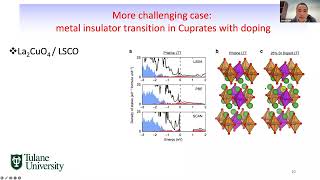
SCAN Functional and DFT Errors for Open-Shell d- and f-Electron Systems
Explore DFT challenges in correlated materials, focusing on SCAN functional's improvements for open-shell d- and f-electron systems. Analyze error sources and symmetry breaking effects.
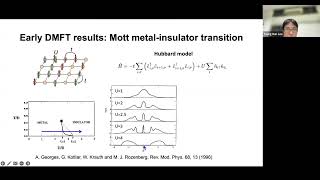
An Efficient and Accurate Approach to Strongly Correlated Materials
Explore an enhanced method for simulating strongly correlated materials using ghost-rotationally-invariant slave-boson (g-RISB) approach, improving accuracy in describing material properties with realistic parameters.
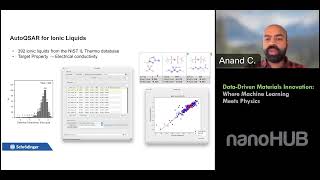
Data-Driven Materials Innovation: Where Machine Learning Meets Physics
Explore how machine learning and physics-based methods synergize to revolutionize materials science, addressing challenges in data-driven design across various technology fields with Schrödinger's innovative tools.
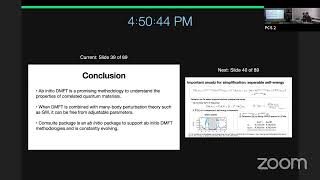
Ab Initio DMFT Methodologies for Correlated Quantum Materials
Explore ab initio DMFT methodologies for understanding correlated quantum materials, their novel physics, and potential applications in quantum information science.