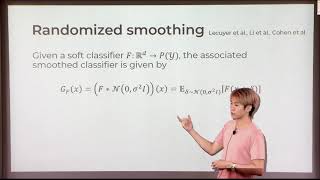
Provably Robust Deep Learning via Adversarially Trained Smoothed Classifiers
Explore adversarially trained smoothed classifiers for robust deep learning, covering theory, implementation, and experimental results in this technical talk.
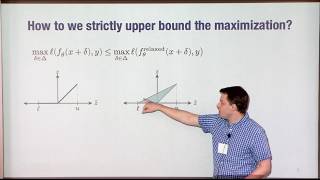
Provable Robustness Beyond Bound Propagation
Explore adversarial robustness in deep learning, focusing on randomized smoothing as a defense strategy and its theoretical guarantees for certified robustness.
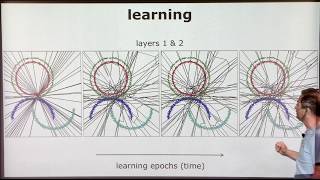
Mad Max - Affine Spline Insights into Deep Learning
Explore deep learning through spline theory, focusing on max-affine splines and their role in neural networks, data memorization, and network complexity.
Computation in Very Wide Neural Networks
Explore infinite-width neural networks, their correspondence to Gaussian processes, and implications for deep learning performance and dynamics in parameter space.
Training on the Test Set and Other Heresies
Explore unconventional approaches to machine learning, challenging traditional wisdom on generalization, model size, and dataset usage in deep learning research.
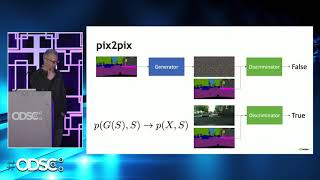
Generative Adversarial Networks for Image Synthesis and Translation - Dr. Jan Kautz
Explore recent GAN advancements for image synthesis and translation, including conditional GANs, supervised vs unsupervised methods, and multimodal approaches. Learn to design, modify, and understand GAN architectures.
Effective Transfer Learning for NLP - Madison May - ODSC East 2018
Explore effective transfer learning techniques for NLP, including parameter-efficient methods using sequence representations. Learn practical improvements for real-world tasks and discover the Enso library for benchmarking.
Challenges and Opportunities in Applying Machine Learning - Alex Jaimes - ODSC East 2018
Explore strategies for effective machine learning implementation, covering data quality, metrics selection, error handling, and process optimization to maximize real-world impact and avoid common pitfalls.
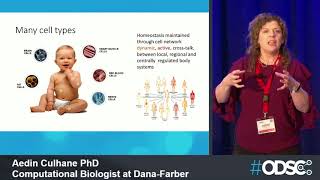
Unsupervised Feature Learning with Matrix Decomposition - Aedin Culhane, PhD | ODSC East 2018
Explore unsupervised learning techniques for high-dimensional data analysis, focusing on matrix factorization methods and their applications in oncology and precision medicine.
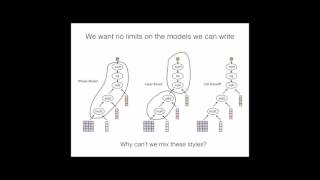
ODSC East 2016 - Building Neural Networks at Twitter with Autograd
Explore building flexible neural networks using autograd, a tool that simplifies gradient computation and enables easy experimentation with new model architectures at Twitter.
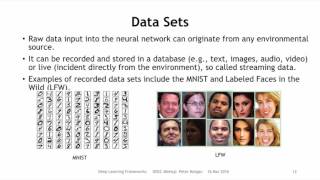
ODSC London Meet-up - Deep Learning Frameworks
Explore deep learning frameworks, algorithms, and state-of-the-art developments with industry expert Peter Morgan in this comprehensive overview of neural network technologies.
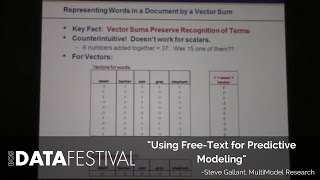
Using Free Text for Predictive Modeling
Explore efficient text representation for predictive analytics, covering techniques to transform varied-length text into fixed-length vectors for machine learning applications like sentiment analysis and news classification.
Loss Landscape and Performance in Deep Learning by Stefano Spigler
Explore deep learning's loss landscape, performance, and theoretical insights. Discover connections to statistical physics, jamming, and neural tangent kernels. Gain understanding of learning dynamics and network behavior.
Artificial Intelligence: Success, Limits, Myths and Threats - Lecture 1
Explore AI's successes, limitations, and societal impact. Delve into machine learning, neural networks, and the future of AI. Gain insights on scientific intelligence and ethical considerations.
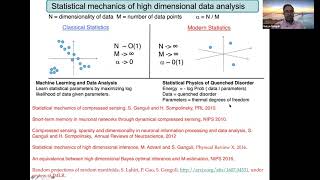
Weaving Together Machine Learning, Theoretical Physics, and Neuroscience
Exploring the intersection of machine learning, physics, and neuroscience through complex systems analysis to develop better algorithms and understand neural systems.
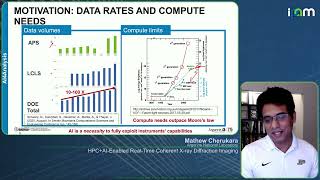
HPC+AI-Enabled Real-Time Coherent X-ray Diffraction Imaging - IPAM at UCLA
Explore HPC and AI-enabled real-time coherent X-ray diffraction imaging, revolutionizing materials characterization with advanced light sources, multi-modal techniques, and innovative data processing methodologies.
Computational Microscopy at IPAM in Fall 2022
Explore cutting-edge computational microscopy techniques in this comprehensive program, featuring workshops on cryoelectron microscopy, deep learning, and electron microscopy advancements.
Deep Learning in Interactive Theorem Proving - IPAM at UCLA
Explore deep learning's impact on interactive theorem proving, challenges in formal mathematics, and future possibilities in machine-assisted proofs.
End-to-End Learning and Auto-Differentiation - Forces, Uncertainties, Etc.
Explore deep learning and auto-differentiation in molecular simulations, covering surrogate functions, sampling distributions, and time-propagation of differential equations for scientific problem-solving.
Advancing Molecular Simulation with Deep Learning - IPAM at UCLA
Explore cutting-edge applications of deep learning in molecular simulation, covering quantum chemistry, force fields, and Markov State Models for advanced scientific research.
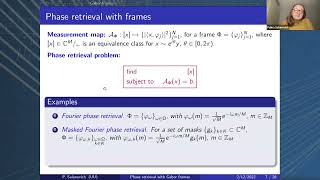
STFT Phase Retrieval - Robustness and Generative Priors - IPAM at UCLA
Explore STFT phase retrieval, focusing on robustness and generative priors. Learn about stable reconstruction techniques, application of generative models, and reducing required measurements in imaging and acoustics applications.