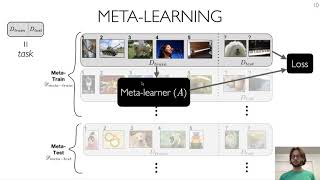
Transfer Learning Larochelle
Transfer learning techniques for deep learning, including few-shot learning, fine-tuning, and universal representations, with a focus on addressing limited labeled data challenges.

SIGCOMM 2020 - Server-Driven Video Streaming for Deep Learning Inference
Explore server-driven video streaming for deep learning inference, including real-time camera set heuristics, object detection, and experimental results.
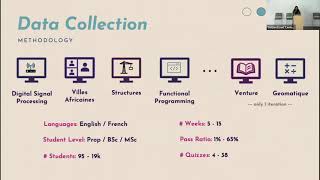
Meta Transfer Learning for Early Success Prediction in MOOCs
Explore innovative deep learning techniques for predicting student success in MOOCs, focusing on meta transfer learning and attention layers to enhance early intervention strategies.

PyTorch - A Modern Library for Machine Learning with Adam Paszke
Explore PyTorch's capabilities in machine learning, from research to production. Learn about its innovative solutions for efficient inference and its versatility across various ML scenarios.

Introduction to Neural Networks in Python - Tensorflow-Keras
Learn neural network basics, architecture, hyperparameters, and implementation in Python using TensorFlow/Keras. Includes hands-on coding examples for various classification tasks, from simple to complex datasets.

Solving Real World Data Science Problems With Python - Computer Vision Edition
Learn to build and improve convolutional neural networks for computer vision tasks using Python, TensorFlow, and Keras. Explore data augmentation, preprocessing, and network architecture optimization techniques.
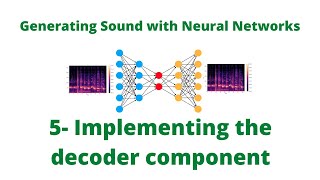
How to Implement Autoencoders in Python and Keras - The Decoder
Learn to implement the decoder component of autoencoders using Python, TensorFlow, and Keras. Covers building methods, layers, and architecture for generating sound with neural networks.
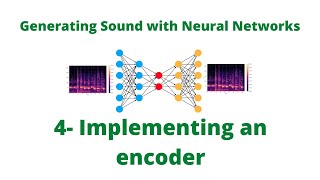
How to Implement Autoencoders in Python and Keras - The Encoder
Learn to implement autoencoders in Python and Keras, focusing on building the encoder component. Covers autoencoder class construction, convolutional layers, bottleneck creation, and practical implementation.

Autoencoders Explained Easily
Intuitive explanation of autoencoders, covering key concepts like representation learning and latent space, with applications in data generation, denoising, and anomaly detection.

Types of Audio Features for Machine Learning
Explore audio feature types for ML: time, frequency, and time-frequency domains. Learn categorization based on abstraction, ML approach, and temporal scope for intelligent audio applications.
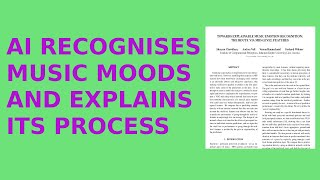
This AI Recognises Moods in Songs and Explains How It Does It
Explore a deep learning architecture for recognizing and explaining moods in songs, focusing on mid-level features, datasets, and potential applications in music emotion analysis.
Long Short Term Memory Networks Explained Easily
Comprehensive explanation of LSTM networks, comparing them to simple RNNs and exploring their architecture and mathematical foundations for improved sequence learning.
How to Implement a CNN for Music Genre Classification
Implement a CNN for music genre classification using TensorFlow. Learn cross-validation, inference, and practical application with code examples and step-by-step guidance.
Audio Processing in Keras with Kapre
Learn to process audio in Keras using Kapre, exploring its advantages, features, and implementation. Discover how to embed audio transformations within deep learning models for optimized GPU-based calculations and easier deployment.
Pre-Processing Audio with Different Durations
Learn to preprocess audio data with varying lengths using PyTorch and torchaudio. Master techniques for cutting and zero-padding waveforms to standardize input for machine learning models.
Implementing and Training a Neural Network with PyTorch
Build and train a feed-forward neural network using PyTorch to classify MNIST digits. Learn data management, network implementation, and training loop creation in this hands-on tutorial.
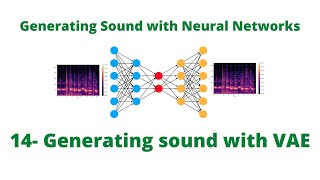
Generating Sound Digits with a Variational Autoencoder
Learn to generate audio spectrograms of sound digits using a trained Variational Autoencoder, then convert them into audio. Includes implementation, scripting, debugging, and result evaluation.
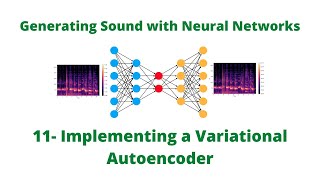
How to Implement a Variational Autoencoder in Python and Keras
Implement a Variational Autoencoder using Python, TensorFlow, and Keras. Learn to modify the encoder, update loss functions, train the model, and visualize the latent space for data generation.
From Autoencoders to Variational Autoencoders - Improving the Encoder
Explore the transformation from autoencoders to variational autoencoders, focusing on improved encoding using multivariate normal distributions for enhanced generative capabilities in AI and sound processing.
Generation with AutoEncoders - Results and Limitations
Explore image generation using autoencoders, analyze latent space representations, and understand limitations in generative tasks. Learn why variational autoencoders are necessary for improved generation.
Building and Training an Autoencoder in Keras - TensorFlow - Python
Learn to build and train autoencoders using Python, TensorFlow, and Keras. Explore encoder-decoder architectures, implement training with the MNIST dataset, and gain practical insights into autoencoder development.