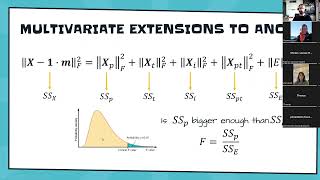
Statistical Inference of Omics Data with Variable-Selection
Learn statistical inference techniques for omics data analysis, focusing on variable selection methods to enhance spectral matching and predict molecular structures from LC-MS/MS spectra using chemometrics and deep learning approaches.
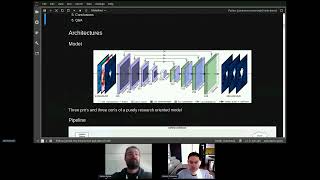
AIUK 2022 Workshop - IceNet: Deep Learning Framework for Sea Ice Forecasting
Deep learning framework for Arctic sea ice forecasting, exploring IceNet's model, pipeline, and ecosystem. Insights into data processing, visualization, and real-world applications.
Solving Overfitting in Neural Networks
Learn techniques to identify and prevent overfitting in neural networks, including early stopping, audio data augmentation, dropout, and L1/L2 regularization, with practical implementation in a music genre classifier.
Implementing a Neural Network for Music Genre Classification
Implement a music genre classifier using TensorFlow and MFCC features. Learn key deep learning concepts like binary/multiclass classification, ReLUs, batching, and overfitting while building the neural network.

Understanding Audio Data for Deep Learning
Explore fundamental audio processing concepts for deep learning, including waveforms, pitch, Fourier transform, and MFCCs, essential for AI applications in sound analysis.
How to Implement a Simple Neural Network With TensorFlow 2
Learn to implement a simple neural network using TensorFlow 2 and Keras for arithmetic sum, covering model building, training, testing, evaluation, and prediction.
Training a Neural Network - Implementing Backpropagation and Gradient Descent from Scratch
Implement backpropagation and gradient descent from scratch in Python, training a neural network to perform arithmetic sum. Includes step-by-step coding and explanations.
Training a Neural Network - Backward Propagation and Gradient Descent
Explore the theory and mathematics behind neural network training, focusing on backpropagation and gradient descent algorithms for deep learning enthusiasts.

ComfyUI - Node Based Stable Diffusion UI
Explore ComfyUI, a node-based interface for Stable Diffusion, offering modular AI image generation with advanced techniques like ControlNET, T2I, and Lora for unparalleled creative control.
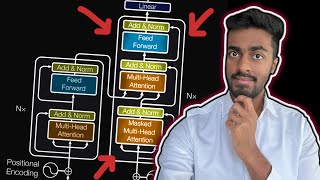
Blowing Up Transformer Decoder Architecture
Detailed exploration of Transformer Decoder architecture, covering key components like masked self-attention, cross-attention, and position encoding. Includes implementation insights and training considerations.
Designing Robust Learners
Explore robust machine learning techniques to handle data perturbations and improve model resilience, focusing on TV estimation, modulus examples, and arbitrary loss scenarios.

How to Fail Interpretability Research
Explore common pitfalls in AI interpretability research, including misconceptions about user trust, model understanding, and evaluation methods.
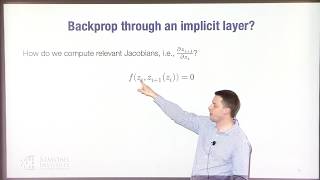
Integrating Constraints into Deep Learning Architectures with Structured Layers
Explore integrating constraints into deep learning using structured layers, covering deep equilibrium models, implicit layers, and weight-tied networks for enhanced architecture design.
Towards Verified Deep Learning
Explore formal methods for verifying deep learning systems, focusing on robustness, semantic analysis, and applications in cyber-physical systems with UC Berkeley's Sanjit Seshia.

Off-Policy Policy Optimization
Explore advanced reinforcement learning techniques, focusing on off-policy optimization, batch methods, and sequential decision-making in deep learning contexts.
Optimality and Approximation with Policy Gradient Methods in Markov Decision Processes
Explore policy gradient methods in Markov Decision Processes, covering optimality, approximation, and key concepts like entropy regularization and natural policy gradient.
On the Hardness of Reinforcement Learning With Value-Function Approximation
Explore challenges in reinforcement learning with value-function approximation, focusing on batch learning in large MDPs and the limitations of realizability assumptions.

Machine Learning-Based Design of Proteins and Small Molecules
Explore machine learning techniques for designing proteins and small molecules, covering directed evolution, model-based optimization, and challenges in deep learning applications.
Knowledge Is Embedded in Language Neural Networks but Can They Reason?
Explore language models' reasoning capabilities, from n-grams to transformers, and discuss future research directions in neural state machines for improved natural language understanding.
Sample-Complexity of Estimating Convolutional and Recurrent Neural Networks
Explore sample-complexity in estimating neural networks, focusing on CNN and RNN architectures. Learn about generative models, minimax analysis, and key results through theoretical proofs and practical experiments.
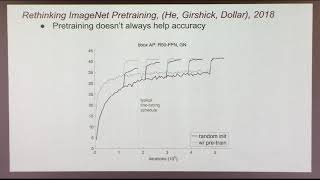
Towards Understanding Transfer Learning with Applications to Medical Imaging
Explore transfer learning in medical imaging, focusing on deep learning applications, performance evaluation, and feature similarity analysis using CCA. Insights on ImageNet models and chest X-rays included.