
Machine Learning Accelerating Scientific Discovery
Explore how machine learning is revolutionizing scientific research, from consumer applications to breakthroughs in healthcare and video game development.
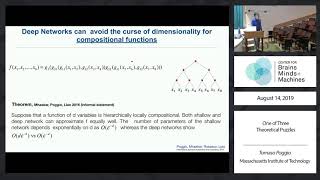
One of Three Theoretical Puzzles - Generalization in Deep Networks
Explore deep network generalization, dimensionality challenges, and optimization techniques with MIT's Tomaso Poggio. Gain insights into overparameterized networks and gradient descent for RELU architectures.
Multilingual Representations for Low-Resource Speech Processing
Explore multilingual speech representations to reduce data requirements for new language speech recognition systems, focusing on low-resource scenarios and keyword search performance.
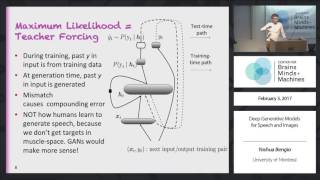
Deep Generative Models for Speech and Images
Explore deep learning's power in generating sounds and images, focusing on unsupervised learning and multiple levels of abstraction for advanced AI applications.

Unsupervised Learning of Spoken Language with Visual Context
Explores unsupervised learning of spoken language using visual context, aiming to develop ASR capabilities for more languages through audio-visual embedding and clustering techniques.

Connections Between Physics and Deep Learning
Explore the fascinating intersections of physics and deep learning, from neural networks to scale-invariant behavior, with insights from MIT's Max Tegmark.

Transformer Encoder in 100 Lines of Code
Learn to implement a Transformer Encoder from scratch in Python. Explore key concepts like attention mechanisms, layer normalization, and feed-forward networks through hands-on coding.
Training BERT - Train With Next Sentence Prediction
Learn to pre-train BERT models using Next Sentence Prediction (NSP) for improved language understanding in specific domains. Practical implementation with unstructured text data.

Kubernetes for AI Workloads - What Works and What Doesn't
Explore Kubernetes for AI workloads: benefits, challenges, and solutions. Learn to train deep learning models, use GPUs efficiently, and overcome K8s limitations in research environments.
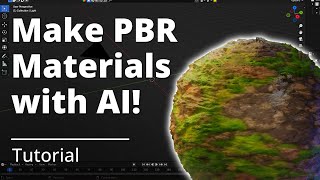
How to Make PBR Materials with AI - Stable Diffusion Tutorial 2023
Learn to create realistic PBR materials using AI and Stable Diffusion. Explore local and fast methods, prompting techniques, upscaling, and tools like Materialize and Poly for high-quality textures.
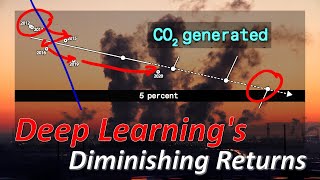
How Far Can We Scale Up? Deep Learning's Diminishing Returns
Explores the limits of scaling up deep learning, discussing computational costs, CO2 emissions, and potential solutions to overcome diminishing returns in AI model performance.
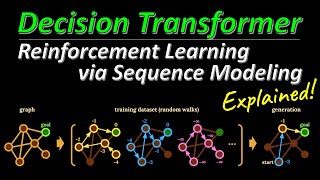
Decision Transformer - Reinforcement Learning via Sequence Modeling
Explore how Decision Transformer reframes offline reinforcement learning as sequence modeling, leveraging Transformer architecture to generate optimal actions based on desired returns, past states, and actions.
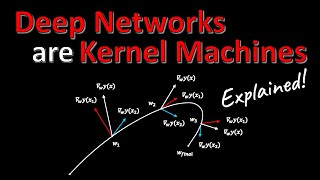
Deep Networks Are Kernel Machines
Explores the theory that deep neural networks function as kernel machines, challenging the view that they discover new data representations. Discusses implications for interpretability and algorithm development.
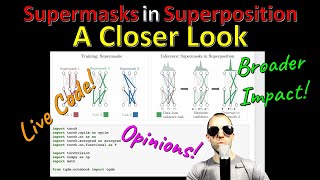
Addendum for Supermasks in Superposition - A Closer Look
In-depth analysis of "Supermasks in Superposition" paper, exploring G objective, superposition concept, and broader impact. Includes live coding demonstration and theoretical discussions.
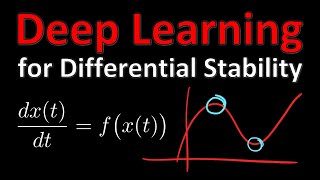
Deep Differential System Stability - Learning Advanced Computations from Examples
Explore how language models can learn complex mathematical computations for differential systems, including stability analysis and controllability, through example-based training.
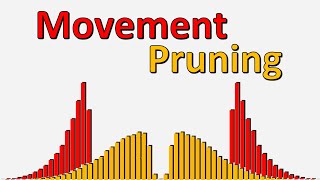
Movement Pruning - Adaptive Sparsity by Fine-Tuning
Explore Movement Pruning, an adaptive sparsity technique for fine-tuning deep neural networks. Learn its advantages over Magnitude Pruning in transfer learning scenarios and its impact on model efficiency.
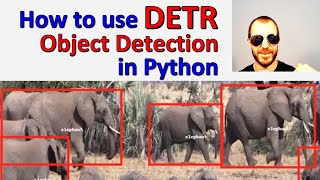
How to Use Facebook's DETR Object Detection Algorithm in Python - Full Tutorial
Hands-on tutorial implementing Facebook's DETR object detection algorithm in Python, covering model loading, image processing, output handling, and visualization with various test cases.

A Critical Analysis of Self-Supervision, or What We Can Learn From a Single Image
Explores self-supervision in deep learning, revealing that a single image with data augmentation can effectively train lower network layers, challenging assumptions about large dataset requirements.
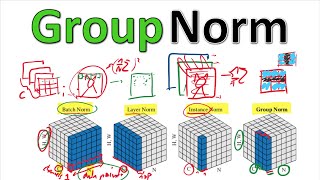
Group Normalization - Paper Explained
Explore Group Normalization as an alternative to Batch Normalization, addressing batch size limitations and improving performance in various deep learning tasks.
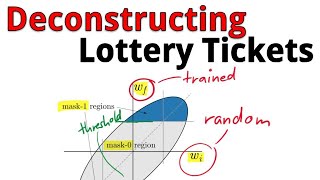
Deconstructing Lottery Tickets - Zeros, Signs, and the Supermask
Explores the Lottery Ticket Hypothesis, analyzing key components of sparse networks and uncovering insights on weight initialization, sign importance, and the concept of Supermasks in neural network training.
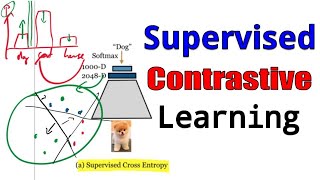
Supervised Contrastive Learning
Explore a novel supervised learning approach that outperforms cross-entropy loss, improving image classification models' performance and robustness across various architectures and data augmentations.