Dictionaries.jl - Improved Productivity and Performance in Julia
Explore Dictionaries.jl for enhanced Julia productivity: alternative interface, data manipulation tools, implementation insights, and applications in tabular data with keys.
Agents.jl and the Next Chapter in Agent-Based Modelling
Explore Agents.jl for complex system modeling: learn its philosophy, simplicity, performance, interactivity, and integration with Julia ecosystem. Discover the future of agent-based modeling.
Introduction to Metaprogramming in Julia - JuliaCon 2021 Workshop
Comprehensive workshop on Julia metaprogramming, covering expressions, macros, and code generation. Ideal for intermediate users seeking to enhance their programming skills and create domain-specific languages.
Statistics with Julia from the Ground Up - JuliaCon 2021 Workshop
Learn statistical applications in Julia through hands-on examples, covering probability, data manipulation, plotting, and modeling. Ideal for R users transitioning to Julia for data science and machine learning.
Read and Manipulate Text Files in Julia - Week 4 Lesson 2
Learn to process text files in Julia, transforming them into word arrays and analyzing content through word and phrase counting techniques.
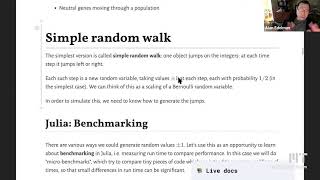
Random Walks in Computational Thinking - Lecture 12
Explore random walks in computational thinking, covering visualization, Julia concepts, benchmarking, and advanced topics like mutable structs and type parameters.
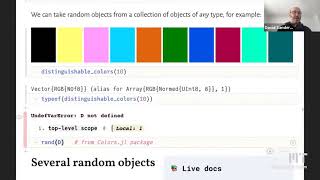
Sampling and Random Variables in Julia - Lecture 9
Explore random sampling, probability distributions, and data visualization techniques using Julia, covering topics from basic coin tosses to complex probability densities and histogram normalization.
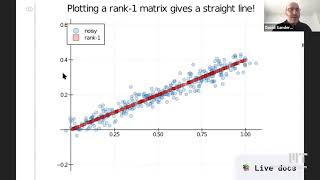
Principal Component Analysis - Lecture 8
Explore Principal Component Analysis: from matrix rank to SVD. Learn to measure data cloud size, understand correlated data, and navigate high-dimensional spaces using statistical techniques.
Introduction to Arrays and Images in Computational Thinking - Lecture 1
Explore computational thinking through image manipulation and array operations in Julia, with hands-on examples and an introduction to abstraction concepts.
Data Wrangling Techniques in Julia - Part 2 - Tom Kwong
Explore advanced data wrangling techniques in Julia, covering reading, cleaning, tidying, analyzing, and visualizing data using two sample datasets for practical application.
Data Wrangling Techniques in Julia - Part 1 - Tom Kwong
Comprehensive overview of data wrangling in Julia, covering ecosystem, workflow stages (read, clean, tidy, analyze, visualize), and DataFrames.jl resources for effective data science practices.
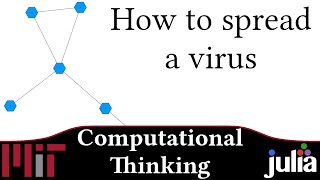
Graphs, Trees, and Spreading Disease - MIT 18.S191 Fall 2020 Week 5
Explore graph theory, tree traversal, and epidemic modeling using Julia programming, with hands-on demonstrations and practical applications in network analysis and disease spread simulation.
Probability via Computation - Week 4
Explore probability concepts through computational methods, covering random sampling, Monte Carlo simulations, Bernoulli trials, and the Central Limit Theorem with practical examples and visualizations.
Understanding Structure in Data - Week 3
Explore data structure analysis using Julia, covering matrix rank, data visualization, PCA, and building a simple recommendation engine. Gain practical insights into advanced data science concepts.
Developing Rating Curves from Measurements and Models
Learn techniques to improve accuracy and reliability of river flow data using rating curves. Explore field data collection, modeling methods, and practical examples for refining stage-discharge relationships.
An Introduction to Julia for Beginners
Comprehensive introduction to Julia programming, covering basics to advanced topics. Ideal for beginners with technical computing needs and experience in other languages.
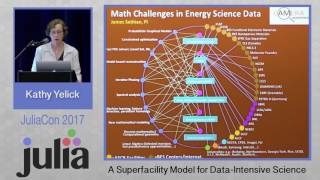
A Superfacility Model for Data-Intensive Science
Explore data-intensive science challenges, high-performance computing, and the role of programming languages like Julia in addressing big data and computational demands in scientific research.
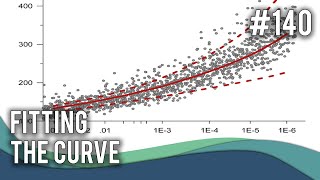
Fitting the Curve
Explore flood frequency analysis techniques, curve fitting approaches, and software tools for managing uncertainty in rainfall and runoff estimates. Learn to interpret results and consider climate change impacts.
Theory vs Practice - The Challenges of Flood Risk Management
Explore best practices in flood risk management, balancing theory and practical constraints. Learn to develop fit-for-purpose methodologies for effective floodplain management and informed decision-making.
Learn Python Pandas - Pandas Course for Beginners
Comprehensive introduction to Python Pandas, covering installation, data structures, file operations, data manipulation, and transformation techniques for beginners in data analysis.

Microsoft Excel Advanced Excel Training Course
Comprehensive advanced Excel training covering dynamic arrays, advanced functions, data manipulation, and statistical analysis. Includes hands-on exercises for practical skill development.