Methods for Disease Analysis Using Multiomic Data
Explore advanced methods for analyzing diseases using multiomic data, focusing on clustering algorithms, cancer subtyping, and driver gene prioritization.
From Population to Person - How to Help a Single, Actual Person with Data Science
Discover how data science can be applied to help individual patients, bridging the gap between population-level insights and personalized healthcare interventions.
Computationally Scalable Approaches for Characterizing Genetic Architectures in Diverse Ancestries
Explore computationally scalable methods for characterizing genetic architectures across diverse ancestries, focusing on fine-mapping and heritability estimation techniques.
Inferring Parsimonious Migration Histories for Metastatic Cancers
Explore computational methods for inferring cancer metastasis patterns, focusing on parsimonious migration histories and multi-strain infections in tumor evolution.
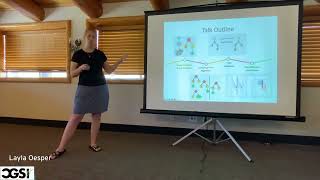
Tumor Evolution: Methods for Comparing, Summarizing and Visualizing Clonal Trees
Explore methods for comparing, summarizing, and visualizing clonal trees in tumor evolution, focusing on weighted distance-based approaches and relaxing infinite sites assumptions.
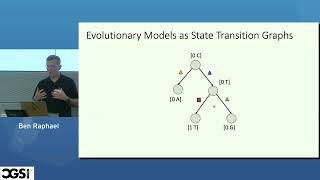
Evolutionary Models for Cancer and Lineage Tracing - CGSI 2023
Explore evolutionary models for cancer and lineage tracing, focusing on tumor phylogeny inference and CRISPR-Cas9 lineage tracing approaches.
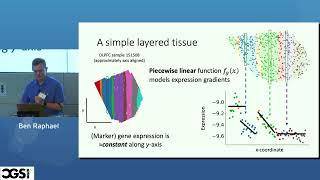
Models and Methods for Spatial Transcriptomics - CGSI 2023
Explore models and methods for spatial transcriptomics, focusing on alignment, integration, and modeling of gene expression variation in spatially resolved data.
Project Logan: Assembling All Public Sequencing Data
Explore Project Logan's ambitious goal of assembling all public sequencing data. Learn about innovative techniques and challenges in large-scale genomic data processing and analysis.
Challenges in Developing a Universal Metagenomic Diagnostic Test - 2024
Explore challenges in creating a universal metagenomic diagnostic test for disease detection, focusing on scalability, sensitivity, and application in community surveillance.
Working with Relational Databases in the Wolfram Language
Explore relational databases using Wolfram Language's Entity framework. Learn key concepts, querying techniques, and advanced features for efficient data management.
Advanced Chat Notebook Use in Wolfram - Lecture 1
Explore advanced techniques for utilizing Chat Notebooks, including custom functions and behavior modifications, to enhance your interactive computing experience.
Using the Wolfram Stack and LLM Tech to Combat Misinformation on SDGs and ESG
Leverage Wolfram's LLM tech and core tools to combat misinformation on SDGs and ESG investing, building effective solutions for accurate information dissemination.
Query: A Functional Programming Construct in the Wolfram Language
Demystify the Query function and learn to use it effectively as a functional programming tool in the Wolfram Language.
Modern Notebook Diffing in Wolfram Language
Explore new Wolfram Language diffing tools to compute and visualize changes between cells and notebooks, enhancing your understanding and workflow.
Exploring Historical Geology with Wolfram Language
Explore Earth's geological history using Wolfram Language tools like GeoGraphics, EntityValue, and Wolfram Function Repository for comprehensive historical geology analysis.
Integrating LLMs into Wolfram Workflows - Process and Analyze Sustainable Development Data Efficiently
Harness Wolfram's tech stack to maximize LLM potential for processing unstructured data, focusing on Sustainable Development Goals and conference videos. Learn integration methods and optimization techniques.
Beyond the Computational Essay - Evolving Notebooks into Robust Computational Systems
Explore techniques for transforming computational essays into robust, ongoing narratives and systems, overcoming common challenges in the process.
Unreal Engine and TouchDesigner Integration - Visualizing API Data in Immersive Experiences
Learn to visualize API data in Unreal Engine using TouchDesigner. Create interactive installations by processing weather data and translating it into visual content through OSC communication and blueprints.

Working with BigQuery and DataForm - Streamlining Data Management and Transformation
Streamline data management with BigQuery and DataForm. Learn setup, optimization, and automation for efficient, scalable data pipelines and transformations.
The Future of Application Development - Cloud Native Summit
Explore Kappa architecture, stream processing, and LLM integration for innovative application development. Learn to build scalable systems leveraging real-time data and AI capabilities.

Robots Learning Like Humans: Leveraging Human-Inspired Techniques in Machine Learning
Explore how robots can learn from human-like methods, including video observation, natural language instructions, and curiosity-driven exploration.