
Experimenting with Real-Time Event Feeds
Explore innovative approaches to real-time event feeds in cybersecurity, challenging traditional SIEM methods and addressing high-volume data management for improved threat detection.

How We Can Power Real Security Machine Learning Progress Through Open Algorithms and Benchmarks
Explore the need for transparency in security machine learning, discussing challenges, benefits, and strategies for fostering openness to drive real progress in the field.

Don't @ Me - Hunting Twitter Bots at Scale
Explore the Twitter bot economy and learn a three-step methodology to track down bots: dataset building, attribute identification, and classifier development for accurate large-scale detection.
Measuring the Speed of the Red Queen's Race - Adaption and Evasion in Malware
Explore the dynamic evolution of malware and security measures using machine learning to quantify adaptation rates in the ongoing cybersecurity arms race.

Dissecting Non-Malicious Artifacts - One IP at a Time
Uncover the risks of security product interactions with online scanners, exploring information leaks, zero detection issues, and practical examples for improved cybersecurity.
DeepPhish - Simulating Malicious AI
Explore AI-driven phishing simulation techniques, including neural networks and URL prediction, to enhance cybersecurity defenses against sophisticated email-based attacks.

Deep Impact - Recognizing Unknown Malicious Activities from Zero Knowledge
Innovative approach to detect unknown malicious activities using machine learning and image processing techniques on standard device logs, overcoming limitations of traditional security methods.
Your Voice is My Passport
Explore machine learning's impact on voice authentication security, including synthetic audio generation and potential vulnerabilities in financial and home automation systems.
Subverting Sysmon - Application of a Formalized Security Product Evasion Methodology
Explore methodologies for subverting Sysmon, a security monitoring tool, through data collector strategies and configuration analysis to enhance adversarial techniques against enterprise defenses.

A Walk Through Historical Correlations Between Vulnerabilities and Stock Prices
Explore the impact of security vulnerabilities and data breaches on stock prices across industries, analyzing recovery patterns and sector-specific effects through historical data analysis.
Attacking and Defending Machine Learning Applications of Public Cloud
Explore techniques for attacking and defending machine learning applications in public cloud environments, focusing on visual classification vulnerabilities and countermeasures.

Don't Eat Spaghetti with a Spoon - An Analysis of the Practical Value of Threat Intelligence
Explore the effectiveness of Threat Intelligence in predicting Internet malicious activity through analysis of over a million indicators across diverse real-world network sensors.
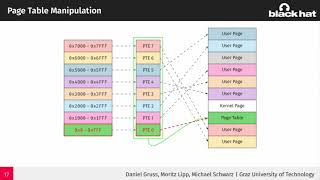
Another Flip in the Row
Explore the Rowhammer bug in DRAM modules, its security implications, exploitation techniques, and potential mitigations in this comprehensive overview of hardware vulnerabilities.
An Offensive Approach to Analyzing Huge and Complex Big Data Infrastructures
Explore attack vectors in Big Data stack layers: ingestion, storage, processing, and access. Learn methodologies to identify vulnerabilities in complex infrastructures handling massive data volumes.
Defeating Machine Learning - What Your Security Vendor Is Not Telling You
Explore attacker strategies to defeat machine learning-based security defenses, analyze industry issues enabling these vulnerabilities, and discover novel data sourcing solutions for improved protection.

Harnessing Intelligence From Malware Repositories
Explore techniques for extracting intelligence from malware repositories using program analysis and data mining, with insights on connecting seemingly disparate cyber attacks and tracking malware trends.

Data-Driven Threat Intelligence - Metrics on Indicator Dissemination and Sharing
Análisis basado en datos de indicadores de inteligencia de amenazas y comunidades de intercambio, explorando eficiencia, calidad y superposición de fuentes durante más de un año.

Hidden Risks of Biometric Identifiers and How to Avoid Them
Explore cutting-edge biometric technologies, their advantages, and potential risks. Learn to evaluate security, reliability, privacy, and ethical concerns for informed implementation of future identification systems.

Internet-Scale File Analysis
Explore TOTEM and DRAKVUF systems for large-scale malware analysis, addressing challenges in file diversity, volume, and dynamic analysis through cloud-based orchestration and hardware virtualization.

Cybercrime in the Deep Web
Explore automated detection of cybercrime in anonymous networks beyond TOR, including I2P and FreeNET. Learn about DeWA system for identifying emerging threats in the Deep Web.
Why Security Data Science Matters and How It's Different
Explore security data science challenges and solutions, including machine learning for attack detection, threat intelligence, and malware analysis, with focus on overcoming unique security-specific obstacles.