Statistical Limits of Causal Inference
Explore fundamental limits of causal effect estimation in observational data, examining personalized effects, non-smooth settings, and discrete scenarios without assuming prior causal inference knowledge.
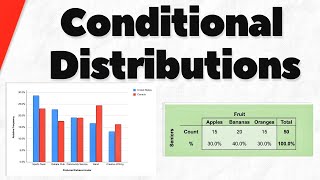
Conditional Distributions of Categorical Variables in Statistics
Explore conditional distributions of categorical variables through examples and charts. Learn to determine associations between variables and interpret data effectively.

Probability and Statistics: An Introductory Overview
Explore probability and statistics fundamentals, from basic concepts to advanced topics, covering applications, history, and key principles in data science and machine learning.
Quivers and Cohomological Hall Algebras - Lecture 3
Explore advanced concepts in quiver theory and cohomological Hall algebras, delving into complex mathematical structures and their applications in algebraic geometry.
Quivers and Cohomological Hall Algebras - Lecture 2
Explore advanced concepts in quiver theory and cohomological Hall algebras, delving into their intricate connections and applications in algebraic geometry and representation theory.
Efficient Decentralized Federated Singular Vector Decomposition
Innovative system for efficient decentralized federated SVD, enhancing privacy and performance in distributed applications. Outperforms existing methods with significant speed improvements and larger throughput.

Statistical Methods for Data Analysis in Particle Physics - Lecture 4
Statistical techniques for particle physics data analysis, covering advanced methods and applications in experimental high-energy physics research.

Statistical Methods for Data Analysis in Particle Physics - Lecture 2
Explore advanced statistical techniques for particle physics data analysis, focusing on hypothesis testing, confidence intervals, and likelihood methods in experimental research.

Statistical Methods for Data Analysis in Particle Physics - Lecture 1
Explore statistical methods for particle physics data analysis, covering fundamental concepts and techniques essential for researchers in high-energy physics experiments.

Paired T-Test - Statistical Analysis for Comparing Group Means
Explore paired t-tests: comparing means in two scenarios. Learn calculation methods, standard error, and when to use nonparametric alternatives for statistical analysis.
NetworkX is Fast Now - Graph Analytics Unleashed
Discover NetworkX's power for graph analytics, from beginner-friendly API to accelerated backends. Learn to extract insights from data using advanced tools for scalable graph analysis.

Python ate my Homework - Using SymPy for Mathematical Problem Solving
Discover SymPy for solving complex math problems with Python. Learn to use Jupyter for assignments and contribute to computational mathematics.
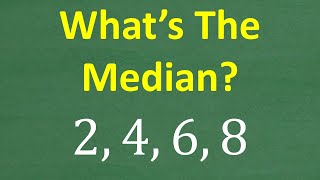
Calculating the Median - Basic Statistics
Learn to calculate the median in statistics with a simple example, enhancing your basic math skills and data analysis abilities.
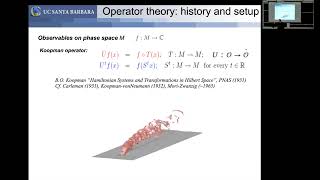
The Operator is the Model - Dynamical Systems and Machine Learning
Explore the intersection of machine learning and dynamical systems with Igor Mezic, focusing on operator-based modeling approaches and their implications for complex system analysis.
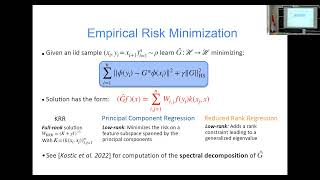
Statistical Learning of Transfer Operators and the Infinitesimal Generator
Explore statistical learning techniques for transfer operators and infinitesimal generators in dynamical systems, focusing on advanced mathematical concepts and applications.
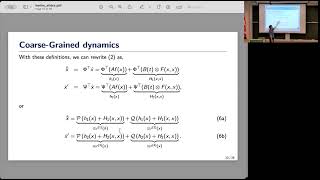
Learning Coarse-Grained Dynamics on Graphs
Explore coarse-grained dynamics on graphs with John Harlim, delving into advanced machine learning techniques for dynamical systems analysis and modeling.
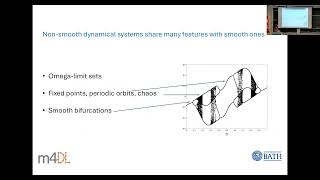
Non-smooth Dynamics and Machine Learning
Explore the intersection of non-smooth dynamics and machine learning, uncovering innovative approaches to complex systems analysis and prediction.
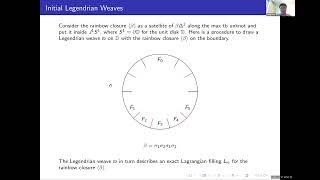
Cluster Algebras Associated to Bott-Samelson Braids
Explore cluster algebras associated with Bott-Samelson braids, focusing on Legendrian links and their connection to algebraic varieties and Lagrangian fillings. Discover weaves and their computational applications.
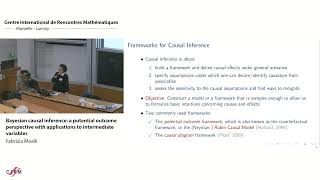
Bayesian Causal Inference: A Potential Outcome Perspective with Applications - Lecture
Explore Bayesian causal inference from a potential outcome perspective, with practical applications and insights from Fabrizia Mealli's conference talk.
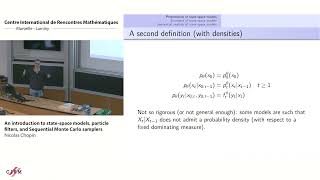
An Introduction to State-Space Models, Particle Filters, and Sequential Monte Carlo - Lecture 1
Explore state-space models, particle filters, and sequential methods in Bayesian statistics with Nicolas Chopin's comprehensive introduction to these advanced mathematical concepts.
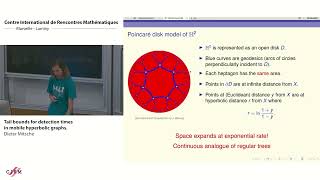
Tail Bounds for Detection Times in Mobile Hyperbolic Graphs
Explore tail bounds for detection times in mobile hyperbolic graphs. Gain insights into probability and geometry in non-Euclidean spaces through this mathematical conference talk.