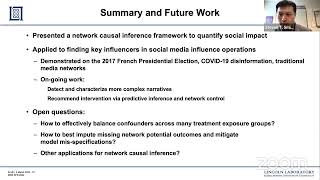
Causal Inference on Networks to Characterize Disinformation Narrative Propagation
Explore techniques for detecting and analyzing disinformation spread on social networks using causal inference, focusing on network construction, influence scoring, and bot detection.
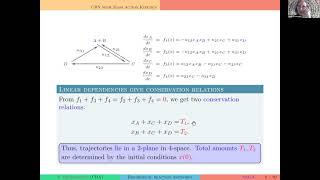
Families of Polynomials in Biochemical Reaction Networks
Exploring polynomial systems in biochemical reaction networks, focusing on computational techniques for analyzing families of polynomials with combinatorial structures derived from reaction digraphs.
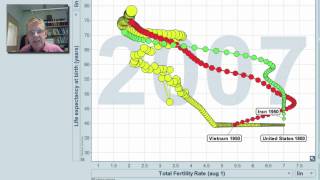
Hans Rosling Answers Top Questions from TED and Reddit Community
Hans Rosling addresses top community questions, offering insights on global health, data visualization, and socioeconomic trends in an engaging 18-minute interview with TED and Reddit.
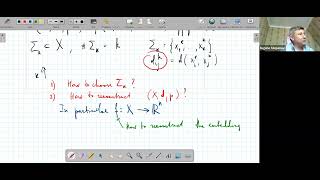
Reconstructing Hidden Geometric Structures in Data From Distance Matrices
Explore techniques for reconstructing metric spaces and embeddings from distance matrices, covering theoretical foundations, practical applications, and open problems in geometric data analysis.
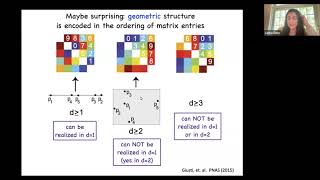
Using Topology to Study the Geometry of Neural Correlations
Explore how topology and persistent homology uncover hidden structures in neural data, focusing on Betti curves and their applications in analyzing hippocampal, olfactory, and zebrafish brain activity.
Alignment of Random Graphs: Informational and Computational Limits - Lecture 2
Explores informational and computational limits in aligning random graphs, focusing on advanced probabilistic techniques for data science and graph theory applications.
Survival Analysis of Cancer Patients Using Machine Learning Technique by Shakuntala Baichoo
Explore machine learning techniques for survival analysis of cancer patients, focusing on predicting outcomes and analyzing clinical data to enhance patient care and treatment strategies.
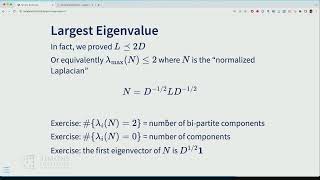
Graph Linear Algebra Part 1
Explore fundamental concepts of graph linear algebra, focusing on matrices, spectral theory, and their applications in algorithmic graph theory and network analysis.
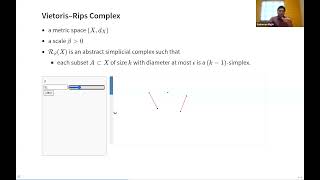
Demystifying Latschev's Theorem for Manifold Reconstruction
Explores quantitative approaches to Latschev's theorem for topological manifold reconstruction, advancing finite sample analysis in data science and manifold learning applications.

Statistics for Data Analysis with Exercises - Lecture 3
Explore advanced statistical methods for data analysis in high-energy physics, focusing on practical applications and exercises to enhance understanding and skills in this specialized field.
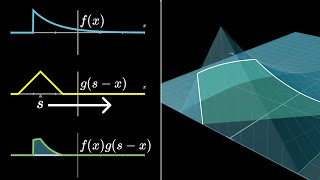
Convolutions and Adding Random Variables, Visually Explained
Visual explanation of convolutions and adding random variables, exploring discrete and continuous cases, with connections to the central limit theorem and practical examples.
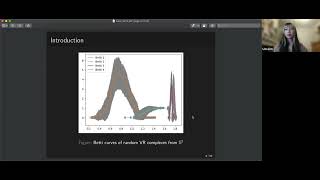
Strange Random Topology of the Circle
Explore the intriguing behavior of "topological noise" in random Cech complexes constructed from the circle, revealing unexpected homotopy equivalences and higher Betti numbers in specific filtration radii intervals.
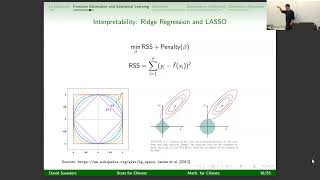
Statistics for Complex Climate Problems
Explore statistical approaches for addressing complex climate issues, focusing on advanced techniques and their applications in environmental research and policy-making.
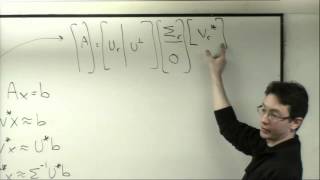
SVD Part 2
Explore advanced concepts of Singular Value Decomposition (SVD) in data analysis and dimensionality reduction, building on fundamental principles to enhance understanding of matrix factorization techniques.
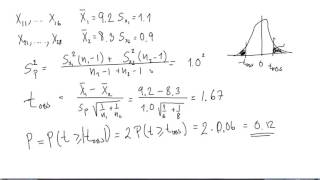
T-Test: Fundamentals and Applications - Lecture 9
Explore the fundamentals and practical applications of t-tests in statistical analysis, enhancing your ability to interpret and conduct hypothesis testing effectively.
Finite Differences and Successive Over Relaxation - Jupyter Notebook Assignment Development
Explore finite differences and successive over-relaxation methods in computational physics through a guided Jupyter notebook project, enhancing problem-solving skills in numerical analysis.
Numerical Integration Methods in Jupyter Notebook - Development Vlog 4
Explore numerical integration methods using Jupyter Notebook, comparing results and enhancing computational skills for physics research and problem-solving.

Jupyter Notebook Assignment - Runge-Kutta Method Development - Vlog 3
Explore the Runge-Kutta Method in computational physics, comparing it with Euler-Cromer. Develop skills in numerical analysis and scientific computing using Jupyter Notebooks.
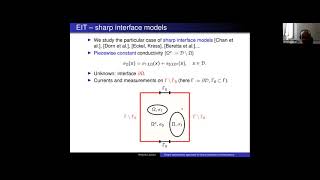
Shape Optimization Approach for Sharp-Interface Reconstructions in Inverse Problems
Shape optimization techniques for inverse problems: analyzing piecewise constant models, shape derivatives, and Lagrangian approaches. Applications in electrical impedance tomography and full waveform inversion.
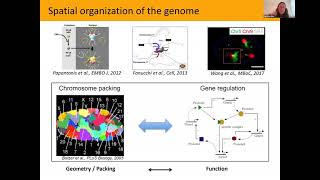
Mathematics of Genome Packing and Regulation
Explore the mathematics of genome organization and its impact on gene expression through geometric packing models and deep learning, with insights on 3D genome reconstruction and autoencoder applications in genomics.
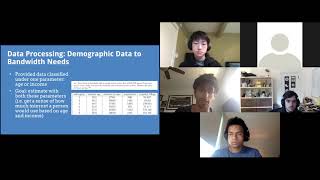
MathWorks Math Modeling Challenge 2021 - Nueva School Winning Presentation
Winning presentation by Nueva School on their solution for the MathWorks Math Modeling Challenge 2021, showcasing innovative approaches to technical computing and problem-solving.