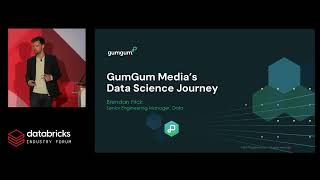
GumGum Media's Data Science Journey on Databricks
Explore GumGum Media's data science evolution with Databricks, featuring insights from Sr. Engineering Manager Brendan Frick on leveraging advanced analytics for media innovation.
Creating a Data and GenAI Ecosystem - Migrating to Databricks
Gerdau's journey to create a flexible, simplified Data and GenAI ecosystem using Databricks, resulting in cost reduction, tool consolidation, and improved governance for the steel industry.
Data Engineering on the Data Intelligence Platform - A Comprehensive Guide
Explore data engineering on Databricks' platform: ingest, transform, and orchestrate data at scale. Learn about streaming pipelines, data quality, and AI-powered tools for real-time insights.
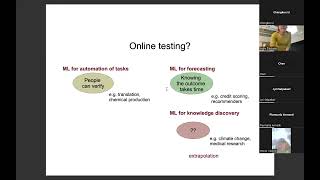
Cross-Validation Revisited: Evaluating Machine Learning Models with Non-IID Data
Explore challenges and techniques for evaluating machine learning models with non-IID data, focusing on spatial autocorrelation, concept drift, and phylogenetic non-independence.
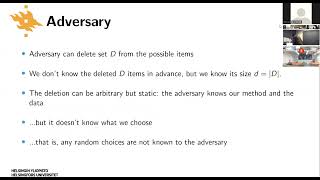
Coresets for Robust Submodular Maximization with Deletions
Explore submodular maximization against deletions, learning about coresets and algorithms for robust optimization in data science problems. Gain insights from Nikolaj Tatti's research on streaming and offline approaches.
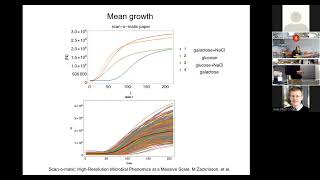
Quantifying Determinants of Microbial Growth
Explore computational approaches for quantifying microbial growth determinants, focusing on genotype-environment interactions and their implications for pathogen control and biotechnology.
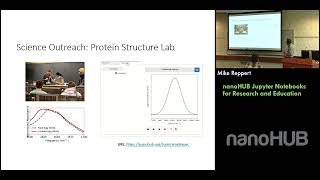
NanoHUB Jupyter Notebooks for Research and Education in Chemistry
Explore nanoHUB Jupyter Notebooks for creating chemistry teaching applications. Learn about tools for simulating proteins, analyzing lab data, and studying molecular spectroscopy. Discover how to develop and share scientific software effectively.

Exploring Datasets with Python and Pandas
Explore datasets using Python and pandas. Learn essential data analysis techniques for scientists, engineers, and analysts working with diverse datasets.
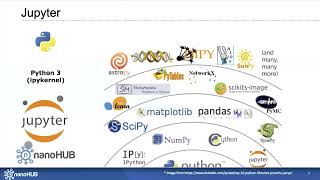
A Guided Tour of Interactive Jupyter Notebooks Powered by nanoHUB
Explore interactive Jupyter Notebooks on nanoHUB. Learn fundamentals, develop code, analyze data, create visualizations, and build GUIs using Jupyter widgets and nanohub-uidl library.

Network Regression and Its Inference
Explore network regression and inference techniques for analyzing complex network data, focusing on estimating regression coefficients with network effects and addressing observational errors.
Document Similarity Using Langchain, OpenAI Embeddings, and Neo4J
Explore document similarity using Langchain, Neo4j, and OpenAI embeddings. Learn practical techniques for machine learning and data science applications.
LLMOps: LLMs Memory and Compute Optimizations
Explore FlashAttention, GQA, FSDP, and DDP techniques to enhance LLM efficiency, training, and fine-tuning in self-attention layers.
Prompt Engineering Techniques with Mistral 7B Instruct for Data Science and Machine Learning
Explore prompt engineering techniques using Mistral 7B Instruct, including zero-shot, few-shot, CoT, and RAG. Learn to craft effective prompts for enhanced machine learning outcomes.
MLOps: Using Python Libraries in DotNet - Spacy, Numpy, Pandas
Integrate Python libraries like Spacy, NumPy, and Pandas into .NET applications using Pythonnet for enhanced machine learning and data science capabilities.
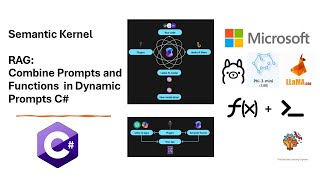
Microsoft AI: Semantic Kernel and RAG Dynamic Prompts with C# - Data Science and Machine Learning
Explore RAG component creation using Dynamic Prompts with Microsoft Semantic Kernel, utilizing Ollama Framework and Phi3 Mini model in C#.
Creating Synthetic Data with Langchain, OpenAI, and Faker
Generate synthetic data using Langchain, OpenAI, and Faker for data science and machine learning applications. Learn powerful techniques to create realistic datasets.
LLMOps: Quantization Models and Inference with ONNX Generative Runtime
Explore ONNX runtime GPU support for inference with generative models, including Phi3-mini quantization and conversion techniques.
Neo4J Knowledge Graph Builder App with Langchain, OpenAI, and Gemini
Build knowledge graphs from unstructured data using Neo4J's Knowledge Graph Builder App with AI integration for efficient data extraction and visualization.
Microsoft LLMs: Phi3 Vision 128k Instruct and Florence Large - Introduction to Multimodal Models
Explore state-of-the-art multimodal models Phi3 Vision Instruct 128k and Florence Large from Microsoft, with practical demonstrations and code examples.
MLOps: Comparing Microsoft Phi3 Mini 128k in GGUF, MLFlow, and ONNX Formats
Explore Microsoft Phi3 Mini 128k model: compare inference time and precision across MLFlow, GGUF, and ONNX formats. Learn quantization techniques and performance optimization for various platforms.
MLOps with MLFlow: Working with Spacy NLP and Training NER Models
Explore Spacy NLP models in MLflow and learn to train a custom NER component using your own data for advanced natural language processing tasks.