Breaking Data Silos with Semantic Link in Microsoft Fabric
Explore Semantic Link in Microsoft Fabric to break data silos, enabling seamless collaboration between data scientists and analysts for creating insightful solutions and leveraging semantic information.
Simplifying Data Analysis and Visualization with Developer Tools and AI
Explore data analysis and visualization using AI-assisted tools. Learn to leverage GitHub, Jupyter, Copilot, and LIDA for efficient insights and visualizations, even without extensive Python experience.
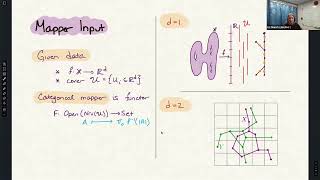
Bounding the Interleaving Distance for Mapper Graphs with a Loss Function
Exploring interleaving distance for Mapper graphs, introducing a loss function to measure assignment quality and enable polynomial-time computation for data comparison and clustering.
Workflows of Highly Functional App and Data Engineering Teams
Explore enterprise data engineering principles: schema management, standards enforcement, testing, and automated deployment. Learn strategies for handling change, observability, and quality at scale.
Vector Databases Explained - Insights, Applications, and Pinecone Tutorial
Explore vector databases, embeddings, and advanced search techniques. Learn how to leverage Pinecone for powerful vector search solutions, with real-world applications and hands-on experience.
Cover Your Bases: Minimizing Sequencing Coverage in DNA Storage Systems
Explores minimizing DNA sequencing coverage in storage systems, focusing on error-correcting codes and retrieval algorithms to reduce costs and latency while optimizing information retrieval efficiency.
Toward Efficient Genomic Compression Using Channel Codes for Joint Alignment and Reconstruction
Explore innovative genomic compression techniques using channel codes for efficient alignment and reconstruction, advancing data storage and analysis in genomics research.

Interactive Session on Data Analysis - Lecture 1
Explore data analysis techniques through an interactive session, focusing on practical applications and hands-on learning to enhance analytical skills and problem-solving abilities.

Interactive Session on Data Analysis - Lecture 2
Hands-on data analysis session exploring techniques and tools for probing hadron structure at the Electron-Ion Collider, emphasizing practical skills and real-world applications.

Bootstrapping the Right Way - Data Science Best Practices
Learn effective bootstrapping techniques for data analysis, including proper resampling, package selection, and considerations for parametric Bayesian approaches from a distinguished data scientist.
Graphing Zephyr Development and Project Health - How Visualizing Data Helps with Growth and Scaling
Explore how data visualization and metrics tracking drive growth and scaling in the Zephyr project, addressing challenges and identifying trends for improved project health.
Bringing CI/CD Practices to Machine Learning with MLOps
Learn how to apply CI/CD practices to machine learning pipelines, enhancing model development from data exploration to deployment for better, faster results in MLOps.
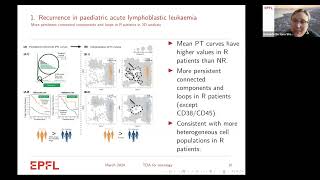
Applications of Topology to Oncology Data
Exploring Persistent Homology in oncology: predicting leukaemia relapse risk and analyzing tumor microenvironments using topological data analysis and machine learning techniques.
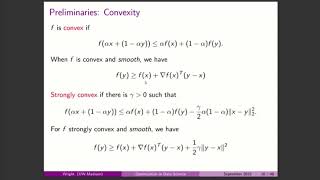
Optimization for Data Analysis
Explore optimization techniques for data analysis and machine learning, covering kernel learning, regression, graph analysis, neural networks, and matrix analysis. Learn about regularization and gradient methods.
Data Analysis Using Zigzag Persistence for Temporal Hypergraphs
Explore temporal hypergraphs and zigzag persistence in Topological Data Analysis to understand complex systems' evolution, with applications in cybersecurity and social networks.
Geometry and Complex Networks - A Powerful Partnership
Explore the intersection of geometry and complex networks, uncovering powerful applications in network science, data analysis, and modeling real-world systems.

Unstable Log Sequence Anomaly Detection - Introducing Vocabulary-Free BERT
Innovative anomaly detection method for unstable log data in cybersecurity, improving on BERT models to reduce false positives and enhance SOC efficiency.

A Quest for Little Eureka Moments
Explore the intersection of poetry, science, and learning with Sara Garg as she shares insights on finding "little Eureka moments" and pursuing interdisciplinary passions.
The Case for Alien AI
Exploring the potential of diverse, "alien" AI to revolutionize scientific discovery and societal progress, challenging our perspectives on artificial intelligence and human knowledge.
Solving Real-World Data Science Problems with LLMs - Historical Document Analysis
Learn to analyze historical documents using Python and LLMs. Covers entity parsing, document connection, and data insights extraction. Practical application with Freedmen's Bureau dataset and both closed and open-source LLMs.

Excel for Finance and Accounting: Expert Tutorial
Master Excel for finance: NPV, IRR, charts, Pivot Tables. Create income statements, balance sheets, cash flow statements. Practical exercises for real-world financial data analysis and presentation.