
Molecular Docking for Beginners - Autodock Full Tutorial
Guía paso a paso sobre acoplamiento molecular proteína-ligando utilizando AutoDock. Aprenda a investigar interacciones a nivel atómico para comprender mecanismos bioquímicos.
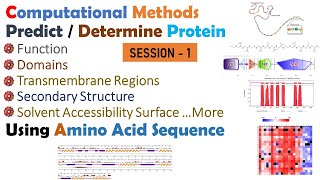
Bioinformatics Methods for Protein Function Identification - Domains and Transmembrane Regions
Explore protein sequence annotation using computational tools for properties, domains, transmembrane regions, and structural elements. Learn to analyze amino acid sequences effectively.
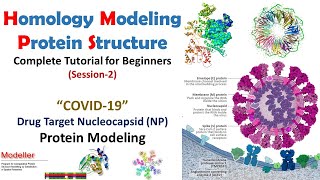
Homology Modeling for Beginners - COVID-19 NP Protein Modeling - Session 2
Learn sequence alignment, model generation, and validation for COVID-19 NP protein using Modeller and PROCHECK tools in this practical bioinformatics tutorial on homology modeling.
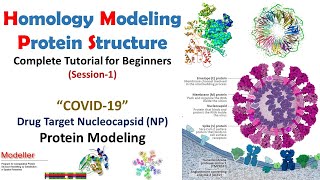
Homology Modeling for Beginners - COVID-19 NP Protein Modeling with Modeller
Learn homology modeling basics and hands-on pipeline using Modeller tool to construct atomic-resolution protein models from amino acid sequences and related homologous structures.
NGS Analysis Practical Using Galaxy Server - Section 1
Hands-on demonstration of NGS analysis using Galaxy server, covering step-by-step procedures and providing practical insights for bioinformatics researchers.
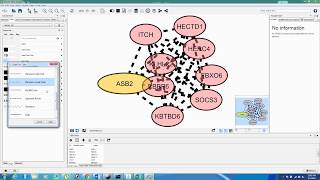
Identification of Nodes and Edges in Cluster Finder - CFinder and Clique Percolation Method
Explore k-clique communities in networks using CFinder's Clique Percolation Method algorithm for effective subgraph analysis and community detection.
Learning from Simulations - Marc Huertas Company
Explore astrostatistics and machine learning in galaxy formation, comparing models with observations and discussing innovative data analysis techniques for advancing astrophysical understanding.
The CAMELS Project - Paco Villaescusa Navarro
Exploring the CAMELS project: a large-scale simulation suite for galaxy formation and cosmology, combining hydrodynamics and machine learning to advance our understanding of the Universe.
Towards Astronomical Search by Image - The Hubble Image Similarity Project - Josh Peek
Exploring astronomical image similarity using machine learning, focusing on the Hubble Image Similarity Project to enhance search capabilities and facilitate new discoveries in astrophysics.
Generating High-Fidelity HI Maps Using Score-Based Diffusion Models - Sultan Hassan
Exploring score-based diffusion models to generate high-fidelity HI maps, discussing applications in astrostatistics and machine learning for galaxy formation and evolution studies.
Learning Representations of Galaxies from Simulations and Observations - Suchetha Cooray
Explore advanced data science techniques for analyzing galaxy formation and evolution, bridging simulations with observations to uncover new insights in astrophysics.
Finding Simple Structures in Complex Datasets - Dalya Baron
Exploring data-driven techniques to uncover simple structures in complex astronomical datasets, focusing on galaxy formation and evolution using advanced statistical and machine learning tools.
FLORAH - Planting Better Merger Trees with Deep Generative Models - Tri Nguyen (MIT)
Explore deep generative models for improved merger tree creation in galaxy formation studies, enhancing our understanding of cosmic structure evolution and linking observations with theoretical models.
Constraining Ωm with Phase-Space Information of Galaxies - Natali Soler Matubaro De Santi
Explore innovative techniques for constraining the matter density parameter using galaxy phase-space data, combining astrostatistics and machine learning to advance our understanding of cosmic structure formation.
Too Hot to Handle - The Role of Supermassive Black Holes in Heating the Low Redshift Intergalactic Medium
Explore the impact of supermassive black holes on intergalactic medium heating at low redshift, focusing on AGN feedback mechanisms and their role in galaxy formation and evolution.
How Supermassive Black Holes Ignite the Intergalactic Medium - Tales from the Low Redshift Lyman-alpha Forest
Explore how supermassive black holes impact the intergalactic medium through the lens of the low redshift Lyman-alpha forest, offering insights into galaxy formation and evolution.
Prospects for Detecting Gaps in GC Streams with Roman - Christian Aganze
Exploring detection of gaps in globular cluster streams using Roman Space Telescope, applying advanced statistical and machine learning techniques to enhance our understanding of galaxy formation and evolution.
Optimizing Target Selection for Low-Redshift Galaxy Surveys - Elise Darragh Ford
Explores data-driven techniques for optimizing galaxy survey target selection, enhancing our understanding of galaxy formation and evolution through advanced statistical and machine learning methods.
Multivariate Time Series on COVID-19 - Time Series Forecasting
Learn multivariate time series forecasting techniques applied to COVID-19 data. Explore statistical modeling for predicting trends and making informed decisions across various industries.

Stock Price Prediction Using Deep Learning - Deep Learning Tutorial
Learn to predict stock prices using deep learning techniques, including time series forecasting, ANN, and RNN, with practical implementation and a case study approach.
Excel Formulas and Functions - Excel for Beginners
Learn essential Excel formulas and functions for data analysis and visualization. Master basic operations, conditional functions, and data manipulation techniques to enhance your spreadsheet skills.