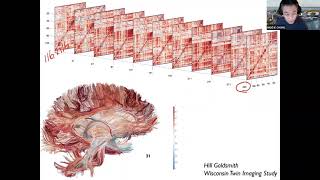
Topological Learning and Its Application to Multimodal Brain Network Integration
Explore topological learning for integrating multimodal brain networks, focusing on a novel framework using persistent homology and Wasserstein distance-based loss for efficient computations in neuroimaging studies.
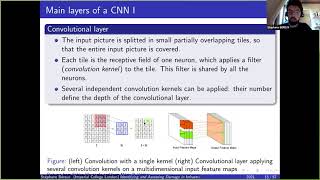
Identifying and Assessing Damage in Infrastructure Using Topological Data Analysis and Machine Learning
Innovative approach using topological data analysis and machine learning for low-cost, imaging-based concrete damage assessment in infrastructure, offering a potential alternative to expensive laboratory diagnostics.
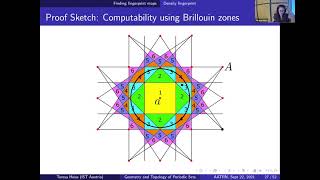
Geometry and Topology of Periodic Point Sets, for Example Crystals
Explore geometric and topological tools for characterizing crystalline materials, including Brillouin zones and persistent homology, and discuss challenges in defining persistent homology for periodic point sets.
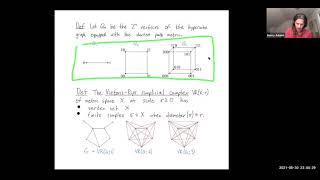
Henry Adams - Vietoris-Rips Complexes of Hypercube Graphs
Explore Vietoris-Rips complexes of hypercube graphs, their homotopy types, and applications in genetic recombination and persistent homology. Discover formulas, open questions, and conjectures in this fascinating area of applied algebraic topology.

Other Persistence Invariants - Homotopy and the Cohomology Ring
Explore persistent homotopy groups and cohomology rings, focusing on fundamental groups, rational homotopy, and cup-length diagrams. Learn about new tools complementing persistent homology in topological data analysis.
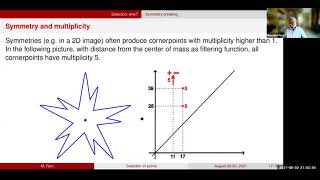
Massimo Ferri - Selection of Points in Persistence Diagrams
Explore point selection in persistence diagrams, including Kurlin's criterion and the Ziqqurat method, for noise reduction and improved data analysis in topological data analysis.
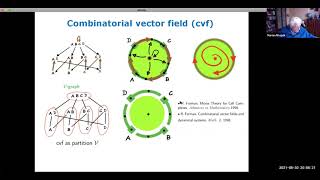
Marian Mrozek - Combinatorial vs. Classical Dynamics: Recurrence
Explore combinatorial dynamics in data science, its ties to classical dynamics, and applications in computer-assisted proofs. Learn about topological invariants and recent developments in recurrent behavior analysis.
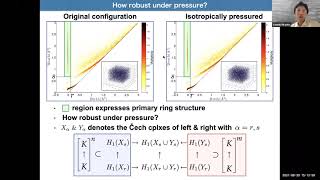
On Characterizing Rare Events in Persistent Homology
Explore rare events in persistent homology, focusing on indecomposables in multi-parameter settings. Learn about large deviation principles and laws of large numbers in topological data analysis.
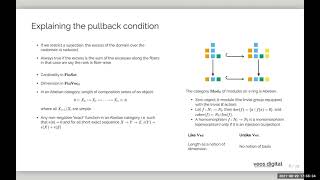
Comparing Neural Networks via Generalized Persistence
Exploring generalized persistence to compare neural network architectures, analyzing data representations at each layer and providing insights into network behavior and performance.
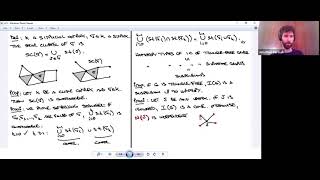
Star Clusters in Clique Complexes and the Vietoris-Rips Complex of Planar Sets
Explore star clusters in simplicial complexes and their applications to independence complexes and Vietoris-Rips complexes of planar sets, with insights on homotopy information and related conjectures.
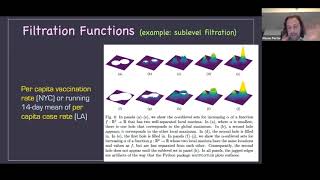
Mason Porter - Topological Data Analysis of Spatial Complex Systems
Explore topological data analysis in spatial systems, from spider webs to COVID-19 spread. Learn filtered simplicial complexes and their applications in various real-world scenarios.
Sequence Alignment - Hidden Markov Models, Category Theory and All That Jazz by Soumyashant Nayak
Explore sequence alignment methods, from traditional algorithms to modern pseudo-alignment techniques, with insights on hidden Markov models and applications in RNA-Seq data analysis and evolutionary genetics.
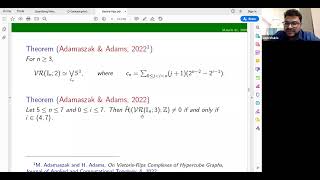
Vietoris-Rips Complexes of Hypercube Graphs
Explore Vietoris-Rips complexes of hypercube graphs, their collapsibility, and applications in genetic trees and persistent homology. Gain insights into simplicial complexes and topological data analysis.
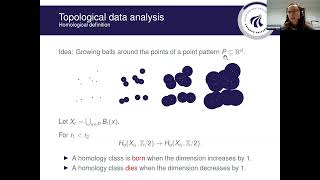
Analyzing Point Processes Using Topological Data Analysis
Explore point processes using topological data analysis, covering models, statistical techniques, and applications in spatial statistics. Learn to distinguish between process types and understand central limit theorems.
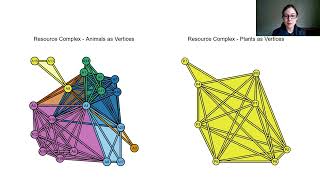
Topological Data Analysis of Plant-Pollinator Resource Complexes - Melinda Kleczynski
Explore topological data analysis in ecology, focusing on plant-pollinator interactions. Learn about resource complexes and insect-flower visitation patterns using advanced mathematical tools.
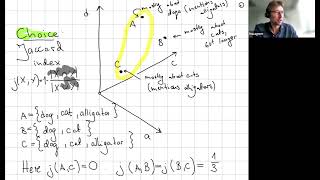
Hubert Wagner - Topological Data Analysis in Non-Euclidean Spaces
Explore topological data analysis in non-Euclidean spaces, focusing on techniques for applying TDA tools and their applications in detecting neural network backdoor attacks.

GPU Accelerated Computation of VR Barcodes in Evaluating Deep Learning Models
GPU-accelerated computation of VR barcodes for evaluating deep learning models, focusing on Ripser++ software and its applications in measuring data distribution shifts and analyzing attention graphs in BERT models.
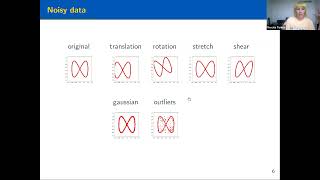
On the Effectiveness of Persistent Homology
Exploring persistent homology's effectiveness in shape analysis tasks, outperforming baselines in detecting holes, curvature, and convexity from point clouds, with robustness to limited resources and data transformations.

Approximation of Compact Metric Spaces by Finite Samples
Explore topological data analysis through finite approximations of compact metric spaces, connecting Shape Theory and Persistence for robust feature extraction from noisy datasets.
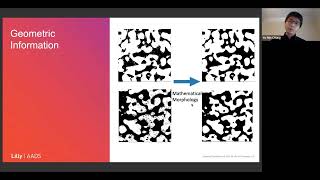
A Multi-Parameter Persistence Framework for Mathematical Morphology
Exploring mathematical morphology through persistent homology, offering new insights for image processing and automated denoising techniques in binary, grayscale, and color images.

Discrete Homotopy Theory and Applications
Explore discrete homotopy theory's evolution, applications in topology, geometry, and group theory. Learn simplified approaches to fundamental groups and covering spaces, with insights into various mathematical domains.