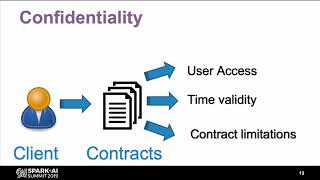
Revolutionizing Legal Industry with Spark, NLP and Azure Databricks - Clifford Chance Case Study
Explore how a top law firm revolutionizes operations using advanced analytics, Spark, NLP, and Azure Databricks to handle millions of legal documents and enhance client relationships.
How to Handle High Cardinality Predictors for Data on Museums in the UK
Explore effect and likelihood encodings for high cardinality predictors in tidymodels, using UK museum data to demonstrate practical applications.
Deploy Different Prediction Types for a Bigfoot Sighting Model
Learn to deploy various prediction endpoints for a Bigfoot sighting model using vetiver, including feature engineering, logistic regression, and natural language processing techniques.
Understand the Gender Pay Gap Three Ways
Explore three increasingly complex approaches to analyze UK gender pay gap data, from basic comparisons to robust statistical modeling.

Time Series Analysis via Matrix Estimation
Explore matrix estimation techniques for time series analysis, focusing on imputation, algorithms, and theoretical foundations with practical applications in societal networks.
Batch Create Reports with App Scripts
Learn to automate report generation in Google Sheets using Apps Script. Create tables, graphs, and text replacements without add-ons, streamlining data processing from raw CDC EU information.

Using Theories of Decision-Making Under Uncertainty to Improve Data Visualization
Explore decision-making under uncertainty to enhance data visualization. Learn techniques for improving inductive reasoning, pattern finding, and effect size judgment in visual data analysis and communication.

Identification and Estimation of Dynamic Structural Models with Unobserved Choices
Explore dynamic structural models with unobserved choices, focusing on identification, estimation, and applications in information design and data science.

Complementary Information and Learning Traps
Explore complementary information sets and their impact on learning efficiency, with insights into learning traps and efficient information aggregation in decision-making environments.
Why Do Our Models Learn?
Exploring biases in ImageNet and their impact on machine learning models, discussing dataset creation processes and their consequences for real-world applications of AI.
Introduction to Databricks Lakehouse Platform Architecture and Security
Explore Databricks Lakehouse Platform's architecture, focusing on data reliability, Delta Lake features, and Photon's performance enhancements for efficient data management and analytics.
Building a Lakehouse Architecture for Business Data Empowerment
Explore building a data platform using LakeHouse Architecture, focusing on data curation, GDPR compliance, and open-source technologies to empower businesses with reliable, timely, and accessible data.
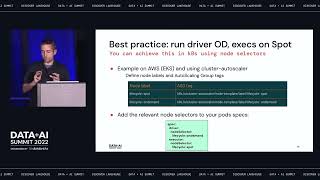
How to Make Apache Spark on Kubernetes Run Reliably on Spot Instances
Learn to run Apache Spark on Kubernetes using spot instances for cost savings. Discover best practices, code examples, and techniques to handle spot interruptions while maintaining reliability and performance.
Low-Code Machine Learning on Databricks with AutoML
Discover how to build, train, and deploy ML models using Databricks AutoML and low-code tools, empowering users of all expertise levels to create predictive analytics solutions.
Improving Apache Spark Application Processing Time - Configuration and Optimization Techniques
Optimize Spark streaming app performance through configurations, code improvements, and custom data source implementation for processing 700 MB/s of compressed data with strict KPIs.
Implementing End-to-End Demand Forecasting with Databricks and MLflow
Discover how to implement a scalable demand forecasting solution using Databricks and MLflow, improving retail efficiency and reducing food waste through accurate production and delivery planning.
Orchestration Made Easy with Databricks Workflows
Discover Databricks Workflows: a managed orchestration service for streamlined data pipelines. Learn to create, run, and monitor reliable workflows, implement recovery actions, and explore new features for efficient data management.
Administrator Best Practices for Scaling and Securing Databricks Deployments
Optimize Databricks administration for enterprise-scale deployments. Learn best practices, new capabilities, and customer insights for efficient onboarding, security, and workspace management.
Apache Spark on Kubernetes - Lessons Learned from Launching Millions of Spark Executors
Lessons learned from running massive Spark workloads on Kubernetes at Apple, covering orchestration, resource management, monitoring, and optimization for scalability and performance.
Securing Databricks on AWS Using PrivateLink - Deployment and Automation
Learn to secure Databricks on AWS using PrivateLink, covering architecture, setup, and automation. Gain insights on minimizing public internet data transfers for enhanced security and cost-efficiency.
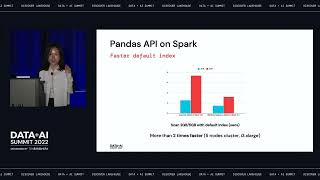
PySpark in Apache Spark 3.3 and Beyond
Explore PySpark's evolution in Apache Spark 3.3, including improved Pandas API, enhanced productivity features, and future developments. Learn about new functionalities, usability improvements, and performance enhancements.