CUDA Kernels with C++
Explore CUDA for C/C++ with practical examples, focusing on using C++ features to enhance kernel code safety without compromising performance in GPU programming.
MLOps: Using GPUs in Local, Docker, and Docker Compose Environments
Aprende a instalar PyTorch con soporte GPU y configura Docker y Docker Compose para aprovechar el poder de procesamiento gráfico en tus proyectos de aprendizaje automático.
cuCatch: A Debugging Tool for Efficiently Catching Memory Safety Violations in CUDA Applications
Explore cuCatch, an innovative debugging tool for CUDA applications that efficiently detects memory safety violations with low performance overhead and high error detection coverage.
Perfect PC for AI, Object Detection and LLMs - Complete Guide
Learn how to build the optimal PC setup for AI development, focusing on computer vision, object detection, and large language model implementation.
Descend: A Safe GPU Systems Programming Language
Explore Descend, a safe GPU programming language enforcing memory management through type systems. Learn about its holistic model, extended Borrow checking, and competitive performance against CUDA.
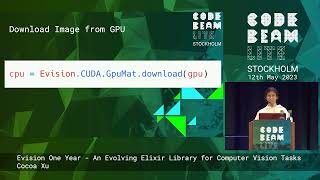
Evision: An Evolving Elixir Library for Computer Vision Tasks
Explore Evision, an evolving Elixir library for computer vision. Learn about Kino widgets, Nx integration, and performance comparisons across CPU, OpenCL, and CUDA for image processing tasks.

How Comcast Powers AI Speech Recognition with Weak Supervision
Explore Comcast's innovative approach to AI speech recognition using weak supervision and efficient inference techniques, achieving improved accuracy and speed for voice-enabled smart TVs.
The State of Open Source AI: Deployment Engines, Licenses, and Hardware
Explore the latest in open-source AI: deployment challenges, evolving licenses, and hardware advancements. Gain insights into project maintenance, permissive architectures, and improving software portability for AI development.
Installing WSL with CUDA Support and PyTorch for Data Science and Machine Learning
Aprenda a instalar WSL con soporte CUDA y PyTorch para potenciar sus proyectos de aprendizaje automático y ciencia de datos en Windows.
Accelerating Python Code with Numba and CuPy for Machine Learning
Boost Python code execution with GPU acceleration and compilation using Numba and Cupy for machine learning tasks.
Installing NVIDIA cuDNN and First Steps with NVCC in C++
Aprenda a instalar Cudnn y desarrolle aplicaciones de ML con soporte GPU en C++, utilizando la biblioteca de redes neuronales profundas de Nvidia.

Addressing Challenges of Cross-Architecture Dynamic Migration Over Heterogeneous Acceleration Systems
Explore cross-architecture dynamic migration for AI applications on diverse accelerators. Learn unified abstraction, middle-compiler techniques, and runtime support for seamless transitions between hardware.

Addressing Challenges of Cross-Architecture Dynamic Migration Over Heterogeneous Acceleration Systems
解决AI应用在不同加速硬件间平滑迁移的挑战。介绍统一抽象、跨架构编译和动态链接运行时等技术,实现无需改变开发习惯的跨系统应用迁移。
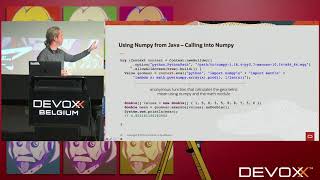
Optimizing the Performance of Machine Learning in Enterprise Java SaaS with GraalVM, Python and CUDA
Enhance Java SaaS with GraalVM: integrate Python ML libraries, leverage GPU acceleration for model training, and implement recommender systems in enterprise applications.

How to Install Detectron2 for Computer Vision with OpenCV Python - Part 2
Step-by-step guide to installing Detectron2 for computer vision projects using OpenCV and Python, covering essential requirements, software setup, and testing procedures.
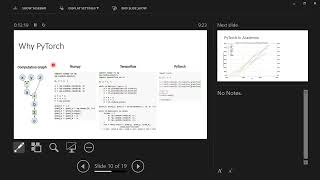
PyTorch Tutorial: Deep Learning Framework Fundamentals - Fall 2022
Master PyTorch fundamentals and deep learning concepts, from tensor operations to GPU acceleration, autograd, and data loading - all through hands-on coding examples and practical implementations.
Maximiser l'Utilisation des Ressources GPU pour l'IA Générative dans un Environnement OpenStack et Kubernetes (Français)
Découvrez les stratégies d'optimisation des GPU pour l'IA générative dans OpenStack et Kubernetes, incluant vGPU, CUDA streams, MIG et SR-IOV pour une meilleure efficacité des ressources.
CUDA and the Wolfram Language: Latest Developments and Future Directions
Explore CUDA integration in Wolfram Language, covering latest developments and future directions for massively parallel GPU computation.
Heterogeneous Accelerator Toolkit (HAT) Update - Project Babylon and GPU Acceleration in Java
Explore updates on Java's Heterogeneous Accelerator Toolkit (HAT) project, focusing on GPU acceleration, programming models, and integration with Babylon and Panama FFM. Includes demos and future plans.
Installing Python, CUDA, cuDNN, C++ Build Tools, FFMPEG, and Git for AI Applications
Set up essential tools for AI applications: Python, CUDA, cuDNN, C++ Build Tools, FFMPEG & Git. Learn to install, configure, and troubleshoot for seamless AI development on Windows.
LLVM in HPC: Enabling Performance Portability, Interoperability, and Novel Features - Part 2
Explore recent LLVM efforts for HPC: portable CUDA, debugging at scale, GPU execution of legacy codes, automatic differentiation, ML in compilers, and static information impact.