Writing Badass Malware for OS X
Explore advanced OS X malware techniques, persistence methods, and security bypasses. Learn to create sophisticated threats and enhance Mac protection against current and future malware.

Harnessing Intelligence From Malware Repositories
Explore techniques for extracting intelligence from malware repositories using program analysis and data mining, with insights on connecting seemingly disparate cyber attacks and tracking malware trends.

Quantum Key Distribution and the Future of Encryption
Explore quantum key distribution and its role in future encryption, covering quantum mechanics basics, algorithms, and real-world experiments to ensure data security in the quantum computing era.

The Node.js Highway - Attacks Are At Full Throttle
Explore Node.js security issues and effective measures for secure application development. Learn about weak cryptography, testing, MongoDB, and see a practical demo.
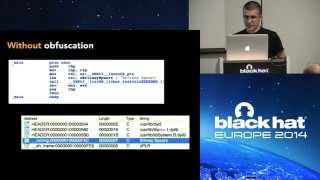
C++11 Metaprogramming Applied to Software Obfuscation
Explore advanced C++11 metaprogramming techniques for software obfuscation, including compile-time code generation, polymorphism, and practical applications like string encryption and call obfuscation.
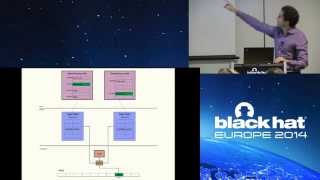
Next Level Cheating and Leveling Up Mitigations
Explore sophisticated attacks on anti-cheat systems in multiplayer gaming, including practical demonstrations and implications for game security and the future of cheat prevention.

When the Cops Come A-Knocking - Handling Technical Assistance Demands from Law Enforcement
Guidance on handling law enforcement demands for technical assistance, covering types of requests, legal authority, and response options for companies protecting user data and privacy.

The Hidden Architecture of Our Time - Why This Internet Worked, How We Could Lose It
Exploring the Internet's success, its underlying principles, and the potential threats to its architecture. Emphasizes the importance of cryptography, open networks, and hacking in shaping a functional global network.

Hiding In Plain Sight - Advances In Malware Covert Communication Channels
Explores recent malware techniques using steganography and covert channels to evade detection. Analyzes real-world examples from cybercrime and targeted attacks, detailing implementation and discussing implications.
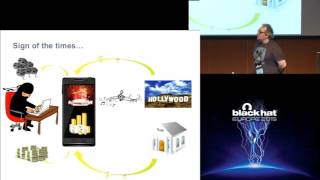
Unboxing the White-Box - Practical Attacks Against Obfuscated Ciphers
Explore practical attacks on obfuscated ciphers, focusing on White-Box Cryptography. Learn techniques to assess security, understand vulnerabilities, and evaluate robustness against key extraction in software implementations.

Exploit Delivery With Steganography and Polyglots
Explore innovative exploit delivery techniques using steganography and polyglots, focusing on encoding browser exploits in image files for undetectable payload transmission.
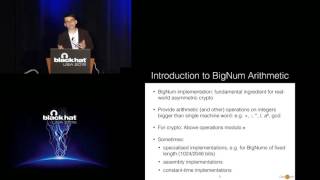
Assessing and Exploiting BigNum Vulnerabilities
Explore vulnerabilities in multi-precision integer arithmetic used in cryptography implementations. Learn bug patterns, exploitation techniques, and strategies for automated vulnerability detection.
Back Doors and Front Doors - Breaking the Unbreakable System
Exploring government demands for backdoor access to encrypted data, examining proposed solutions, and discussing the balance between security and privacy in digital communications.
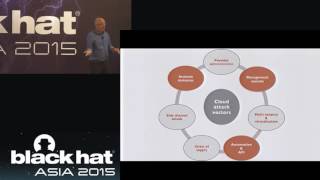
From Zero to Secure in One Minute
Automated cloud security tool for rapid instance lifecycle: pre-configured, patched, encrypted, and auto-mitigated. Introduces "Cloudefigo" for accelerated security in dynamic cloud environments.

Mapping the Wireless IoT
Explore wireless IoT security challenges, signal identification techniques, and best practices for revealing unknown signals. Includes a demo of a new tool for mapping radio spectrum and identifying devices.
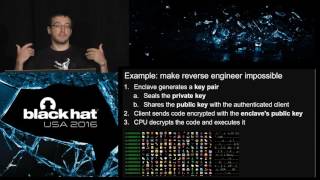
SGX Secure Enclaves in Practice - Security and Crypto Review
Explore Intel's SGX technology for secure remote computation, including its implementation, development environment, cryptographic aspects, and potential applications in secure storage and delegation.

An Inconvenient Trust - User Attitudes Toward Security and Usability Tradeoffs
Exploring user perspectives on encryption methods, balancing security and usability in digital communications. Insights from a study on key-exchange vs. key-directory models for everyday messaging.
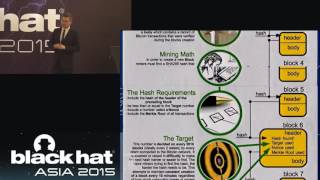
Decentralized Malware on the Blockchain
Explore the potential threat of embedding malware in blockchain transactions, its implications for cybersecurity, and possible solutions to mitigate risks in decentralized systems.
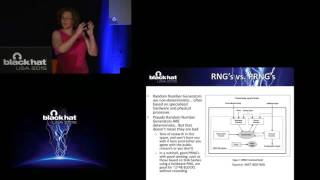
Understanding and Managing Entropy Usage
Explore cryptographic entropy usage, sources, and management across systems. Learn to analyze and improve random number generation for enhanced security in modern IT infrastructures.

Cracking WEP Keys
Explore WEP encryption vulnerabilities, key generation flaws, and cracking techniques. Learn to implement a WEP cracker and understand its implications for wireless network security.
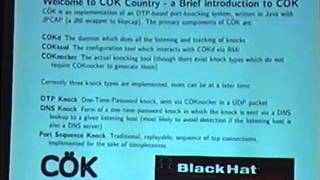
Cryptographic Port-Knocking
Explore cryptographic port-knocking techniques for enhanced network security. Learn innovative methods to protect servers from unauthorized access and potential attacks.