Qubit Recycling Revisited - Optimizing Quantum Circuit Width
Explore qubit recycling optimization for quantum circuits, focusing on complexity, algorithms, and verification using qubit dependency graphs and matrix triangularization techniques.

A Proof Recipe for Linearizability in Relaxed Memory Separation Logic
Explore a novel proof recipe for linearizability in relaxed memory, using object modification order to simplify event reordering and enable proof reuse in concurrent libraries.
DisLog: A Separation Logic for Disentanglement
Explore DisLog, a novel separation logic for verifying disentanglement in parallel programs. Learn about its applications, benefits, and case studies in concurrent programming.
VST-A: A Foundationally Sound Annotation Verifier for Imperative Programs
Explore VST-A, a foundationally sound annotation verifier combining automation with rich assertion language and formal soundness proofs for imperative program verification.
Deadlock-Free Separation Logic: Linearity Yields Progress for Dependent Higher-Order Message Passing
Explore LinearActris, a novel logic ensuring deadlock and leak freedom in message-passing concurrency, combining session types and separation logic for higher-order program verification.
The Logical Essence of Well-Bracketed Control Flow
Explore the logical foundations of well-bracketed control flow in programming, introducing a Hoare-style program logic for reasoning and verification, with formalized results in the Iris framework and Coq.
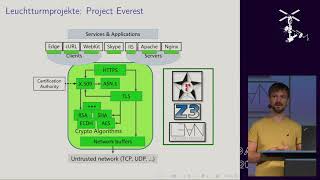
Beweisbar sichere Software
Überblick über verifizierbare Programmiersprachen und Theorembeweiser zur Entwicklung beweisbar sicherer Software. Vergleich verschiedener Ansätze anhand von Beispielen.
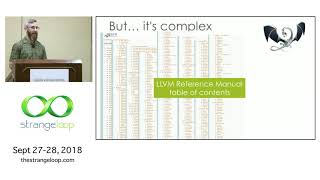
Verifying the LLVM
Explore LLVM's intermediate representation, its complexities, and the Vellvm project's approach to formal verification using Coq, aimed at ensuring compiler reliability and security.

Automated Ambiguity Detection in Layout-Sensitive Grammars
Explore automated ambiguity detection in layout-sensitive grammars using SMT solving. Learn about local ambiguity, reachability conditions, and their application to language design.
Osiris: An Iris-Based Program Logic for OCaml
Explore Osiris, an Iris-based program logic for OCaml, enabling code verification using Separation Logic. Learn about its features, limitations, and future development plans.

Translating Canonical SQL to Imperative Code in Coq
Explore a mechanically verified compiler translating SQL to imperative code, addressing implementation challenges and leveraging formalization advances in query compilation.
Iris-Wasm: Robust and Modular Verification of WebAssembly Programs
Explore robust and modular verification of WebAssembly programs using Iris-Wasm, a mechanized higher-order separation logic for specifying and verifying individual modules with strong isolation guarantees.
RefinedRust: A Type System for High-Assurance Verification of Rust Programs
Explore RefinedRust, a novel type system for verifying both safe and unsafe Rust code. Learn about its implementation, evaluation, and potential impact on high-assurance software development.
An Intrinsically-typed Probabilistic Programming Language in Coq - Extended Abstract
Explore formalization of intrinsically-typed probabilistic programming language in Coq, focusing on syntax, evaluation, and formal verification applications.
A Type-Theoretic Account of Quantum Computation
Explore type-theoretic concepts for describing and proving properties of quantum computations, focusing on quantum circuits using Coq's dependent and polymorphic types.

Dependent Session Protocols in Separation Logic from First Principles - Functional Pearl
Explore dependent session protocols in concurrent separation logic, building from mutable references to channels. Simplify verification using basic mechanisms for one-shot protocols and extend to dependent session protocols.

Etna: An Evaluation Platform for Property-Based Testing - Experience Report
Explore Etna, a platform for evaluating property-based testing techniques. Compare popular frameworks in Coq and Haskell to understand best practices and tradeoffs in functional programming.
The Last Yard: Foundational End-to-End Verification of High-Speed Cryptography
Explore foundational end-to-end verification of high-speed cryptography, connecting Hacspec, Jasmin, and SSProve tools using Coq. Demonstrates approach with AES implementation proof.
Modular Denotational Semantics for Effects with Guarded Interaction Trees
Explore guarded interaction trees for representing higher-order computations with effects in Coq. Learn about modular reasoning and cross-language interactions in higher-order languages.
Functorial Syntax for All - Representing and Reasoning About Binding Structures
Explore a Coq library for reasoning about variable binding in programming languages using functorial syntax, with insights from development and application across projects.
Hashing Modulo Context-Sensitive Alpha-Equivalence - PLDI 2024
Explore efficient hashing for lambda-terms with context-sensitive alpha-equivalence. Learn about improved algorithms for subterm comparison and structure sharing in mathematical knowledge graphs.