
Junior Devs are the Solution to Many of Your Problems
Discover how early-career software developers can bring unique value to your team. Learn strategies for identifying and leveraging their potential to solve key problems and drive performance.
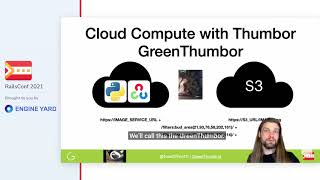
Exploring Real-time Computer Vision Using ActionCable
Integrate Rails and Python for real-time computer vision analysis, combining OpenCV with ActionCable & Sidekiq to broadcast insights and create time-lapse renderings with graphs.

Implicit to Explicit - Decoding Ruby's Magical Syntax
Demystify Ruby's "magical" syntax by converting implicit code to explicit, enhancing comprehension of Rails models and config files. Gain a new perspective on Ruby and improve code reading skills.
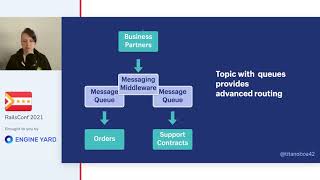
High Availability by Offloading Work
Explore strategies for maintaining high availability by offloading work: background jobs, message-oriented middleware, and event logs. Learn their foundations and compare approaches to choose the right tool.

The History of Making Mistakes
Explore software engineering's history of mistakes, learning from past errors to improve future practices and understand the human element in technological failures.
How to Teach Your Code to Describe Its Own Architecture
Automatically generate up-to-date architecture docs and diagrams from code, improving developer productivity and code quality through better understanding.
Engineering MBA - Be The Boss of Your Own Work
Improve your development career with strategic planning, leadership, and process management skills. Learn MBA concepts valuable for developers without the costs of business school.

Who Are You? Delegation, Federation, Assertions and Claims
Explore protocols for delegating identity management, including SAML, OAuth, and OpenID Connect. Learn about single sign-on, authentication issues, and considerations for implementing these solutions.

API Optimization Tale - Monitor, Fix and Deploy
Discover strategies for API optimization, monitoring, and deployment in a high-stakes environment. Learn from real-world experiences of managing service migrations and handling production issues.
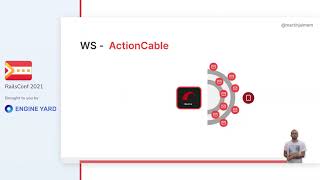
Using Rails to Communicate with the New York Stock Exchange
Learn to build scalable trading apps with Rails, managing complex APIs, TCP protocols, and RPC for high-frequency transactions with the New York Stock Exchange.

Rails DB - Migrate - Even Safer
Explore advanced techniques for evolving database schemas in large Rails applications, focusing on maintaining uptime and avoiding errors during complex migrations and schema changes.
Rust-based, Secure and Lightweight Container Runtime for Embedded Systems
Explore a Rust-based container runtime for embedded systems, offering enhanced security, faster startup, reduced memory usage, and fine-grained access control using seccomp notify.
The Rust Borrow Checker - A Deep Dive
Explore Rust's borrow checker: from basics to advanced concepts. Learn to leverage its guidance for writing safer, more powerful code, understanding its critical role in Rust's functionality and philosophy.
Leveraging State Machines to Build Operators in Rust
Explore Krator, a Rust crate for building state-machine-based Kubernetes Operators. Learn its API, design decisions, and new functionalities through a live demo and in-depth discussion.

Fluent Bit - Swiss Army Tool of Observability Data Ingestion
Discover how Fluent Bit revolutionizes observability data ingestion, offering scalability, performance, and cost-efficiency. Learn about custom plugins, dynamic log metrics extraction, and overcoming data schema challenges.
Logging Operator the Cloud Native Fluent Ecosystem
Explore Logging Operator for Kubernetes: efficient log management, namespace isolation, label selectors, filtering, and secure credential handling. Learn about challenges and lessons from real-world deployments.
Customized Cloud Native Logging - Fluent Bit in Open Service Mesh
Explore Fluent Bit integration in Open Service Mesh for customized cloud-native logging. Learn practical examples of filtering, annotating, and routing logs in containerized environments.
From Napkin to the Cloud - A WebAssembly Journey
Explore WebAssembly's impact on software development, from concept to cloud deployment. Learn to build cloud-native apps with polyglot actors using wasmCloud, enhancing scalability and performance without complex re-architecture.
Serverless WebAssembly for Compute-Intensive Workloads
Explore serverless WebAssembly for building scalable APIs with near-zero initialization times and support for multiple languages, demonstrated through a bioinformatics analysis function.
Embrace DevOps Practices to ML Pipeline Development
Integrating DevOps practices into ML pipeline development using Kubeflow and Tekton, focusing on workflow orchestration, CI/CD, and overcoming challenges in the process.
Scaling ML Pipelines with KALE - The Kubeflow Automated Pipeline Engine
Discover KALE, the Kubeflow Automated Pipeline Engine, for scaling ML pipelines. Learn how to transform Jupyter Notebook experiments into production-grade pipelines for efficient model training and real-time serving.