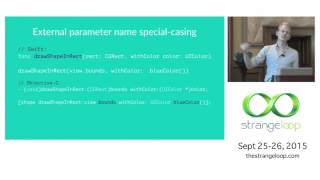
Feet in Both Worlds - From Objective-C to Swift
Explore the transition from Objective-C to Swift, focusing on interoperability challenges, design impacts, and practical adoption strategies in existing codebases.
Kolmogorov Music
Explore Kolmogorov complexity in music, algorithmic composition, and program transformations. Discover implications for creation, copyright, and performance through demonstrations and examples.
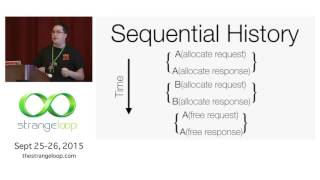
Using Race Conditions in Correct Concurrent Software
Explore how race conditions can be leveraged to improve performance in concurrent systems, focusing on lock-free algorithms and high-throughput lock acquisition techniques.
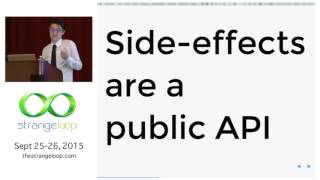
Side Effects Are a Public API
Explore techniques for isolating and representing side effects as intents, improving code testability and maintainability in Python and functional programming paradigms.
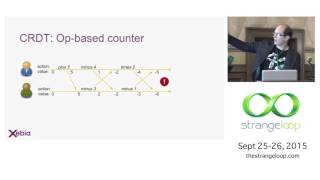
CRDTs Illustrated
Explore CRDTs for partition-tolerant applications, covering concepts, implementation methods, and real-world examples in distributed storage and offline-friendly web apps.
Make the Back-End Team Jealous - Elm in Production
Discover how Elm can revolutionize front-end development, offering reliability, performance, and clean code. Learn to integrate Elm into existing JS projects and explore its unique features and benefits.
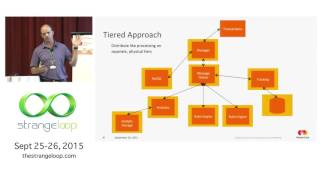
Performance Engineering at MasterCard
Explore high-volume, low-latency performance engineering at MasterCard, covering real-time fraud detection, system architecture, testing strategies, and optimization techniques for millisecond-level transaction processing.
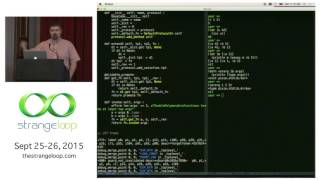
Pixie - A Lightweight Lisp with 'Magical' Powers
Explore Pixie, a lightweight Lisp language with fast startup, C interop, immutable data structures, and async I/O. Learn its features and the technology enabling its rapid development.
No, Really - Robots and JavaScript
Explore the surprising synergy between JavaScript and robotics, uncovering the potential of NodeBots and the unique advantages of using JS in robotic development.

Architectural Patterns of Resilient Distributed Systems
Explore architectural patterns for building resilient distributed systems, focusing on adaptation, decomposition, consistency, and safety. Learn strategies for system evolution and testing.

Cache à la Carte - A Framework for In-Memory Caching
Modular cache framework for diverse in-memory caching needs, offering predictable performance, fixed memory footprint, and easy customization. Lessons from large-scale cache cluster operations shared.
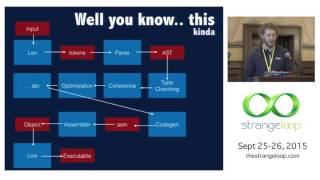
Rustc in Userland
Explore Rust's compiler architecture to build static analysis tools and compilers. Learn to implement a simple LISP and create JIT-like compilers using Rust's codegen machinery.
GC Tuning Confessions of a Performance Engineer
Explore Java garbage collection optimization with insights on performance metrics, tuning tradeoffs, and comparisons of Parallel Old, CMS, and G1 collectors in OpenJDK's HotSpot JVM.
Big-Bang - The World, Universe, and Network in the Programming Language
Explore functional programming with Racket's Universe library, from teaching middle school students to implementing complex network systems. Learn how algebraic functions can create interactive, graphical programs.
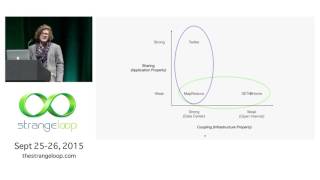
Distributed, Eventually Consistent Computations
Explore Lasp, a new programming model for distributed computations, combining convergent data structures with dataflow execution for large-scale applications with limited connectivity and unreliable networks.
The Art of Service Discovery at Scale
Explore service discovery in microservices, focusing on Netflix's Eureka. Learn about high availability, multi-datacenter awareness, and favoring availability over consistency in network partitions.
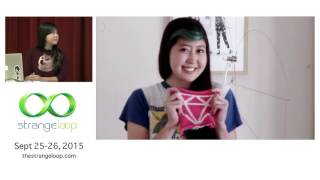
Sweaters as a Service
Discover how engineers hacked a 1980s knitting machine, creating a computer-controlled system to knit custom patterns and even memes, blending retro technology with modern programming.
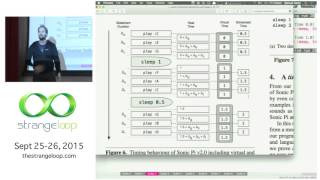
Beating Threads - Live Coding with Real Time
Explore live coding with Sonic Pi, learning temporal semantics, thread coordination, and innovative programming techniques while creating music in real-time.
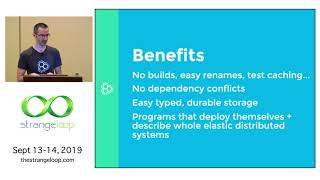
Unison - A New Distributed Programming Language
Explore Unison, a functional language for distributed systems. Learn its unique features, including self-deployment, elastic scaling, and simplified code management for building complex distributed applications.
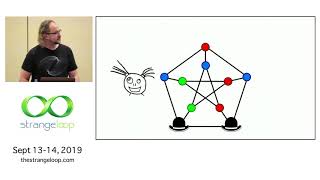
Rhapsody in Zero Knowledge - Proving Without Revealing
Explore zero-knowledge proofs: a cryptographic technique enabling proof verification without revealing sensitive information, balancing security and privacy in modern computing.
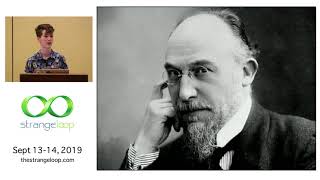
Minimalist Piano Forever
Explore generative music using Erik Satie's minimalist piano works. Learn about Markov chains, MIDI, and browser-based audio to create endless, evolving compositions and dynamic sheet music.