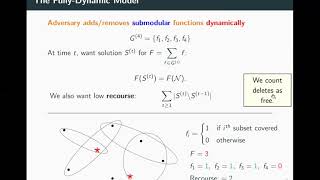
Fully-Dynamic Submodular Cover with Bounded Recourse
Explore dynamic submodular cover algorithms with bounded recourse, focusing on greedy approaches, competitive ratios, and potential functions for efficient problem-solving.
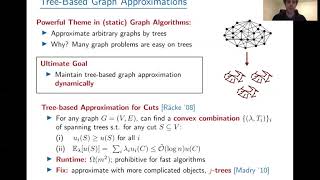
Fast Dynamic Cuts, Distances and Effective Resistance via Vertex Sparsifier
Explore dynamic graph algorithms and vertex sparsification techniques for efficient computation of cuts, distances, and resistance in evolving networks.
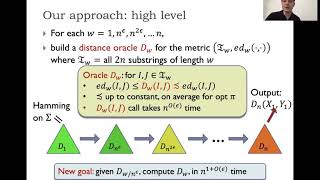
Edit Distance in Near-Linear Time - It’s a Constant Factor
Explore efficient algorithms for computing edit distance, focusing on near-linear time solutions and constant factor improvements in computational complexity.
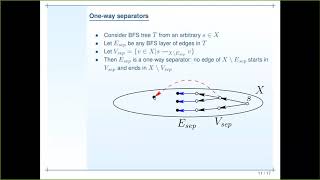
Near-Optimal Decremental SSSP in Dense Weighted Digraphs
Explore near-optimal algorithms for maintaining shortest paths in dense weighted digraphs as edges are deleted, focusing on efficient update times and approximation techniques.
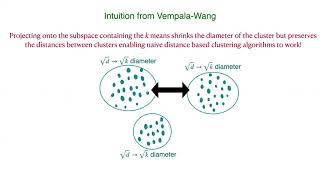
List Decodable Mean Estimation in Nearly Linear Time
Learn efficient algorithms for list-decodable mean estimation, exploring win-win strategies, affine subspace detection, and generalized solvers. Gain insights into cutting-edge statistical techniques.
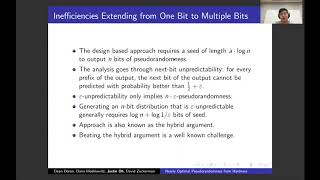
Nearly Optimal Pseudorandomness From Hardness
Explore cutting-edge pseudorandomness techniques derived from computational hardness, focusing on novel approaches using codes with large alphabets and pseudoentropy extraction.
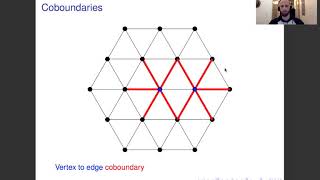
Decodable Quantum LDPC Codes Beyond the Square Root Distance Barrier Using High Dimensional Expander
Explore quantum LDPC codes using high dimensional expanders, surpassing distance barriers. Learn about CSS codes, geometric complexes, and LSV constructions for improved quantum error correction.
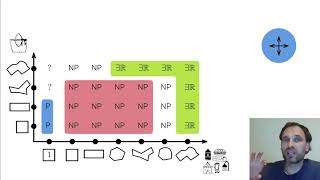
Framework for Existential Real-Completeness of Two-Dimensional Packing Problems
Explore complexity of 2D packing problems, focusing on $\exists\mathbb R$-completeness. Learn key concepts, coding techniques, and real-world applications in this advanced computational geometry talk.
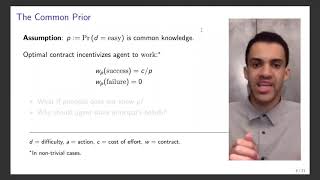
Mechanisms for a No-Regret Agent - Beyond the Common Prior
Explore advanced mechanism design principles for no-regret agents, challenging common prior assumptions and presenting innovative frameworks and algorithms.
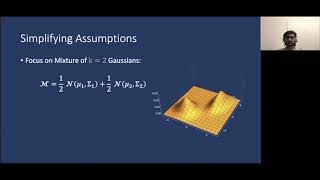
Outlier-Robust Clustering of Gaussians and Other Non-Spherical Mixtures
Explore robust clustering techniques for Gaussian mixtures and non-spherical distributions, covering TV-separation, anti-concentration, and sum-of-squares relaxation methods.
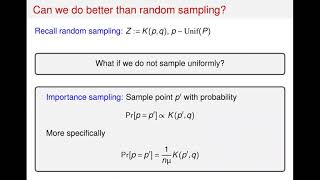
Kernel Density Estimation through Density Constrained Near Neighbor Search
Explore kernel density estimation through near neighbor search, focusing on importance sampling, locality sensitive hashing, and data-dependent techniques for improved efficiency and accuracy.

Unit Capacity Maxflow in Almost m - 4/3 Time
Explore advanced algorithms for solving unit capacity maxflow problems, featuring innovative techniques and improved time complexity.

Smoothing the Gap Between NP and ER
Explore the relationship between NP and ER problems through smooth analysis, examining key results and applications in recognition problems.

A Dichotomy for Real Boolean Holant Problems
Explore the complexity classification of real-valued Boolean Holant problems, focusing on tractable signatures, gadget construction, and induction proofs for a comprehensive dichotomy theorem.
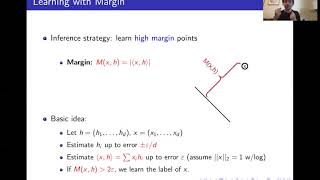
Point Location and Active Learning - Learning Halfspaces Almost Optimally
Explore advanced techniques in machine learning, focusing on point location, active learning, and halfspaces. Gain insights into cutting-edge algorithms and strategies for optimal learning outcomes.
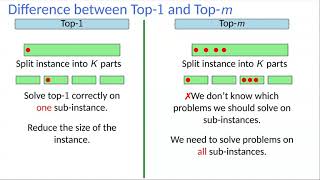
Collaborative Top Distribution Identifications with Limited Interaction
Explore collaborative learning strategies for efficient multi-armed bandit problem-solving, focusing on top-m identifications with limited interactions and error reduction techniques.
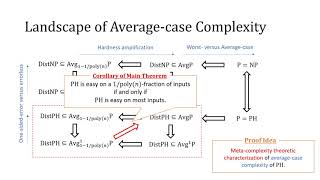
Characterizing Average-Case Complexity of PH by Worst-Case Meta-Complexity
Explore the relationship between worst-case meta-complexity and average-case complexity in PH, examining key concepts and open questions in computational complexity theory.
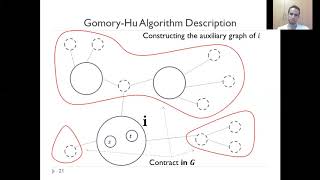
Cut-Equivalent Trees are Optimal for Min-Cut Queries
Explore cut-equivalent trees and their optimality for min-cut queries, covering algorithms, data structures, and approximation techniques in graph theory.
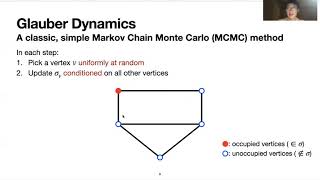
Rapid Mixing of Glauber Dynamics up to Uniqueness via Contraction
Explore rapid mixing of Glauber dynamics in spin systems, focusing on the hardcore model and Ising model. Learn about uniqueness thresholds, MCMC methods, and self-avoiding walk trees.
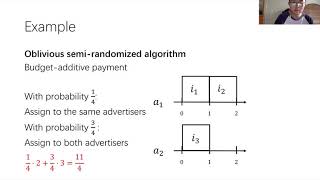
AdWords in a Panorama
Explore online bipartite matching and primal-dual algorithms for AdWords, featuring a panoramic view and hybrid approach to achieve competitive performance.
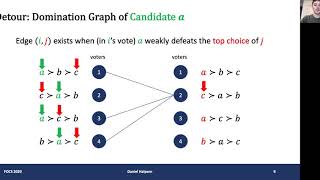
Resolving the Optimal Metric Distortion Conjecture
Explore voting theory and the Downseam Proximity Model to understand the Optimal Metric Distortion Conjecture, its proof, and implications for fair decision-making.