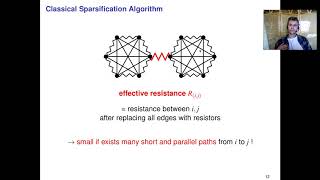
Quantum Speedup for Graph Sparsification, Cut Approximation and Laplacian Solving
Explore quantum algorithms for graph sparsification, cut approximation, and Laplacian solving, offering speedups over classical methods in these fundamental graph problems.
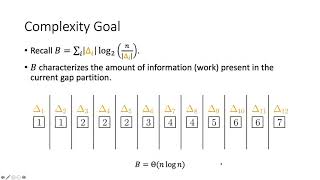
Lazy Search Tree
Explore lazy search trees, a novel data structure for efficient sorted dictionaries. Learn about its design, complexity analysis, and potential applications in computer science.
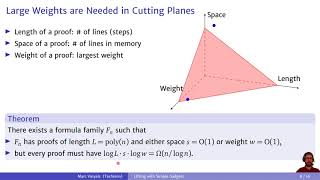
Lifting with Simple Gadgets and Applications to Circuit and Proof Complexity
Explore lifting techniques in circuit and proof complexity, focusing on Cutting Planes measures, communication complexity, and applications to monotone circuits and formulas.
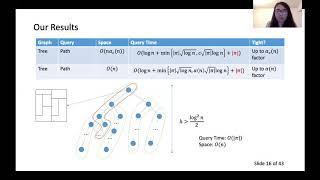
2D Fractional Cascading on Axis-Aligned Planar Subdivisions
Explore advanced data structures for efficient querying in planar subdivisions, focusing on 2D fractional cascading techniques and their applications in computational geometry.
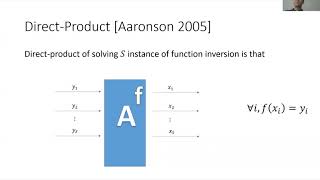
Tight Quantum Time-Space Tradeoffs for Function Inversion
Explore quantum time-space tradeoffs for function inversion, examining classical tradeoffs, circuit complexity, and a generic framework. Delve into proof overviews and multi-instance gains.
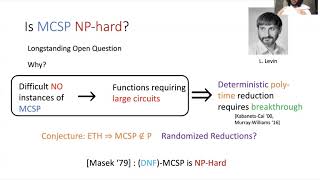
The Constant Depth Formula and Partial Function Versions of MCSP are Hard
Explore the complexity of MCSP variants, including partial function and constant depth formula versions, and their implications for circuit lower bounds and computational hardness.
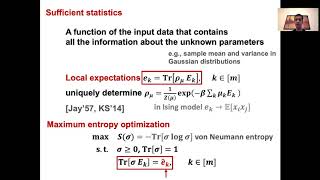
Sample-Efficient Learning of Quantum Many-Body Systems
Learn efficient techniques for studying complex quantum systems, exploring probability distributions, state operators, and optimization methods in quantum mechanics.
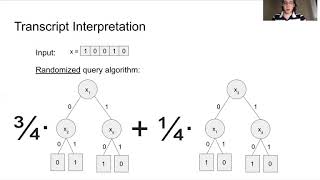
A New Minimax Theorem for Randomized Algorithms
Explore a novel minimax theorem for randomized algorithms, comparing it with Yao's minimax and discussing its implications for algorithm analysis and design.
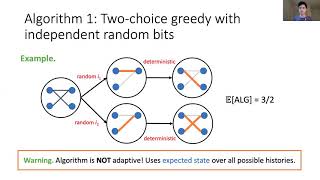
Edge-Weighted Online Bipartite Matching
Learn techniques for edge-weighted online bipartite matching, including competitive ratio analysis, greedy algorithms, and online correlated selection. Explore primal-dual methods and factor-revealing linear programs.
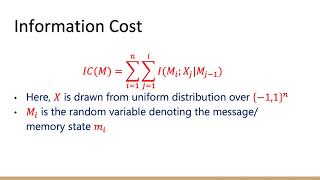
The Coin Problem with Applications to Data Streams
Explore the Coin Problem's applications to data streams, covering previous works, counting techniques, information cost, and proof overview.
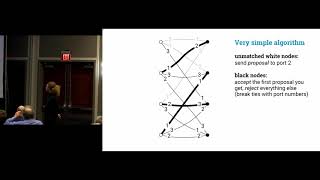
Lower Bounds for Maximal Matchings and Maximal Independent Sets
Explore lower bounds for maximal matchings and independent sets in distributed settings, using round elimination techniques and the LOCAL model.
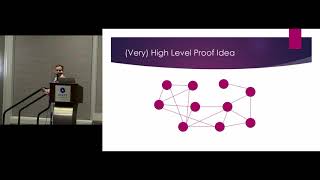
Random K-Out Subgraph Leaves Only O-N-K- Inter-Component Edges
Explore efficient graph partitioning techniques, focusing on random k-out subgraphs and their impact on inter-component edges. Learn about applications in connectivity and dense graph analysis.
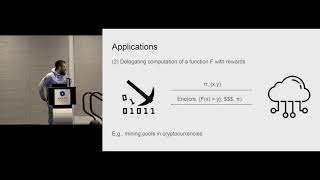
Laconic Conditional Disclosure of Secrets and Applications
Explore innovative cryptographic techniques for secure information sharing, including probabilistically checkable proofs and garbled circuits, with applications in malicious laconic oblivious transfer.
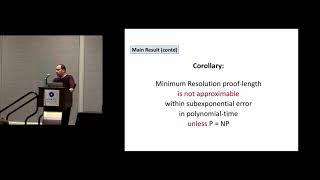
Automating Resolution is NP-Hard
Explore the complexity of automating resolution in proof systems, including key developments, positive and negative results, and implications for computational theory.
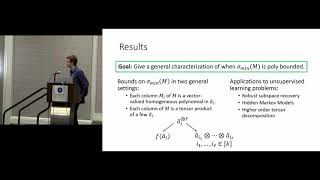
Smoothed Analysis in Unsupervised Learning via Decoupling
Explore smoothed analysis in unsupervised learning, focusing on tensor decomposition, high-dimensional data, and robust subspace recovery. Gain insights into condition number bounds and perturbation techniques.
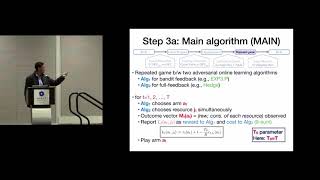
Adversarial Bandits with Knapsacks
Explore dynamic pricing and bandits with knapsacks in adversarial settings, covering algorithms, challenges, and future research directions in this field.
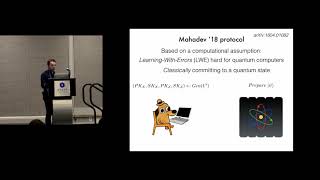
Computationally-Secure and Composable Remote State Preparation
Explore secure remote state preparation protocols, including verification, classical commitment, and quantum random access codes. Learn about computational security and composability in quantum systems.
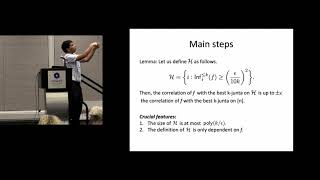
Junta Correlation Is Testable
Explore property testing, tolerant junta testing, and Fourier analysis in this theoretical computer science talk on testable junta correlation.
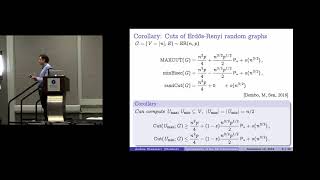
Optimization of the Sherrington-Kirkpatrick Hamiltonian
Explore the optimization of the Sherrington-Kirkpatrick Hamiltonian, covering stochastic block models, random graphs, and algorithmic insights for solving complex optimization problems.
Fast Uniform Generation of Random Graphs with Given Degree Sequences
Explore efficient algorithms for generating random graphs with specified degree sequences, focusing on rejection and switching methods.
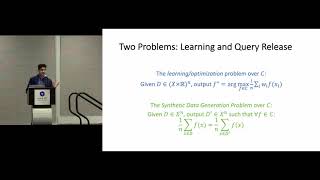
How to Use Heuristics for Differential Privacy
Learn about differential privacy heuristics, their properties, and applications in machine learning. Explore modular design, universal identification, and privacy analysis techniques.