Software Update Solutions for Yocto and OpenEmbedded
Explore open-source software update solutions for embedded Linux devices using Yocto and OpenEmbedded, including Mandar, Metamender, Rock, and Eclipse Hogbit.

Linux on RISC-V with Open Hardware
Explore RISC-V architecture, its global impact, and implementation in Linux systems. Learn about open hardware, SBI, and FPGA toolchains for RISC-V development.

Virtualization for the Masses - Exposing KVM on Android
Explore KVM virtualization on Android, covering ARM exception models, hardware virtualization, security improvements, and challenges, with insights on future developments.
The ELISA Project - Enabling Linux in Safety Applications
Explore the ELISA Project's mission to enable Linux in safety-critical applications, its working groups, and strategies for bridging gaps between safety and open-source communities.

Group Fairness - Independence Revisited
Explore the concept of group fairness and independence in algorithmic decision-making, examining its implications, limitations, and potential improvements for ethical AI systems.
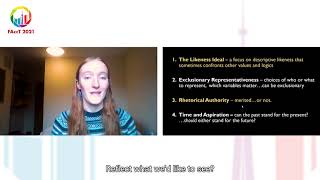
Representativeness in Statistics, Politics, and Machine Learning
Explore the concept of representativeness across statistics, politics, and machine learning, examining its roots, applications, and ethical implications in various fields.
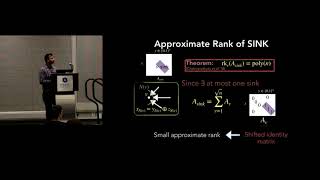
Exponential Separation between Quantum Communication and Logarithm of Approximate Rank
Explore quantum communication's exponential advantage over logarithmic approximate rank, focusing on the SINK function and its implications for communication complexity theory.
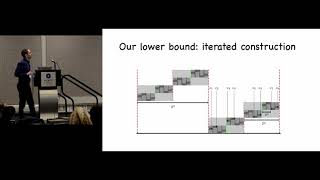
Finding Monotone Patterns in Sublinear Time
Explore efficient algorithms for detecting monotone patterns in large datasets, focusing on sublinear time complexity and adaptive techniques for various pattern types.
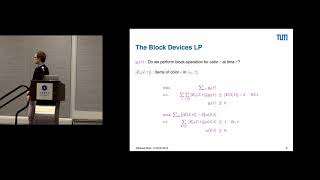
Polylogarithmic Guarantees for Generalized Reordering Buffer Management
Explore polylogarithmic guarantees for generalized reordering buffer management, covering special cases, previous work, and applications in scheduling block devices.
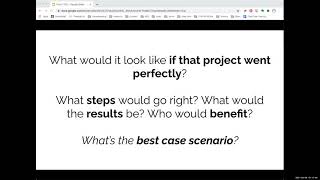
Translation Tutorial - Thinking Through and Writing About Research Ethics Beyond "Broader Impact"
Explore research ethics beyond "broader impact" in computing, focusing on lifecycle approaches and case studies to develop a more comprehensive ethical framework for technology projects.

Translation Tutorial - Data Externalities
Explore data externalities through case studies, examining privacy values, excessive sharing, low reimbursements, and data substitutability. Discuss collective bargaining as a potential solution.
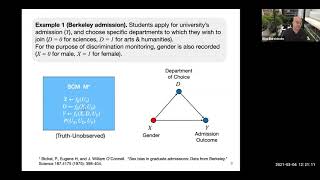
Translation Tutorial - Causal Fairness Analysis
Explore causal fairness analysis through structural causal models, examining real-world cases like university admissions and criminal justice predictions to understand and mitigate algorithmic bias.

Implications Tutorial - Using Harms and Benefits to Ground Practical AI Fairness Assessments
Explore practical AI fairness assessments in finance using a harms and benefits approach. Learn methodologies, case studies, and strategies for evaluating system objectives and performance.

Responsible AI in Industry - Lessons Learned in Practice
Explore practical lessons on implementing responsible AI in industry, covering explainability, fairness, and challenges faced by major tech companies.

Power in Political Philosophy - Nature and Justification
Explore the nature and justification of power in political philosophy, examining concepts like power over, power to, modalities, structure, agency, and legitimacy.
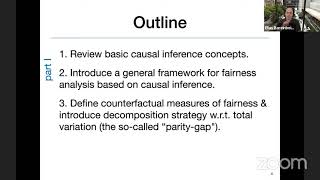
Translation Tutorial - Causal Fairness Analysis
Explore causal fairness analysis in AI, covering structural causal models, causal diagrams, and demographic disparities. Learn why causality matters and how to address fairness challenges in artificial intelligence.

Implications Tutorial - AI on the Ground Approach
Explore the real-world impact of AI through case studies, examining challenges, harms, and social implications. Learn strategies for studying AI's effects on communities and society.

Algorithms, Accountability and Journalism
Explore algorithmic accountability in journalism with Julia Angwin. Discover The Markup's innovative approaches to privacy, data analysis, and investigative reporting on tech companies and societal impacts.

When the Umpire is also a Player - Bias in Private Label Product Recommendations on E-commerce Marketplaces
Explore bias in e-commerce product recommendations, focusing on private labels. Analyze exposure bias and sponsored recommendations to understand fairness implications in online marketplaces.
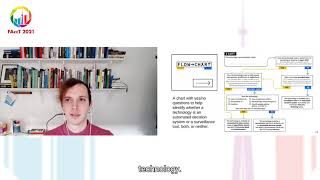
An Action-Oriented AI Policy Toolkit for Technology Audits by Community Advocates and Activists
Explore a toolkit for community advocates to audit AI technologies, focusing on algorithmic equity, policy implications, and practical assessment methods for identifying potential biases and injustices.

Outlining Traceability - A Principle for Operationalizing Accountability in Computing Systems
Explore traceability as a key principle for accountability in computing systems, focusing on voting machines and their vulnerabilities, with insights on implementation and future challenges.