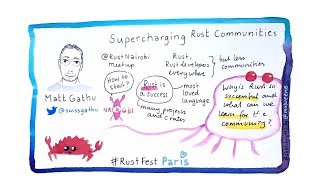
Supercharging Rust Communities
Explore strategies for growing Rust communities worldwide, drawing inspiration from the Rust project's success and Rust Nairobi's journey. Learn to foster inclusivity and collaboration in tech communities.
Immutable Data Structures and Why You Want Them
Explore immutable data structures in Rust: their benefits, implementation, and performance advantages. Learn about innovative alternatives to standard library structures for efficient immutable operations.
A QUIC Future in Rust
Explore QUIC protocol implementation in Rust, its advantages over HTTP/2, and the future of serverside Rust using the futures ecosystem.
A Rust Crate that Also Quacks Like a Modern C++ Library
Explore API design patterns for seamless integration of Rust crates into C++ codebases, focusing on encoding_rs as a case study for cross-language compatibility in systems programming.

Bringing Intel SGX to the Rust Ecosystem
Explore Rust SGX SDK: combining Intel SGX and Rust for enhanced security. Learn about porting Rust std, crates, and Xargo support for x86_64-unknown-linux-sgx platform.
Vector Graphics Rendering on the GPU in Rust with Lyon
Explore GPU-based vector graphics rendering with Lyon, a Rust tool for games and applications. Learn about tessellation, challenges, and future developments in 2D graphics.
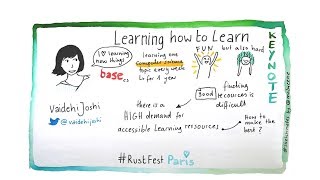
Learning How to Learn
Explore a powerful technique for effective learning in tech and beyond, empowering you to adapt in the fast-paced industry and acquire new skills efficiently.
Scalable Networking with Rust
Discover how to build efficient real-time networking applications using Rust, MIO, and thread pools. Learn techniques for achieving 10X+ memory and CPU efficiency in backend systems.
Building Reliable Infrastructure in Rust
Techniques for building reliable infrastructure in Rust: advanced testing methods, bias reduction, and maximizing bug detection efficiency for distributed systems and databases.
Increasing Rust's Reach Project Highlight
Discover the Increasing Rust's Reach initiative: its goals, experiences, and impact on the Rust community. Learn from project leaders about expanding Rust's accessibility and inclusivity.
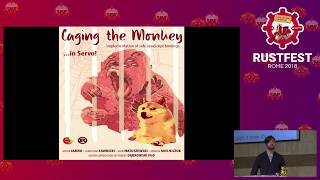
Caging the SpiderMonkey - Ensuring Safe JS Bindings in Servo
Explore challenges and solutions in integrating SpiderMonkey with Servo, focusing on Rust's type system for enforcing safety rules and developing a custom compiler plugin for error verification.

Grappling with Growth, and Other Good Problems to Have
Aaron Turon discusses Rust's growth, challenges, and future plans, addressing stakeholders, governance, and product development as the language evolves beyond its 2018 edition.
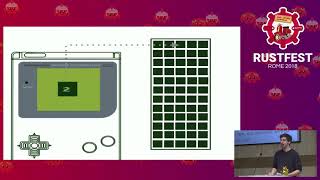
Oh Boy! Creating a Game Boy Emulator in Rust
Explore Game Boy emulator creation in Rust, covering hardware aspects, implementation techniques, and deployment across multiple platforms including web browsers and mobile devices.
Declarative Programming in Rust
Explore declarative programming in Rust: techniques for better abstraction, maintainability, and code clarity. Learn from examples and apply to your own projects.
Rust, For Science!
Explore Rust's potential in scientific computing: its strengths, weaknesses, and areas for improvement. Learn about the language's applications in research and data science.
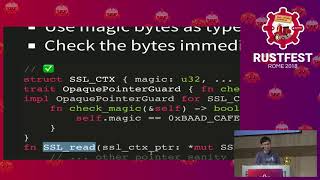
One Thousand Ways to Die in Rust FFI
Explore common pitfalls in Rust FFI, learn principles for writing safe and correct code, and discover effective strategies to avoid potential issues when working with foreign function interfaces.

Simple CRDT in Rust
Explore implementing a CRDT shopping list CLI in Rust, covering data types, state-based approach, composition, and API design with practical code examples and documentation.

Fun with Rusty Robots
Explore Rust programming for autonomous robots across various platforms, from bare metal to Linux and real-time OS, with practical insights for robotic competitions.
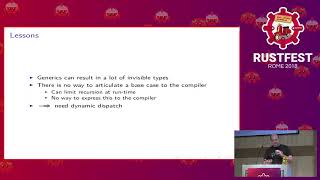
Sequoia - A New OpenPGP Implementation in Rust
Explore Sequoia, a new OpenPGP implementation in Rust, focusing on usability and security. Learn about challenges faced and solutions in API design, infinite types, and streaming iterators.
Behind the Scenes of Producing an Executable
Explore the journey from Rust code to executable, uncovering the transformation process through various stages and examining the resulting RISC-V assembly code.
Zbus - Yet Another D-Bus Library
Explore zbus, a new D-Bus library for Rust. Learn about its design goals, development challenges, and solutions for efficient inter-process communication on Linux systems.