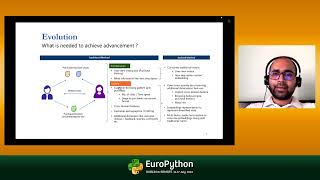
A Network Embeddings Based Recommendation Model with Multi-Factor Consideration
Explore a novel recommendation model using network embeddings and multi-factor analysis. Learn about knowledge transfer across implicit and explicit factors for improved accuracy in real-world applications.

Developers Documentation - Your Secret Weapon
Discover how high-quality documentation can be a powerful tool for product adoption and growth. Learn principles for creating solid, educational content that enhances the developer experience and community engagement.
Common Python Mistakes with Kubernetes - How They Can Cause Vulnerabilities and How to Solve Them
Explore common Python vulnerabilities in Kubernetes deployments, their potential impacts, and effective mitigation strategies using tools like Falco, TUF, Open Policy Agent, and Bandit.

ShapePipe - A Modular Weak-Lensing Processing and Analysis Pipeline
Explore a Python-based pipeline for analyzing weak gravitational lensing, aiding cosmologists in understanding dark matter and dark energy through precise galaxy shape measurements.
Correlating Messy Data with "Correlate"
Discover a novel scoring algorithm and clever heuristics for matching items in messy real-world data sets with inexact string matches, solving data correlation challenges efficiently.
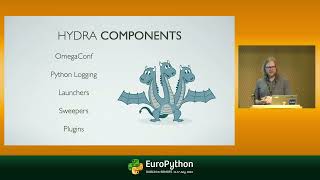
Managing Complex Data Science Experiment Configurations with Hydra
Learn to manage complex data science experiments efficiently using Hydra, an open-source framework that simplifies configuration handling, enhances traceability, and improves reproducibility with minimal boilerplate code.
Simple Data Validation and Setting Management with Pydantic
Learn efficient data validation and setting management using Pydantic. Explore models, validators, and converters with real-life examples to enhance code readability and prevent processing errors.
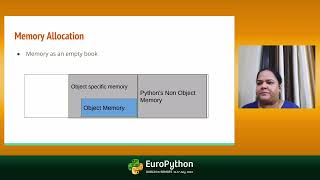
Memory Problems, Did Collector Forget to Clean the Garbage?
Explore Python memory management, common errors, and optimization techniques. Learn about CPython's allocation, garbage collection, and practical ways to improve code efficiency.
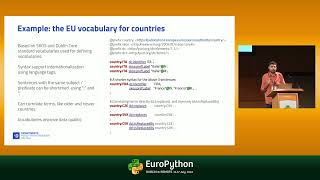
Self-Explaining APIs
Strategies and tools for creating semantically interoperable REST APIs, including contract-first development, RDF processing, and centralized catalogs. Ideal for those with API design experience.
Async Django
Explore asynchronous programming in Django, covering key concepts, tools, efficient practices, and Django's async request handling from NGINX to database operations.
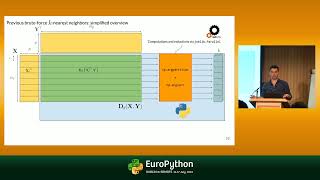
Scaling scikit-learn - Introducing New Sets of Computational Routines
Discover recent performance improvements in scikit-learn, exploring computational patterns, new routine implementations, and future hardware-specialized developments for enhanced machine learning efficiency.
Online Voting System Used for Primary Elections for the French Presidential - Must Be Secure Right?
Analyse critique du système de vote en ligne Neovote utilisé pour les élections primaires présidentielles françaises, examinant ses revendications de sécurité et ses vulnérabilités potentielles.
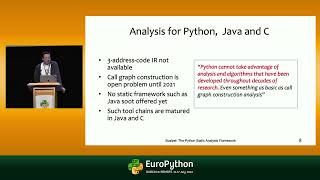
Scalpel - The Python Static Analysis Framework
Explore Scalpel, a Python static analysis framework offering essential functions for developers to implement problem-focused analyzers, including control-flow graphs and scope analysis.
Debugging Asynchronous Programs in Python
Explore powerful debugging techniques for asynchronous Python programs, including asyncio debug mode, tracebacks for unhandled exceptions, and monitoring tools for enhanced development efficiency.
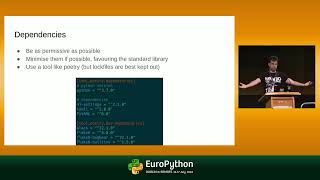
Lessons Learnt from Building My Own Library
Insights and lessons from a developer's journey in creating a Python library, covering decision-making processes, common pitfalls, and valuable experiences for aspiring library creators.
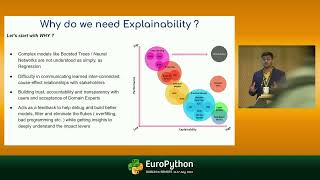
Synergize AI and Domain Expertise - Explainability Check with Python
Explore model explainability using SHAP algorithm in Python, focusing on building trustworthy AI models and integrating domain expertise for practical industry applications.
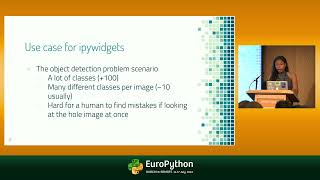
Creating Great User Interfaces on Jupyter Notebooks with Ipywidgets
Learn to create user-friendly interfaces in Jupyter Notebooks using ipywidgets, enabling data scientists to build interactive tools without extensive front-end skills or deployment concerns.
Real-Time Browser-Ready Computer Vision Apps with Streamlit
Learn to build real-time computer vision applications for browsers using Streamlit and streamlit-webrtc, with demos of object detection, speech-to-text, and style transfer.
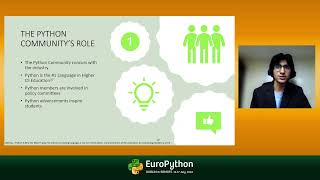
Revolutionizing Education - How Python is Essential Beyond Computer Science
Explore the integration of Python in non-computing fields, its impact on student understanding, and the potential to revolutionize education across disciplines. Gain insights from case studies and recommendations for implementation.
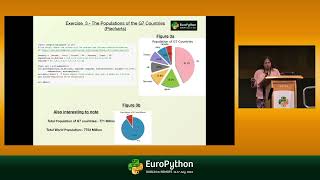
Creating the Next Generation of Billionaires - Part 4
Explore how young people use Python to analyze real-world issues like climate change and population growth, showcasing the impact of early programming education on problem-solving skills.
Lint All the Things!
Explore how linting tools like flake8, import linter, and pre-commit can automate code conventions, improve code quality, and streamline development processes for more efficient and focused coding.