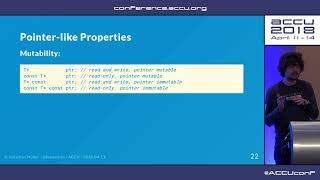
I Just Wanted to Point to Something
Comprehensive guide to pointer-like types in C++, exploring when to use references, pointers, smart pointers, and other alternatives for efficient and correct object referencing.
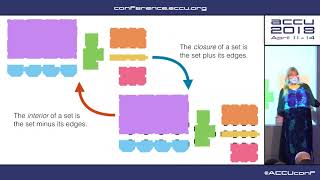
The Shape of a Program
Explore topology's application to programming, viewing code as a shape in time, space, causality, and possibility. Gain insights into program structure and design.
If You’re Happy and You Know It - Inside the Mind of a Developer
Explore the complexities of IT project communication, bridging the gap between developers and business stakeholders to improve understanding and avoid common pitfalls.
Debug C++ Without Running
Explore advanced C++ debugging techniques without running code, focusing on macros, templates, and preprocessor challenges. Learn IDE-based solutions for improved code analysis and development.
Hacker’s Guide to Rust Programming
Explore Rust's core concepts, including ownership, borrowing, traits, and error handling. Learn to build safe, fast, and concurrent systems with hands-on demos and essential tools.
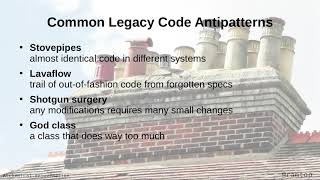
Alchemical Code Rejuvenation
Hands-on workshop exploring techniques to refactor legacy code efficiently, focusing on separating and disentangling small bits of code at a time without risky rewrites. Learn to apply TDD for sustainable design in big code bases.
C++ API & ABI Versioning
Explore C++ API & ABI versioning techniques, focusing on compatibility, breaking changes, and versioning strategies to maintain libraries and adapt to client needs over time.
What's New About Fake News
Explore the interplay of technology and psychology in the spread of misinformation, and discover potential solutions to combat fake news in the digital age.
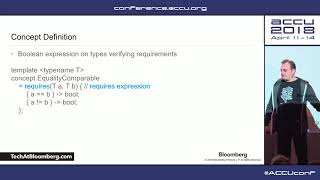
Concept Based Testing
Explore generic testing in C++17 using concepts, detection idiom, and constexpr if to verify concept implementations and guide class development for robust generic programming.
Hacker’s Guide to Web Assembly
Explore WebAssembly's basics, speed advantages, and applications. Learn how to build web apps using C/C++/Rust, with live demos and coding examples for a hands-on understanding of this powerful technology.
Total War - How AI Can Deliver Entertainment
Explore AI techniques in Total War games, focusing on Monte Carlo Tree Search, profiling, and optimization for complex strategy environments with limited resources.
The Fantastic Four Coding Patterns of Continuous Delivery
Discover four Continuous Delivery coding patterns that increase development speed without sacrificing quality or safety, as learned from experiences in Formula 1 racing software development.
Building Modern Native Applications with Gradle
Explore modern native application development using Gradle, covering C/C++, D, Rust, Go, cross-platform builds, and integration with tools like GNU Make, CMake, Doxygen, and Conan.
Turtles! Hill Climbing! Hammers! Paper Bags!
Explore optimization techniques through turtle graphics, from hill climbing to simulated annealing, laying the groundwork for understanding neural networks and machine learning concepts.
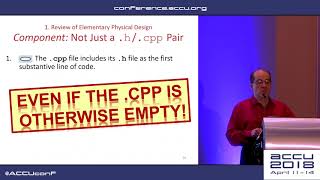
C++ Modules and Large-Scale Development
Explore C++ modules' impact on program architecture, code organization, and large-scale development, covering migration strategies and design principles for improved software structure.
Creating an Incremental Architecture for Your System
Learn to create flexible software architecture incrementally, balancing upfront design with adaptability. Discover techniques for evolving system design as requirements change, focusing on key qualities and delaying non-critical decisions.
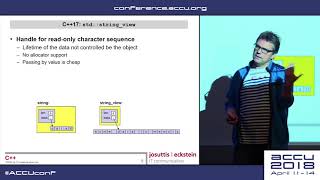
C++ Templates Revised
Explore modern C++ templates, discussing new features, style recommendations, and practical implications for application programmers in generic programming.
Class Template Argument Deduction in C++17
Comprehensive introduction to Class Template Argument Deduction in C++17, covering usage, benefits, pitfalls, and language rules for cleaner, shorter code in both standard library and custom classes.
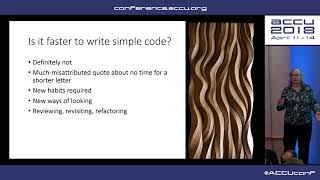
Simplicity - Not Just for Beginners
Explore techniques for writing simpler, more efficient C++ code, focusing on naming conventions, function length, and modern language features to improve readability and performance.
Linux User - Kernel ABI - The Realities of How C and C++ Programs Really Talk to the OS
Explore the intricacies of Linux system calls, signal handlers, pthreads, and ptrace. Gain insights into low-level interactions between C/C++ programs and the operating system for advanced debugging and optimization.
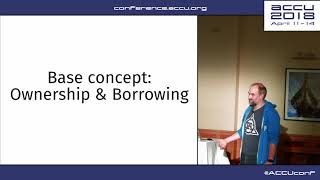
Three Years of Rust - A Look Around
Comprehensive overview of Rust's evolution, features, and industry adoption. Explores current capabilities, future developments, and changes since its inception.