
The Various Shades of Supply Chain - SBOM, N-Days and Zero Trust
Explore supply chain security challenges in semiconductors, focusing on SBOMs, N-day vulnerabilities, and Zero Trust principles to enhance transparency and mitigate risks in firmware development.

SOWalker - An I-O-Optimized Out-of-Core Graph Processing System for Second-Order Random Walks
Innovative system for efficient second-order random walks in large-scale graph processing, featuring I/O optimization techniques to enhance performance and scalability on a single machine.
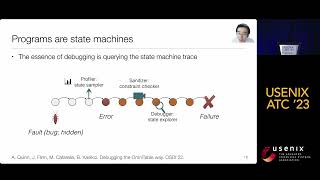
The Hitchhiker's Guide to Operating Systems
Innovative approach to teaching operating systems using state transition systems, featuring a minimal OS model with nine system calls and tools for exploring system behaviors.
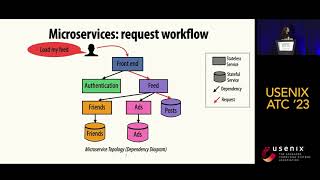
Lifting the Veil on Meta's Microservice Architecture - Analyses of Topology and Request Workflows
Comprehensive analysis of Meta's microservice architecture, revealing insights on topology, request workflows, and challenges in large-scale distributed systems. Implications for tool development and future research opportunities.

Bifrost - Analysis and Optimization of Network I-O Tax in Confidential Virtual Machines
Analysis and optimization of network I/O performance in confidential virtual machines, focusing on reducing overhead through innovative para-virtualized I/O design and packet processing techniques.
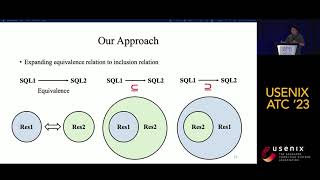
Pinolo - Detecting Logical Bugs in Database Management Systems with Approximate Query Synthesis
Innovative approach to detect logical bugs in DBMSs using query synthesis for approximate result sets, overcoming limitations of existing methods and uncovering hidden issues.

Overcoming the Memory Wall with CXL-Enabled SSDs
Explores using flash memory with CXL to overcome memory limitations. Discusses design, caching, and prefetching techniques to enhance performance and longevity of CXL-enabled flash devices.
AutoARTS - Taxonomy, Insights and Tools for Root Cause Labelling of Incidents in Microsoft Azure
Comprehensive study on incident root causes in Microsoft Azure, proposing a novel hierarchical taxonomy and automated labeling tool to improve postmortem analysis and prevent future incidents.

MELF - Multivariant Executables for a Heterogeneous World
Explore MELF: a novel approach for including multiple function variants in a single binary, enabling runtime switching for optimized performance across heterogeneous systems.
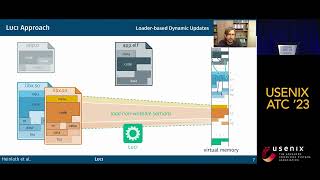
Luci - Loader-based Dynamic Software Updates for Off-the-shelf Shared Objects
Explore Luci, a lightweight technique for dynamically updating shared libraries during runtime without service interruptions or source modifications, enhancing security and availability in software systems.
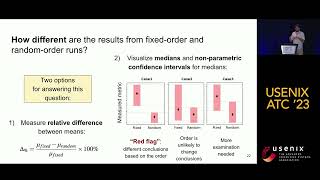
Avoiding the Ordering Trap in Systems Performance Measurement
Explores the impact of trial ordering on systems performance experiments, revealing hidden biases and proposing methods to detect and mitigate ordering effects in research studies.
Revisiting Secondary Indexing in LSM-based Storage Systems with Persistent Memory
Explores PERSEID, an efficient secondary indexing mechanism for LSM-based storage systems using persistent memory, offering improved performance over existing techniques.

TC-GNN - Bridging Sparse GNN Computation and Dense Tensor Cores on GPUs
Innovative framework accelerating graph neural networks using GPU Tensor Core Units, reconciling sparse GNN computation with dense TCUs for improved performance in graph-based machine learning.

Deploying User-space TCP at Cloud Scale with LUNA
Explore LUNA, a high-performance user-space TCP stack deployed at Alibaba Cloud, offering significant improvements in throughput and latency compared to kernel-based and other user-space solutions.

Towards Iterative Relational Algebra on the GPU
Explores GPU-based iterative relational algebra for high-performance data analytics, presenting a novel hash-join implementation with optimizations for memory access and deduplication, outperforming existing solutions.

Nodens - Enabling Resource Efficient and Fast QoS Recovery of Dynamic Microservice Applications in Datacenters
Explore Nodens, a runtime system for fast QoS recovery in dynamic microservice applications, featuring traffic-based monitoring, blocking-aware load updating, and efficient query draining.

Adaptive Online Cache Capacity Optimization via Lightweight Working Set Size Estimation at Scale
Explore Cuki, an innovative data structure for efficient cache optimization in big data applications, improving accuracy and performance in distributed file caching systems.
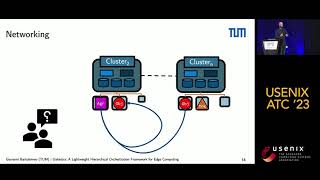
Oakestra - A Lightweight Hierarchical Orchestration Framework for Edge Computing
Lightweight, hierarchical orchestration framework for edge computing, offering reduced resource usage and improved performance through federated management and semantic overlay networking.

Cyclosa - Redundancy-Free Graph Pattern Mining via Set Dataflow
Innovative framework for efficient graph pattern mining, eliminating redundancies through set dataflow representation and parallel execution, outperforming existing systems in various scenarios.
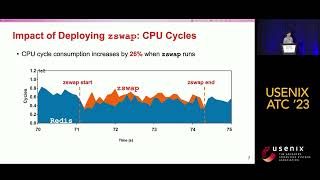
STYX - Exploiting SmartNIC Capability to Reduce Datacenter Memory Tax
Innovative framework offloading memory optimization tasks to SmartNICs, reducing server CPU load and cache pollution while maintaining efficiency. Demonstrates significant latency improvements for co-running applications.

Comosum - An Extensible, Reconfigurable, and Fault-Tolerant IoT Platform for Digital Agriculture
Explore an innovative IoT platform for digital agriculture, featuring extensible architecture, fault tolerance, and edge analytics for sustainable farming and increased productivity.