
Concurrency and Parallel Computing in JavaScript
Explore concurrency and parallel computing in JavaScript, covering actors, futures, and throughput computing in browsers. Learn techniques for leveraging modern parallel hardware in web development.

Taking PHP Seriously
Exploring PHP's unique design choices in programmer workflow, concurrency, and shared state, highlighting its strengths and impact on successful projects like Facebook and WordPress.
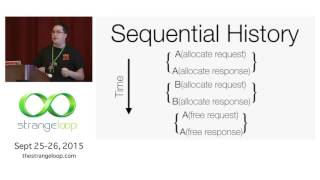
Using Race Conditions in Correct Concurrent Software
Explore how race conditions can be leveraged to improve performance in concurrent systems, focusing on lock-free algorithms and high-throughput lock acquisition techniques.

Haxl - A Big Hammer for Concurrency
Explore Haxl, Facebook's framework that flips the default from sequential to concurrent programming, enhancing I/O, concurrency, testing, and debugging in software development.

Concurrency Options on the JVM
Explore JVM concurrency options, from Java's ExecutorService to Scala's akka actors and Clojure's core.async. Learn design strategies for deadlock-free, efficient concurrent applications.

Level Up Your Concurrency Skills With Rust
Explore Rust's approach to safe concurrent programming, learning how it catches errors at compile time and enhances your skills across languages. Gain insights into race conditions and memory safety.
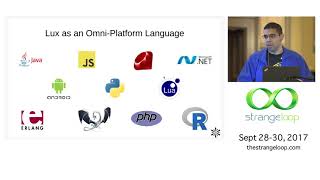
The Lux Programming Language
Explore Lux: a functional, statically-typed Lisp for multiple platforms. Learn about its features, philosophy, and potential impact on programming paradigms and meta-programming.

When "Worst" is Best in Distributed Systems
Explore how designing distributed systems for worst-case network behavior can paradoxically improve typical performance, with practical lessons for web, transaction processing, and database applications.

Unconventional Programming with Chemical Computing
Explore unconventional programming through chemical computing metaphors. Learn artificial chemical computing basics, high-order concepts, and innovative problem-solving approaches using Clojure for demonstrations.

A Tour of Go for the C# Developer
Explore Go's unique features from a C# perspective, including concurrency, error handling, and syntax differences, through building an application with concurrent operations.
C++ Parallel Programming Models
Explore C++'s parallel programming models: unstructured, task-based, and data parallel. Learn key facilities, use cases, and recent features for efficient parallel programming in modern C++.

Kotlin Coroutines - New Ways to Do Asynchronous Programming
Explore Kotlin coroutines for efficient asynchronous programming. Learn about suspend functions, coroutine builders, and structural concurrency to simplify complex async operations and improve code readability.
Rust for C++ Developers - What You Need to Know to Get Rolling With Crates
Explore Rust's advantages over C++ for safe, concurrent programming. Learn about ownership, enums, traits, and using external packages to write elegant code.

Why Databases Cry at Night
Explore NoSQL database performance, examining common features' impact and inherent bottlenecks to understand why databases struggle and how to optimize them.

The Voight-Kampff Test for Discovering Web Application Vulnerabilities
Explore techniques to differentiate between human-discovered and machine-detected web app vulnerabilities, with insights on manual setup, chain exploits, and real-world case studies.
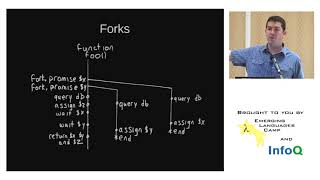
Qbrt Bytecode - Interface Between Code and Execution
Explore Qbrt bytecode's innovative approach to language design, featuring built-in concurrency, asynchronous I/O, and multiple dispatch, aimed at simplifying complex runtime features for developers.

Racing the Dark - A New TOCTTOU Story From Apple's Core
Unveils macOS kernel vulnerabilities, highlighting memory mapping issues and race conditions that bypass security updates. Emphasizes the need to reevaluate macOS/iOS memory mapping mechanisms.
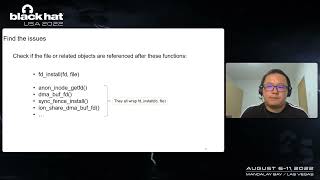
Devils Are in the File Descriptors - It Is Time To Catch Them All
Explore vulnerabilities in Linux kernel file descriptor operations, focusing on high-risk scenarios in exporting and importing, and learn to identify and address these security concerns.
GPU Programming with Modern C++
Explore GPU programming with modern C++, covering parallelism fundamentals, heterogeneous computing, and SYCL for GPU dispatch. Learn to optimize performance and leverage multi-core architectures effectively.

Race Conditions in JavaScript Apps
Explore common race conditions in JavaScript and learn strategies to prevent them in real-time collaborative applications, based on practical experience.

Finagle Under the Hood
Explore Finagle's internals, including connection pooling, load balancing, and circuit breaking. Learn how servers and clients function in this extensible RPC system for JVM, used at Twitter.