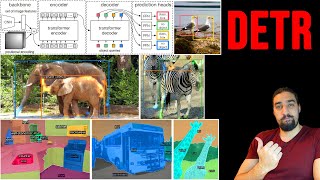
DETR- End-to-End Object Detection with Transformers - Paper Explained
Explore DETR, an innovative object detection approach using transformers. Learn about its architecture, matching loss, Hungarian algorithm, and impressive results in this comprehensive explanation.

Deep Drowsiness Detection Using YOLO, Pytorch and Python
Learn to implement drowsiness detection using YOLO, PyTorch, and Python. Covers object detection, model fine-tuning, and real-time application for driver safety.
Pose Estimation with the Fastest Python Deep Learning Model - MoveNet Lightning
Learn to implement real-time pose estimation using MoveNet Lightning, a fast Python deep learning model. Covers installation, TFLite integration, rendering results, and OpenCV implementation.

Sign Language Detection Using Action Recognition with Python - LSTM Deep Learning Model
Learn to build a sign language detection system using action recognition, LSTM, and Python. Extract keypoints, create datasets, train deep learning models, and make real-time predictions for sign language interpretation.

Body Segmentation with Python and Tensorflow BodyPix - AI Background Removal
Learn to create AI-powered virtual backgrounds using Python, OpenCV, and BodyPix. Segment your body in real-time, remove backgrounds, and apply custom virtual backgrounds without a green screen.
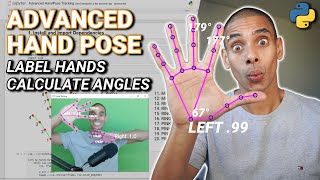
AI Hand Pose Estimation with MediaPipe - Detect Left and Right Hand and Calculate Angles
Learn advanced hand pose estimation using MediaPipe, OpenCV, and Python. Detect left/right hands, calculate joint angles, and render estimations for kinematic analysis and real-time applications.

AI Hand Pose Estimation with MediaPipe and Python
Learn to implement hand pose estimation using MediaPipe and Python. Set up the environment, detect hand poses in real-time, interpret results, and apply styling with OpenCV for enhanced visualization.
AI Body Language Decoder with MediaPipe and Python
Learn to decode body language using MediaPipe and Python. Build custom pose classification models to interpret facial and body landmarks in real-time with OpenCV, Pandas, and Scikit-Learn.

Python ANPR with OpenCV and EasyOCR - Automatic Number Plate Recognition Tutorial
Learn to build an Automatic Number Plate Recognition system using Python, OpenCV, and EasyOCR. Master image processing, contour detection, and optical character recognition for practical computer vision applications.
How to Represent Part-Whole Hierarchies in a Neural Network - Geoff Hinton's Paper Explained
Explore GLOM, a novel computer vision model combining transformers, neural fields, and capsule networks to dynamically construct parse trees for object recognition and scene understanding.
TransGAN - Two Transformers Can Make One Strong GAN - Machine Learning Research Paper Explained
Explore TransGAN, a novel approach using transformers for image generation. Learn about its architecture, key techniques, and competitive performance in various datasets.
NFNets - High-Performance Large-Scale Image Recognition Without Normalization
Explore Normalizer-Free Networks, a novel approach to image recognition that achieves state-of-the-art accuracy without batch normalization, offering faster training and improved transfer learning performance.

OpenAI CLIP- Connecting Text and Images
Detailed explanation of OpenAI's CLIP model, which connects text and images using contrastive learning on 400M image-text pairs, enabling zero-shot transfer to various computer vision tasks.

OpenAI DALL·E - Creating Images from Text - Blog Post Explained
Explore OpenAI's DALL·E model, its architecture, capabilities, and limitations in generating high-quality images from text descriptions. Learn about its potential impact on AI applications combining text and visuals.
LambdaNetworks- Modeling Long-Range Interactions Without Attention
Explore LambdaNetworks, a novel approach to modeling long-range interactions in AI without traditional attention mechanisms, offering improved efficiency and performance in computer vision tasks.
An Image is Worth 16x16 Words - Transformers for Image Recognition at Scale
Explore how Transformers outperform CNNs in image recognition, delving into Vision Transformer architecture, experimental results, and implications for AI research.
Axial-DeepLab - Stand-Alone Axial-Attention for Panoptic Segmentation
Explore a novel approach to image processing using axial-attention, combining positional embeddings and factorized self-attention to achieve state-of-the-art results in image segmentation tasks.
ImageNet Classification with Deep Convolutional Neural Networks - Paper Explained
Detailed explanation of AlexNet, the groundbreaking deep convolutional neural network that revolutionized computer vision and kickstarted the deep learning era in image classification.

Generative Adversarial Networks - Paper Explained
Explore the groundbreaking Generative Adversarial Networks paper, covering its innovative approach, theoretical foundations, and practical implications for AI-driven image generation and deep learning advancements.

Deep Residual Learning for Image Recognition - Paper Explained
Explore deep residual learning for image recognition, covering the problem of depth, residual connections, and their impact on neural network performance in computer vision tasks.
Author Interview - VOS- Learning What You Don't Know by Virtual Outlier Synthesis
Interview exploring Virtual Outlier Synthesis for out-of-distribution detection in neural networks. Discusses motivations, methodology, and key findings of novel approach to improve model robustness using synthesized outlier data.