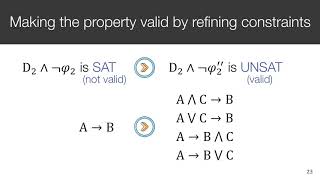
Transys - Leveraging Common Security Properties Across Hardware Designs
Explore hardware security validation techniques and learn how to leverage common security properties across different designs using Transys, improving efficiency in vulnerability detection.

Formal Modelling and Proof in the CHERI Design and Implementation Process
Explore rigorous engineering methods for developing secure processor architecture, focusing on CHERI's hardware capabilities for fine-grained memory protection and secure compartmentalization.

Dragonblood - Analyzing the Dragonfly Handshake of WPA3 and EAP-pwd
Analyze vulnerabilities in WPA3 and EAP-pwd protocols, exploring attacks on clients and access points, information leakage, and potential solutions for Wi-Fi security.

The 9 Lives of Bleichenbacher's CAT - New Cache Attacks on TLS Implementations
Explores novel cache-based attacks on TLS implementations, demonstrating vulnerabilities in popular systems and introducing a parallelization technique for padding oracle attacks against RSA.
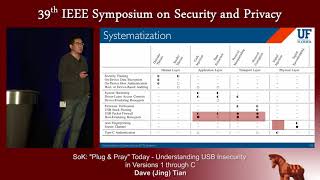
Plug & Pray Today - Understanding USB Insecurity in Versions 1 through C
Comprehensive overview of USB security vulnerabilities and defenses across multiple layers, analyzing attacks, countermeasures, and the USB Type-C Authentication protocol's limitations.
CacheOut - Leaking Data on Intel CPUs via Cache Evictions
Explore Intel CPU vulnerabilities, focusing on CacheOut attack, its mechanisms, potential targets, and countermeasures for enhanced system security.
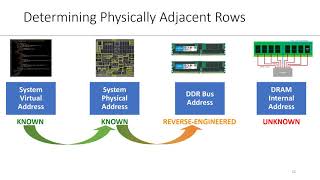
Are We Susceptible to Rowhammer? An End-to-End Methodology for Cloud Providers
Comprehensive methodology for cloud providers to assess DRAM vulnerability to Rowhammer attacks, including near-optimal instruction sequences and row adjacency mapping techniques for modern Intel platforms.
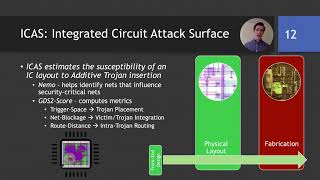
ICAS - An Extensible Framework for Estimating the Susceptibility of IC Layouts to Additive Trojans
Explore an extensible framework for assessing IC layout vulnerability to additive trojans, covering hardware security, development processes, and preventive measures.
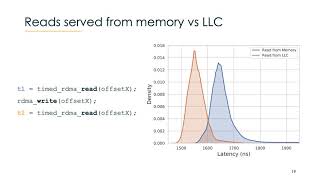
NetCAT - Practical Cache Attacks from the Network
Reverse engineering DDIO to demonstrate NetCAT, a network-based cache attack enabling remote keystroke timing attacks and covert channels, highlighting security risks in modern Intel processors.
Heap Models for Exploit Systems
Formal modeling of heap exploits as abstract machines, exploring physical and logical heap properties to express attacks as reachability problems in specific heap configurations.
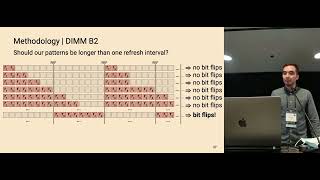
Blacksmith- Compromising Target Row Refresh by Rowhammering in the Frequency Domain
Explore frequency-domain Rowhammer attacks bypassing Target Row Refresh, with insights on mitigations, experiments, and scalable solutions for compromising DRAM security.
How DevOps Becomes DevOpsSec - Chris Raethke, Bugcrowd Webinar
Explore how DevOps evolves into DevOpsSec, integrating security into development processes. Learn strategies for effective implementation and team collaboration.
Car Hacking Explained for Bug Hunters - Automotive Security Vulnerabilities and Methodologies
Explore automotive security vulnerabilities, from IoT to CAN bus hacking. Learn methodologies, attack surfaces, and bug prioritization for car hacking, covering infotainment systems, APIs, and mobile apps.
Shifting Engineering Right - Security Engineers Learning from DevSecOps
Explore how security engineers can enhance their skills by adopting DevSecOps principles, focusing on collaborative feature development and bidirectional knowledge transfer between teams.
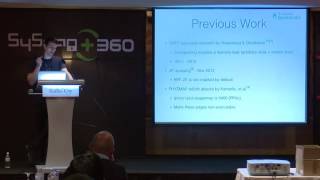
Practical SMEP Bypass Techniques
Explore practical techniques for bypassing Supervisor Mode Execution Prevention (SMEP) in system security, enhancing your understanding of kernel exploitation and protection mechanisms.
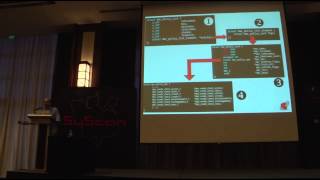
BadXNU - Exploiting Vulnerabilities in Apple's XNU Kernel
Explore vulnerabilities in Apple's XNU kernel, uncovering security flaws and potential exploits in iOS and macOS systems.
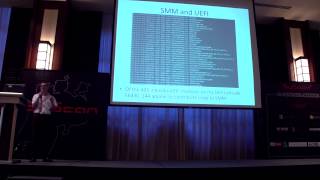
Setup for Failure - Defeating Secureboot
Explore techniques for bypassing Secureboot security measures in this technical presentation, uncovering vulnerabilities and potential exploits in system protection mechanisms.
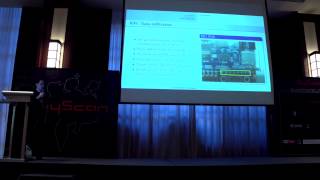
Deep Submicron Backdoor - SyScan'14 Singapore
Explore deep submicron backdoors in hardware security, examining vulnerabilities and potential exploits at the microscopic level of integrated circuits.
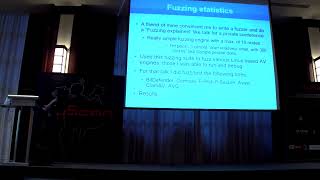
Breaking Antivirus Software - Security Vulnerabilities and Exploits
Explore techniques for exploiting vulnerabilities in antivirus software, uncovering potential security flaws and weaknesses in these critical defense systems.

The State of Memory Safety - Fireside Chat
Experts discuss memory safety vulnerabilities, their impact on modern computing, and strategies for protection. Explores current landscape, challenges, and progress in addressing this critical security issue.
How Geopolitical Change Affects Computer Security and Privacy for Vulnerable Populations
Explores how geopolitical changes impact computer security and privacy for vulnerable populations, examining case studies and recommending design strategies to reduce vulnerability during times of crisis and change.