Portable Graphics Abstraction in Rust with gfx-rs
Explore gfx-rs, a Rust-based graphics abstraction library bringing Vulkan everywhere. Learn about its history, features, and future roadmap for portable graphics development.
Testing in Rust - A Primer in Unit Testing and Mocking
Explore Rust's built-in testing tools and learn how to mock complex dependencies using the double crate, with examples ranging from simple to real-world scenarios.
GStreamer and Rust - Fast, Safe and Productive Multimedia Software
Explore GStreamer's integration with Rust for safer, performant multimedia development. Learn about application and plugin creation, current capabilities, and future plans for this powerful framework.
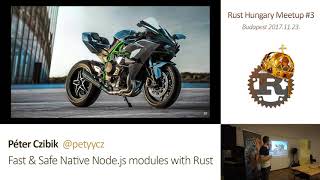
Fast and Safe Native Node.js Modules with Rust - Rust Hungary 2017
Explore creating fast, safe native node.js modules using Rust and NEON wrapper library. Learn techniques for improved performance and security in node.js applications.
Oxidation - How Rust Code Was Integrated into Firefox
Explore the journey of integrating Rust into Firefox, from initial steps to shipping Rust components in production, highlighting key milestones and future plans for the browser.
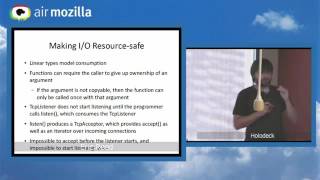
An I/O System for Rust - Design and Implementation
Explore Rust's I/O system, covering multithreading, scheduling, traits, and resource safety in this comprehensive overview by Eric Reed from the Rust Research team.
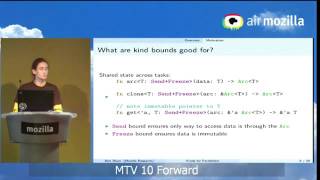
Types of Types in Rust
Explore Rust's type system, including kind bounds, traits, closures, and existential types. Learn advanced concepts for more effective Rust programming.
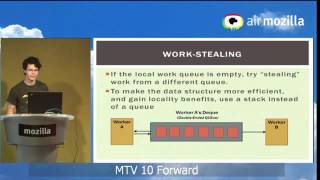
A Work-stealing Runtime for Rust
Explore Rust's work-stealing runtime for efficient task scheduling and parallel execution, featuring lock-free code and performance benchmarks.
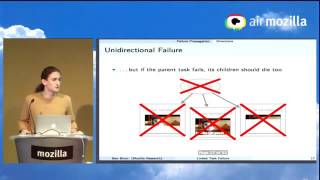
Parallel Programming with Failure in Rust
Explore parallel programming techniques in Rust, focusing on handling failures and static typeclass methods for robust and efficient code development.
Handsome Macros in Rust - Intern Presentation
Explore advanced Rust topics: macros, code coverage, sandboxing, and applied statistics. Gain insights from Mozilla experts on enhancing Firefox's performance and security.
Rust Typeclasses - Trait-Based Programming
Explore Rust's trait system and its similarities to typeclasses in functional programming languages, presented by researcher Lindsey Kuper.
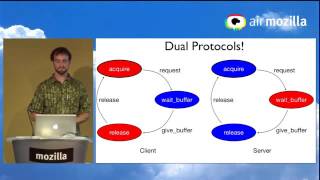
Message Passing in Rust - Fast and Safe Implementation
Explore fast and safe message passing techniques in Rust programming language, enhancing concurrent system development skills.
Rewriting Scientific Computing Tools in Rust - Challenges and Lessons Learned
Exploring Rust's potential in scientific computing by rewriting linear algebra, complex functions, and FFT from Octave. Discusses challenges, benefits, and lessons learned in improving scientific tools.
Techniques for Writing Concurrent Applications with Asynchronous I/O in Rust
Explore asynchronous I/O techniques for concurrent applications, covering architecture changes, code idioms, and API design in Rust. Learn from real-world experience developing a web framework.

Teaching Rust Through Coordinate System Transforms and FFI
Learn Rust by building a coordinate transformation library, exploring multithreading, FFI, performance optimization, and integration with dynamic languages. Gain insights into systems programming from a dynamic language perspective.
Panopticon: A Libre Cross-Platform Disassembler in Rust
Explore Panopticon: a libre cross-platform disassembler in Rust. Learn its architecture, features, and how Rust enhances development for reverse engineering and vulnerability discovery.
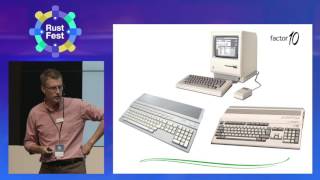
Martin Hellspong - Using QuickCheck for Rust Porting: Lessons from a CPU Emulator Project
Explore QuickCheck's role in porting a CPU emulator to Rust, addressing challenges, compiler issues, and language tradeoffs from a multi-language developer perspective.
Sensors, Servos, and Signals with Rust for IoT Development
Explore IoT with Rust: control servos, read sensors, and use protocols like SPI and I2C. Learn to create fault-tolerant embedded devices accessible from the cloud using Tessel microcontroller.
Subtyping in Rust - Magic and Misconceptions
Explore Rust's subtyping, variance, and advanced data structure concepts with Felix Klock. Gain insights into Rust's unique approach to type systems and memory safety.

Bridging Ruby and Rust
Explore the integration of Ruby and Rust programming languages, focusing on their synergies and practical applications in software development.
Traits and Types in Rust - PDXRust May 2016
Explore Rust's type system, traits, and custom implementations. Learn about basic and built-in types, methods, constructors, and useful traits from the standard library.