Protein Design Workflows Employing Reinforcement Learning and Preference Optimization - Tutorial 4
Explore protein design workflows using reinforcement learning and preference optimization techniques for advanced molecular engineering.
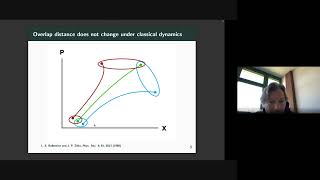
Detection of Quantum Chaos with Quantum Hamming Distance
Explore quantum chaos detection using Quantum Hamming Distance, uncovering state sensitivity in quantum theory and challenging traditional beliefs about quantum evolution.
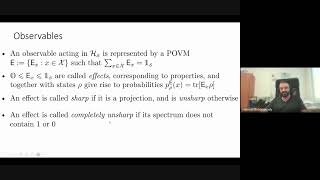
Quantum Measurements Constrained by the Third Law of Thermodynamics
Explore quantum measurements' compatibility with the third law of thermodynamics. Examine implications for ideal and repeatable measurements, and their impact on quantum reality concepts.
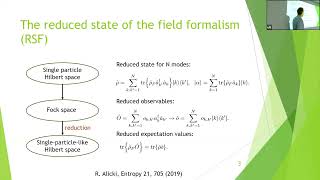
Mesoscopic Description of Entanglement of Bosonic Fields and Its Open Evolution
Explore mesoscopic descriptions of entanglement in bosonic fields, focusing on simplified models that capture non-classical phenomena for photonic quantum computing and communication.

Transforming Hearing Aids Into Multifunctional Communication and Health Devices with Artificial Intelligence - 8 May 2024
Explore AI-powered advancements in hearing aid technology, transforming them into multifunctional communication and health devices for enhanced user experience.
Nonequilibrium: From Heat Conduction to Turbulence and Life - Rothschild Lecture
Explore nonequilibrium phenomena from heat conduction to turbulence, with insights on mathematical approaches and potential applications to life systems.
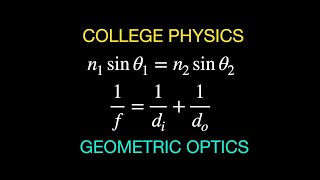
Physics Summary Chapter 25: Geometric Optics
Explore fundamental principles of geometric optics, including reflection, refraction, lenses, and mirrors. Learn how light behaves and forms images in various optical systems.

Orders Perissodactyla and Cetartiodactyla - Lecture 7.3
Explore the unique characteristics and evolutionary history of odd-toed ungulates and even-toed ungulates, including whales and dolphins.
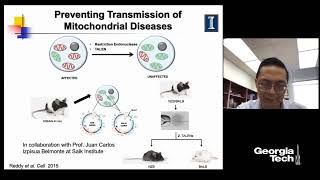
Challenges and Opportunities at the Nexus of Synthetic Biology, Machine Learning, and Automation
Explore challenges and opportunities at the intersection of synthetic biology, machine learning, and automation for rapid prototyping and manufacturing of biological systems in bioproduct synthesis.
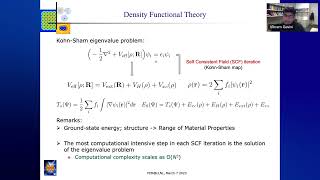
Fast, Accurate and Large-scale Ab-initio Calculations for Materials Modeling
Explore advanced computational methods for large-scale density functional theory calculations using adaptive finite-element discretization, enhancing materials modeling capabilities.
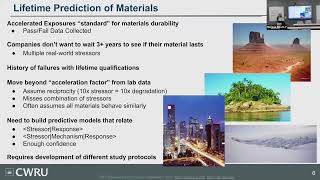
Materials Data Science Approach for Reliability: Materials to Systems
Explore materials data science for reliability prediction, focusing on degradation mechanisms and stressors in complex systems like PV modules. Learn FAIRification and modeling techniques for lifetime forecasting.
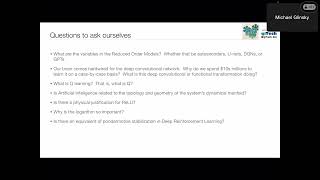
A Physics-Based Reduced Order Model Capturing the Topology of Dynamical Manifolds
Explore a transformational approach to dynamics using the Heisenberg Scattering Transformation, applied to create fast surrogate models for 2D pulsed power liner implosions in MagLIF.
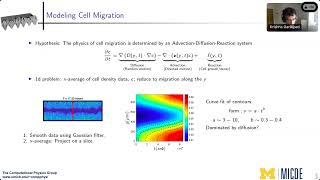
Fokker-Planck-Inverse Reinforcement Learning
Explore Fokker-Planck-Inverse Reinforcement Learning for revealing agent behavior rationale. Learn about a novel physics-aware algorithm inferring transition and reward functions from observed trajectories.
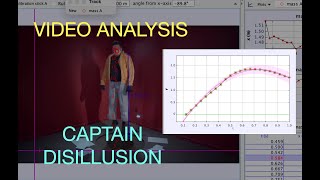
Physics Video Analysis of Captain Disillusion's Floor Jump
Analiza el salto de piso de Captain Disillusion utilizando herramientas de análisis de video para explorar conceptos de física y verificar la autenticidad del contenido.
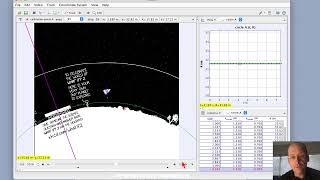
Video Analysis of More Complicated Motions in What If World
Explore advanced video analysis techniques for complex motions using Tracker software, focusing on rocket movement in the What If world.
Evaluating ChatGPT as a Physics Tutor - Kinematic Equations Derivation
Explore ChatGPT's limitations as a physics tutor through kinematic equation derivations and practice problems.
Physics Solution: ChatGPT vs. Google - Boat Acceleration Problem
Explore physics problem-solving using ChatGPT and Google, comparing their approaches to boat acceleration calculations and analyzing the results.
ChatGPT vs. Rhett - Solving a Simple Work-Energy Problem with a Pendulum
Explore ChatGPT's ability to solve a simple work-energy problem involving a pendulum, comparing its approach to human problem-solving methods.

Video Analysis: Acceleration of Boeing Starliner
Analyze Boeing Starliner's launch acceleration using Vernier and Tracker video analysis tools, comparing results and techniques.
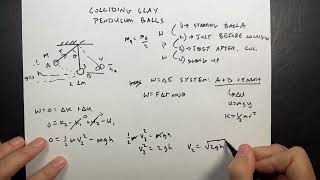
Physics Problem: Colliding Clay Pendulum Balls
Solve a physics problem involving colliding clay pendulum balls using conservation of energy and momentum principles.
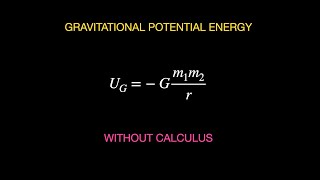
Universal Gravitational Potential Energy Without Calculus
Explore gravitational potential energy through numerical calculations in Python, avoiding calculus for a practical understanding of universal gravitation.