Introductory Lecture - Quantum Many-Body Systems Out of Equilibrium
Explore quantum many-body systems and their dynamics with a focus on entanglement, thermalization, and out-of-equilibrium phenomena in this advanced physics lecture.

Amplitudes - Lecture 2
Explore advanced concepts in particle physics amplitudes, focusing on modern computational techniques and their applications in quantum field theory.

BSM and Naturalness - Lecture 5
Explore beyond Standard Model physics and naturalness concepts in particle physics, focusing on advanced theoretical frameworks and their implications for fundamental interactions.

BSM and Naturalness - Lecture 4
Explore beyond Standard Model physics and naturalness concepts in particle theory, focusing on advanced topics and recent developments in the field.

BSM and Naturalness - Lecture 3
Explore beyond Standard Model physics and naturalness concepts in particle theory, focusing on advanced topics and recent developments in the field.
A Skein Theoretic Approach to CFT Correlators - Part 3
Explore advanced skein theoretic techniques for analyzing conformal field theory correlators in this in-depth mathematical physics lecture.
A Skein Theoretic Approach to CFT Correlators - Part 2
Explore skein theoretic approaches to CFT correlators in this advanced physics lecture, delving into mathematical techniques for analyzing quantum field theories.
A Skein Theoretic Approach to CFT Correlators - Part 1 of 3
Explore complex CFT, vertex algebras, and algebraic structures in this comprehensive lecture on skein theoretic approaches to correlators in conformal field theory.
The Naturalness of Vanishing Black Hole Response
Explore the intriguing concept of vanishing black hole response and its naturalness in this thought-provoking physics lecture by Riccardo Penco.
Introduction to the Dynamics of Disordered Systems - Equilibrium and Gradient Descent - Part 3
Explore equilibrium dynamics and gradient descent in disordered systems, focusing on theoretical concepts and practical applications in statistical physics and optimization.
Exploring Other Worlds Through Earth's Geology - Comparative Planetary Science
Discover how Earth's geological features and processes inform our understanding of other planets and moons, exploring physical, chemical, and biological aspects of extraterrestrial worlds.
The Astrophysics of Neutron Stars and Binaries - Lecture 5
Explore neutron star astrophysics and binary systems in this lecture, covering formation, evolution, and gravitational wave emission from these fascinating cosmic objects.
The Astrophysics of Neutron Stars and Binaries - Lecture 4
Explore neutron star astrophysics and binary systems in this advanced lecture, covering formation, evolution, and gravitational wave implications for these exotic celestial objects.
The Astrophysics of Neutron Stars and Binaries - Lecture 3
Explore neutron star astrophysics and binary systems in this advanced lecture, covering formation, evolution, and gravitational wave implications for these exotic celestial objects.
The Astrophysics of Neutron Stars and Binaries - Course 1, Lecture 2
Explore neutron star astrophysics and binary systems in this advanced lecture, covering their formation, evolution, and gravitational wave implications.
The Astrophysics of Neutron Stars and Binaries - Lecture 1
Explore neutron star astrophysics and binary systems in this lecture, covering formation, evolution, and gravitational wave implications for these fascinating cosmic objects.
Neural Mechanisms of Intelligence - Part 1
Explore neural mechanisms of intelligence in animals, uncovering algorithms behind cognitive processes. Gain insights into measuring and understanding non-linguistic forms of intelligence.
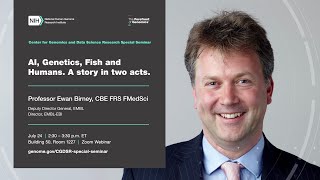
AI, Genetics, Fish and Humans - A Story in Two Acts
Explore AI's role in genomics through fish and human studies, highlighting breakthroughs in understanding genetic code and its implications for data science and molecular biology.
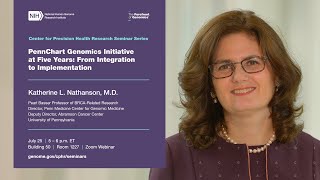
PennChart Genomics Initiative at Five Years: From Integration to Implementation
Explore the PennChart Genomics Initiative's progress in integrating and implementing genomics in healthcare, presented by renowned cancer genetics expert Dr. Katherine Nathanson.
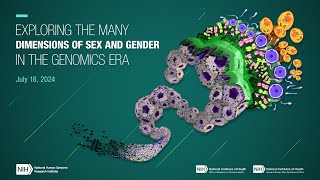
Exploring the Many Dimensions of Sex and Gender in the Genomics Era - Day 2, Part 3
Experts discuss challenges in communicating sex, gender, and genomics, exploring data storage for trans individuals, and promoting equity in scientific publishing. Interdisciplinary insights for scientists and policymakers.
Neural Mechanisms of Intelligence - Part 2 of 3
Explore neural mechanisms of intelligence in animals, uncovering algorithms behind cognitive processes. Gain insights into measuring and understanding non-linguistic forms of intelligence.