Graph Analysis and Acceleration - Tracker for Beginners Part 4
Explore three techniques for analyzing acceleration data in Tracker software, enhancing your video-based motion analysis skills for physics experiments and research.
Tracking Multiple Objects - Tracker for Beginners Part 3
Learn to analyze multiple objects' motion and their center of mass using Tracker software, gaining insights into interesting physics concepts through video analysis techniques.
Projectiles 2 - Computational Simulation of Projectile Motion
Build a computational simulation for projectile motion, demonstrating physics principles through coding. Enhance understanding of trajectory, velocity, and gravitational effects using interactive programming techniques.
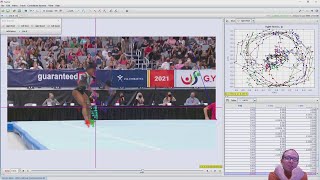
Motion Tracking Simone Biles' Gymnastics Move - Olympics 2021
Analyze Simone Biles' signature gymnastics move using motion tracking software, revealing the intricate dynamics of her hands and feet during Olympic-level performance.
Python Tutorial 3 - Graphing for Computational Physics - Absolute Beginners
Learn to create graphs for computational physics using Python, ideal for undergraduate assignments and beginners in scientific data visualization.
Python Tutorial 1 - Computations and Variables for Computational Physics Beginners
Learn essential Python basics for computational physics, including computations and variables, tailored for undergraduate-level assignments in this beginner-friendly tutorial.
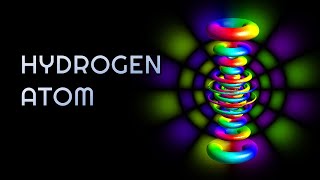
The Hydrogen Atom - A Journey through Modern Physics
Explore quantum mechanics and the hydrogen atom through computational modeling, gaining insights into early 20th-century physics discoveries that revolutionized our understanding of the universe.
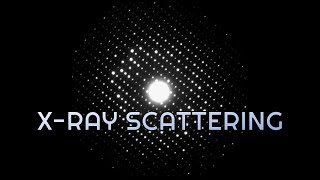
X-Ray Scattering - A Journey through Modern Physics
Explore x-ray diffraction to understand atomic structures in solids. Computational modeling demonstrates this key concept in modern physics, revolutionizing our understanding of materials.
Length Contraction and Time Dilation - A Journey Through Modern Physics - Lecture 1
Explore relativity through computational modeling, examining length contraction and time dilation as key concepts in modern physics. Gain insights into early 20th-century discoveries that revolutionized our understanding of the universe.
Pendulum Simulation: Double Pendulum Dynamics - Part 4
Explore the challenges of simulating a double pendulum system, including unexpected results and troubleshooting techniques in VPython.
Wave Function Evolver for 2D Harmonic Oscillator - Episode 7
Explore a working wave function evolver for a Gaussian wave in a 2-D harmonic oscillator potential, with debugging and tweaks demonstrated in VPython.
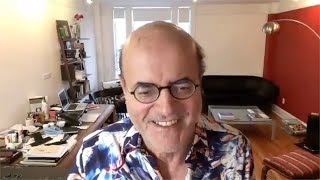
How Does the Brain Beget the Mind? - Bridging Neuroscience and Cognition
Exploring the neural basis of cognition and intelligence through the Assembly Calculus, a computational system bridging the gap between brain activity and higher-level cognitive functions.
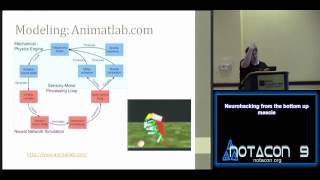
Neurohacking from the Bottom Up
Explore neurohacking fundamentals, from cell biology to neural networks. Learn about action potentials, EEG monitoring, and non-invasive techniques to understand and potentially modify brain function.
Digital Identity Gets Real - Health Credentials, Travel, Climate Change, and Financial Inclusion
Explore digital identity's impact on health, travel, climate, and finance. Learn about selective disclosure, data sharing, and emerging use cases in this insightful discussion.
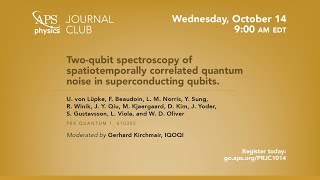
Two-Qubit Spectroscopy of Spatiotemporally Correlated Quantum Noise in Superconducting Qubits
Explore spatiotemporal correlations in quantum noise using two-qubit spectroscopy techniques for superconducting qubits, advancing understanding of quantum system behavior and decoherence mechanisms.
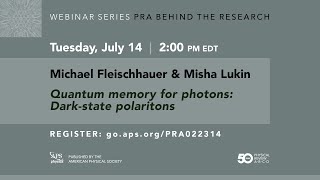
Quantum Memory for Photons: Dark-State Polaritons - Behind the Research
Explore the groundbreaking research on quantum memory for photons with Fleischhauer and Lukin. Gain insights into dark-state polaritons and their impact on quantum physics in this engaging discussion.
Three Qubits Can Be Entangled in Two Inequivalent Ways - Behind the Research
Explore quantum entanglement complexities with Ignacio Cirac as he discusses his groundbreaking paper on inequivalent three-qubit entanglement, offering insights into the research process and findings.
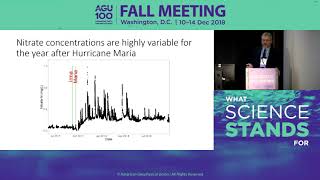
Hurricane Maria's Lasting Impact on Puerto Rico - One Year Later
Experts discuss Hurricane Maria's long-term impacts on Puerto Rico's environment and infrastructure, including forest recovery, stream chemistry, and power restoration, using on-site research and satellite data.
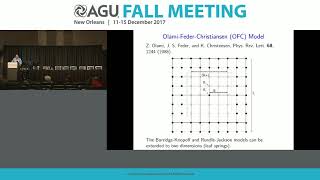
Climate Dynamics and Predictability: Insights from Simple Models - 2017 Fall Meeting Lorenz Lecture
Explore the Lorenz Lecture on simple models in geophysics, covering topics like residual stress, data collapse, and Gutenberg-Richter scaling, with implications for fault behavior and earthquake prediction.
Sagan Lecture: The Cosmic Connection and Solar System Exploration - 2017 Fall Meeting
Explore the cosmic connection, solar system exploration, and potential for life beyond Earth in this captivating lecture by Jonathan I Lunine, covering Viking experiments, Voyager missions, and future opportunities.
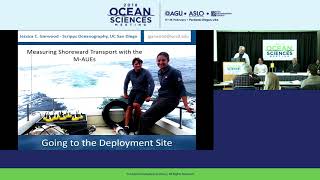
New Technologies to Study the Ocean - Advances in Observations, Robotics, and Imaging
Explore cutting-edge ocean research technologies: next-gen Argo floats, robotic plankton, and 3D coral reef mapping. Learn how these innovations revolutionize our understanding of marine ecosystems and climate change impacts.