Skillful El Nino Prediction Beyond Predictability Barriers - Henk Dijkstra
Explores advanced techniques for predicting El Niño events beyond traditional limitations, discussing innovative approaches to enhance climate forecasting accuracy and extend prediction timeframes.
Relating Coastal Sea Level to Its Drivers in the Interior - Abigail Bodner
Explore the connection between coastal sea levels and interior drivers using advanced data analysis and machine learning techniques to enhance climate change understanding and prediction.
Objective Discovery of Dominant Dynamical Regimes - Bryan Kaiser - Climate-C21
Discover dominant dynamical regimes in climate systems using machine learning and big data. Explore objective methods to advance theoretical understanding and inform future climate predictions at regional scales.
Revealing the Impact of Global Heating on the Meridional Overturning Circulation
Explore the effects of global heating on ocean circulation using transparent machine learning techniques. Gain insights into climate system dynamics and future regional impacts.
Exploring Physical and Machine Learning Approaches for Stochastic Modeling and Ensemble Prediction of Weather and Climate
Explores innovative approaches combining physical principles and machine learning for stochastic modeling and ensemble prediction in weather and climate systems, addressing challenges in multi-scale processes and future projections.
Data-Driven Subgrid-Scale Modeling - Stability, Extrapolation, & Interpretation
Explores data-driven subgrid-scale modeling in climate science, focusing on stability, extrapolation, and interpretation. Discusses advancements in theoretical understanding and the potential of machine learning to address complex climate processes.
Practical Integrability - David Weiss
Explores universal aspects of non-equilibrium many-body physics, focusing on novel phases and universality classes beyond equilibrium paradigms. Bridges statistical, AMO, condensed matter, and high-energy physics.
Nonreciprocity as a Generic Route to Traveling and Oscillatory States - Zhihong You
Explores nonreciprocity in many-body physics, focusing on traveling and oscillatory states. Discusses universal aspects of non-equilibrium systems across various fields of physics.
Distributed Quantum Sensing with Entangled Sensor Networks - Quntao Zhuang
Explore distributed quantum sensing using entangled sensor networks. Learn about recent advances in integrable models, quantum systems, and their applications in physics and string theory.
Recent Developments in Asymptotically Good Quantum LDPC Codes
Explores recent advancements in quantum LDPC codes, focusing on asymptotically good properties. Discusses theoretical developments and potential applications in quantum error correction and fault-tolerant quantum computing.
Entanglement Dynamics in Monitored Quantum Processors - Michael Gullans
Explores entanglement dynamics in monitored quantum processors, discussing recent advances and applications in noisy intermediate-scale quantum systems for mathematical and condensed-matter physics.
Observable Quantum Information Transitions With and Without Measurements - Ehud Altman
Explores quantum information transitions, focusing on observable phenomena with and without measurements. Discusses recent advances in integrable models and their applications in physics and string theory.
Integrable Sigma Models at RG Fixed Points - Quantisation as Affine Gaudin Models
Explores recent advances in integrable models, focusing on quantization as affine Gaudin models. Covers topics from mathematical physics, condensed matter, and string theory, offering insights for researchers across various backgrounds.
Structure and Response in Disparate Universal Regimes - Joe Carlson
Explore universal physics in few-body systems across atomic and nuclear scales. Discover connections between disparate regimes and their implications for structure and response in quantum systems.
Coherent Wandering in Few-Body Land - Lev Khaykovich
Explore few-body physics near unitarity, focusing on atomic and nuclear systems. Discover universal principles and cross-disciplinary connections in this cutting-edge research area.
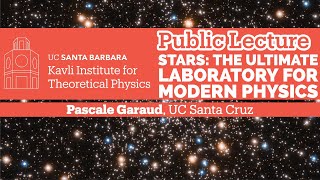
Stars: The Ultimate Laboratory for Modern Physics - KITP Public Lecture
Explore how stars serve as laboratories for modern physics, offering insights into nuclear physics, quantum mechanics, particle physics, and turbulence, with future prospects in stellar seismology.
Connecting Different Scales in Binary Systems - Discussion
Explore binary systems across cosmic scales, from stars to supermassive black holes. Discover how circumbinary gas influences these systems and learn about cutting-edge observational and numerical techniques.
Simulating How Black Holes Burp and Shine - Sasha Tchekhovskoy
Explore cutting-edge simulations of black hole behavior, including their emission and accretion processes, in this advanced astrophysics talk by Northwestern researcher Sasha Tchekhovskoy.
Observational Tests of Theory in Binary Systems - Part II
Explore observational tests of binary system theories, focusing on circumbinary gas evolution and its influence on embedded binaries across stellar and black hole scales.
Observational Tests of Theory I - Discussion on Binary Systems
Explore observational tests of binary systems in astrophysics, from stellar pairs to supermassive black holes, and their interactions with surrounding gas in this insightful conference talk.
Missing Physics III - Discussion on Binary Systems and Circumbinary Gas
Explore circumbinary gas evolution, observational signatures, and numerical modeling techniques in stellar and black hole binary systems with experts Roger Blandford and Sean McWilliams.