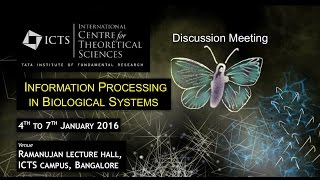
Statistical Mechanics for Real Biological Networks by William Bialek - Turing Lecture
Explore statistical mechanics applied to biological networks, focusing on information processing and self-organization in living systems. Gain insights from leading experts in physics, mathematics, and biology.
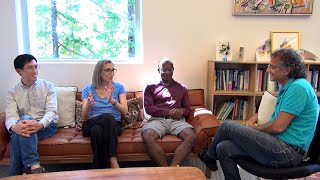
Summer Cluster in Quantum Computation - Polylogues
Explore key themes in quantum computation with experts discussing complexity theory, protocols, entanglement, algorithms, and quantum chemistry in this insightful panel discussion.
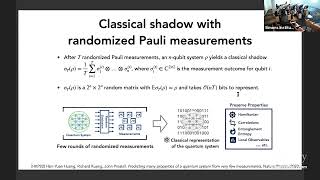
Provably Efficient Machine Learning for Quantum Many-Body Problems
Explore efficient machine learning techniques for solving quantum many-body problems, focusing on provable methods and their applications in computational physics and quantum computing.
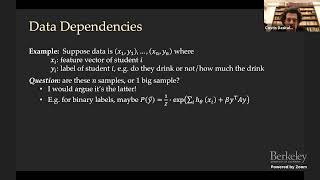
Learning Ising Models from One, Ten or a Thousand Samples
Explore statistical learning theory and Ising models, focusing on sample complexity and efficient algorithms for learning in high-dimensional settings.

Networks of Spiking Neurons Learn to Learn and Remember
Explore how spiking neural networks acquire learning and memory capabilities, bridging computational neuroscience and artificial intelligence research.
An Algorithmic Theory of Brain Networks
Explore an algorithmic approach to understanding brain networks, examining computational theories and their implications for neuroscience and cognitive science.
Inferring Single-Trial Neural Population Dynamics Using Sequential Auto-Encoders
Explore cutting-edge techniques for analyzing neural population dynamics using sequential auto-encoders, with insights from Google researcher David Sussillo.
Cortical Areas Interact through a Communication Subspace
Explore how cortical areas communicate through subspaces, examining neural population dynamics and inter-area interactions in visual processing using advanced data analysis techniques.
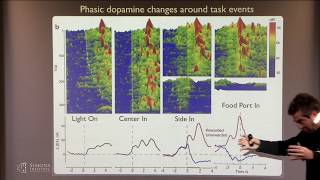
Basal Ganglia Architecture for Reinforcement Learning
Explore the neural circuitry of basal ganglia and its role in reinforcement learning, focusing on representation, coding, and computation in neural networks.
Neural Mechanisms of Vision
Explore the intricate workings of visual perception, delving into neural processes and computational models that shape our understanding of how the brain interprets visual information.
Computation in Networks of Neurons in the Brain I
Explore neural network computation in the brain, focusing on advanced concepts and recent research findings in computational neuroscience.
Alloys - Artificial Intelligence and Scientific Computing for Fluid Mechanics
Explore the fusion of AI and scientific computing for predicting and controlling complex fluid systems, with insights on novel algorithms and the importance of interdisciplinary expertise.
Machine Learning for Determining Protein Structure and Dynamics from Cryo-EM Images
Explore machine learning techniques for analyzing cryo-EM images to determine protein structure and dynamics, focusing on the cryoDRGN algorithm and its applications in structural biology.
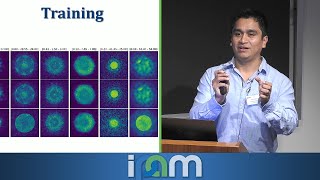
Application of Machine Learning to Electron Microscopy Data - IPAM at UCLA
Explore machine learning applications in electron microscopy, focusing on data modeling and neural networks for distortion compensation in experimental datasets.
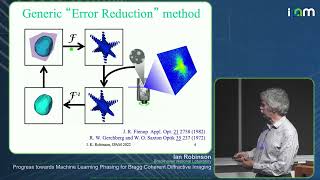
Progress Towards Machine Learning Phasing for Bragg Coherent Diffractive Imaging
Explores machine learning approaches for solving the phase problem in Bragg Coherent Diffractive Imaging, discussing current methods, challenges, and potential ML solutions for 2D and 3D data inversion.
Capturing the First Portrait of Our Milky Way's Black Hole & Beyond
Explore the groundbreaking methods used to capture the first image of Sagittarius A*, our galaxy's central black hole, and future directions in black hole imaging technology.
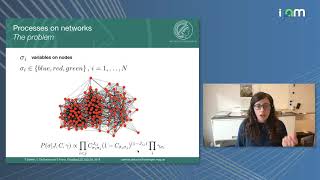
Matrix Product States for Modeling Dynamical Processes on Networks
Explore matrix product states and dynamic message-passing algorithms for modeling network dynamics, reducing computational complexity from exponential to polynomial in system size and duration.
Nonlinear Reduced Basis Methods and Transport in Electronic Structure Calculation
Explore nonlinear reduced basis methods and optimal transport for efficient electronic structure calculations, focusing on a 1D toy model with potential extensions to larger systems.
Uncertainty-Aware Machine Learning Models of Many-Body Atomic Interactions
Explore symmetry-aware machine learning models for atomic interactions, focusing on E(3)-equivariant neural potentials and Bayesian force fields for improved accuracy in materials modeling.
Fully Quantum (Bio)Molecular Simulations: Dream or Reality?
Explore the convergence of quantum mechanics and machine learning in molecular simulations, addressing challenges and future developments for complex (bio)molecular systems.
Machine Learning for Scientific Discovery, with Examples in Fluid Mechanics
Explore machine learning for nonlinear dynamical systems modeling, focusing on the SINDy algorithm and its applications in fluid dynamics, with emphasis on interpretable and physics-respecting solutions.