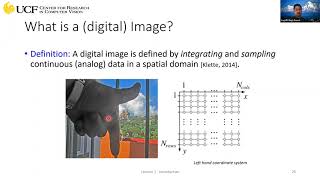
Introduction to Computer Vision - Lecture 1
Introduction to computer vision concepts, applications, and recent advancements. Explores visual perception, image types, object recognition, facial analysis, action detection, and video processing techniques.
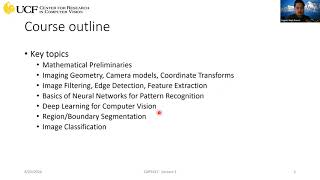
Computer Vision - Administrative Introduction - Fall 2020
Introduction to computer vision course covering topics, grading, expectations, and projects. Provides essential administrative information for students to succeed in the class.

Learning Imbalanced Datasets with Label-Distribution-Aware Margin Loss
Explore effective strategies for handling imbalanced datasets using label-distribution-aware margin loss, improving machine learning model performance on skewed data.
SILCO: Show a Few Images, Localize the Common Object
Innovative approach to object detection using few support images, combining spatial similarity and feature reweighting for improved localization in challenging scenarios.
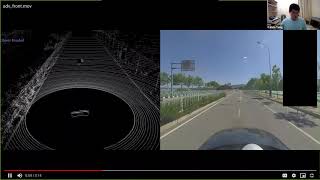
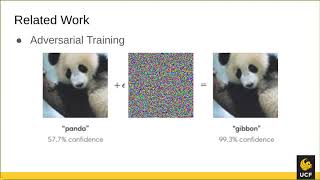
Trust Region Based Adversarial Attack on Neural Networks
Explore trust region optimization for adversarial attacks on neural networks, covering various attack methods and their applications in computer vision and object detection.
Why Can't I Dance in the Mall? Mitigating Scene Bias in Action Recognition
Explores scene bias in action recognition, proposing solutions like adversary training and human mask confusion loss to improve accuracy across different environments.
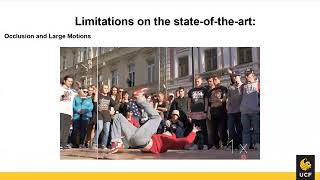
Unsupervised Video Interpolation Using Cycle Consistency
Explore cutting-edge unsupervised video interpolation techniques using cycle consistency, including implementation, constraints, and experimental results for improved frame generation.
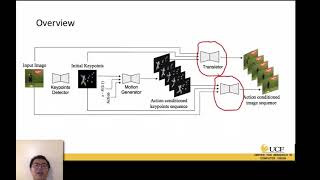
Unsupervised Keypoint Learning for Guiding Class-Conditional Video Prediction
Explore unsupervised keypoint learning techniques for guiding class-conditional video prediction, enhancing the accuracy and efficiency of video generation models.
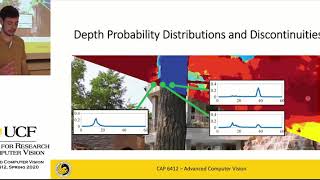
Extreme View Synthesis: Novel Techniques and Challenges
Explore advanced techniques for synthesizing novel views from limited input images, covering multiplane images, patch matching, and depth probability estimation.
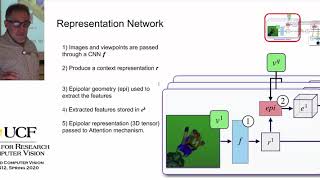
Geometry-Aware Neural Rendering for Novel View Synthesis
Explore novel view synthesis techniques and epipolar extraction in neural rendering, with a focus on geometry-aware approaches and their practical applications.
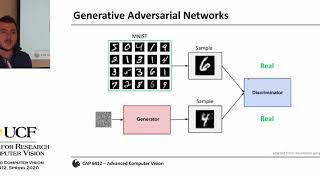
Generative Adversarial Minority Oversampling
Explore innovative techniques for addressing class imbalance in machine learning using generative adversarial networks and convex generators, with a focus on minority oversampling.

CapsuleVOS: Semi-Supervised Video Object Segmentation Using Capsule Routing
Learn semi-supervised video object segmentation using capsule routing, exploring capsule networks, video capsules, and advanced techniques for improved accuracy and efficiency in computer vision tasks.
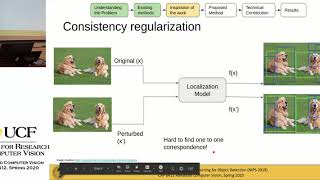
Consistency-Based Semi-Supervised Learning for Object Detection
Explore semi-supervised learning for object detection, focusing on consistency-based approaches. Learn about loss functions, background elimination, and experimental results in this concise presentation.
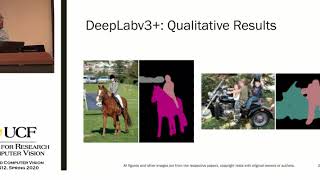
Region Mutual Information Loss for Semantic Segmentation
Explore advanced techniques in semantic segmentation, including region mutual information loss, à trous convolutions, and multi-scale features for improved image analysis and understanding.
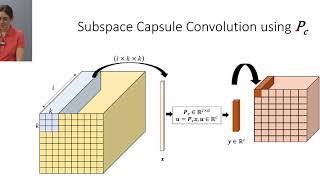
Subspace Capsule Network
Explore Subspace Capsule Networks: a novel approach to neural networks that preserves information, norms, and angles. Learn about its principles, applications, and advantages in image classification and generation.
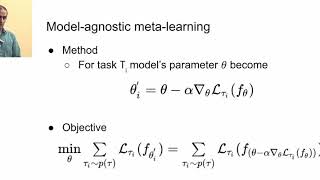
Unsupervised Meta-Learning for Few-Shot Image Classification
Explore unsupervised meta-learning techniques for few-shot image classification, including task construction, augmentation methods, and performance on benchmark datasets.
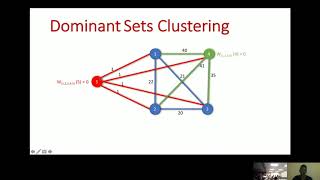
Deep Constrained Dominant Sets for Person Re-Identification
Explore advanced techniques for person re-identification using deep learning, including triplet loss, quadruplet loss, diffusion-based methods, and constrained dominant sets.
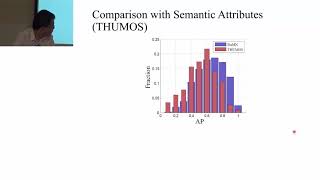
Action Recognition, Temporal Localization and Detection in Videos
Explore action recognition, temporal localization, and detection in videos. Learn about knowledge transfer, 3D adaptations of object detection, and video segmentation techniques.
Capsule Networks for Computer Vision – CVPR 2019 Tutorial
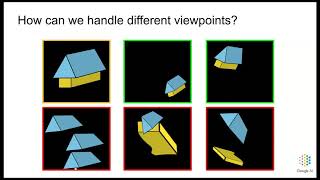
Explore capsule networks for computer vision, covering architecture, challenges, applications, and advancements in this cutting-edge deep learning approach.
Capsule Networks - A Survey by Dr. Yogesh Rawat, UCF
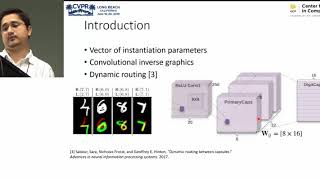
Explore capsule networks in computer vision, covering dynamic routing, equivariance, and applications in segmentation, localization, and medical imaging.
Generalization to Video Capsules - From Convolutional to Video Capsule Networks
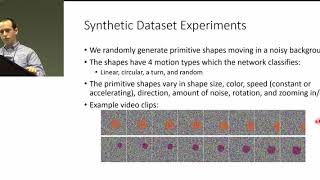
Explore video capsule networks for action detection and object segmentation, including multi-modal approaches and semi-supervised techniques for improved performance in computer vision tasks.