
Linear Algebra in NumPy and SciPy - ME3255
Learn essential linear algebra operations using NumPy and SciPy libraries in Python for efficient numerical computations and data analysis.

Convergence of Integration Methods and Root Finding with SymPy - ME3255
Explore integration methods and root finding using Sympy, focusing on convergence analysis for enhanced numerical problem-solving skills.

ME3255 - Building Moore's Prediction and Using Monte Carlo Buckling Analysis
Explore Moore's prediction and Monte Carlo buckling analysis techniques for advanced engineering applications. Enhance structural design skills.
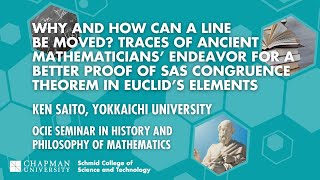
Why and How Can a Line be Moved? - Examining Euclid's Elements
Explore ancient mathematicians' efforts to improve proofs of the side-angle-side congruence theorem in Euclid's Elements, examining linguistic peculiarities and textual variations in related propositions.
Unsupervised Alignment of Graphs and Embeddings: Fundamental Limits and Computational Methods
Explore unsupervised alignment techniques for graphs and embeddings, examining fundamental limits and computational approaches for data analysis and machine learning applications.
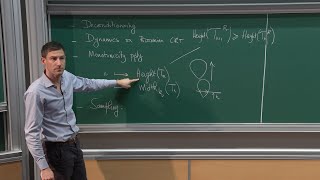
Where Do Random Trees Grow Leaves - A Study of Binary Tree Growth Dynamics
Explore the growth patterns of random binary trees, focusing on leaf addition dynamics and fractal properties in tree structures.
Global Solutions to Quadratic Systems of Stochastic Reaction-Diffusion
Explorez les solutions globales des systèmes quadratiques de réaction-diffusion stochastique en dimension deux, avec un accent sur les perturbations à quatre espèces.
Zeros of Random Power Series with Stationary Gaussian Coefficients
Explore zeros of random power series with stationary Gaussian coefficients, comparing to i.i.d. case and analyzing expected zero count in disks as radius approaches convergence.
Mathematical Foundation of Various MCMC Methods
Explore advanced MCMC methods for combinatorial optimization, including multi-spin flip techniques. Compare mathematical and numerical results to evaluate efficiency in different contexts.
Formalization of Infinity Category Theory
Explore ∞-category theory's formalization, unifying mathematics, computer science, and physics. Learn synthetic reasoning and the Yoneda Lemma in this advanced mathematical seminar.
From HoTT to HOTT - Exploring Homotopy Type Theory
Explore the evolution from Homotopy Type Theory (HoTT) to Higher-Order Type Theory (HOTT) in this insightful lecture by Michael Shulman.

Mathematics as a Translation Task - The Importance of Training Distributions
Explore how mathematical problems can be framed as translation tasks, focusing on the impact of training distributions on model performance and transformer model mechanics.
Three Problems in the Mathematics of Deep Learning
Explore mathematical concepts behind aligning neural networks with classical programs, including polynomial functors, cohomology, and higher categories.
How Machine Learning Can Help Mathematicians
Explore AI's potential in mathematics: from language models guiding problem-solving to automated theorem proving, with real-world examples and future perspectives.
Modularity of Abelian Surfaces
Explorez la preuve de la modularité d'une proportion positive de surfaces abéliennes sur les rationnels dans cette conférence mathématique avancée.
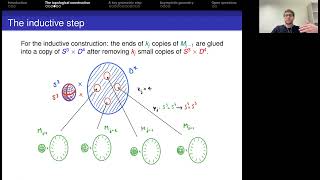
Ricci Curvature, Fundamental Group and the Milnor Conjecture - Part 2
Explore advanced concepts in topology and geometry, focusing on counterexamples to the Milnor conjecture and their construction using mapping class groups and asymptotic cones.

Plectic Cohomology of Mixed Shimura Varieties and Stacks
Explore joint work on plectic cohomology of mixed Shimura varieties and stacks with Tony Scholl from the University of Cambridge.

NetworkX is Fast Now - Graph Analytics Unleashed
Discover NetworkX's power for graph analytics, from beginner-friendly API to accelerated backends. Learn to extract insights from data using advanced tools for scalable graph analysis.

Computational Origami - Harnessing Paper Folding for Problem Solving
Explore the computational power of paper folding, from basic arithmetic to solving cubic equations, using Python simulations and origami principles.

Graphs and Vogue Dance: Using Data Structures to Create Choreographies
Explore how graph data structures can be used to create and visualize Vogue Dance choreographies, combining computer science concepts with artistic expression in this innovative approach to dance composition.

Are Rewrites Always a Bad Idea? - When to Consider Rewriting Legacy Code
Explore when software rewrites can be beneficial, choosing tech stacks, and transitioning to leadership as a junior dev. Learn from a real-world project transforming academic C++ code.