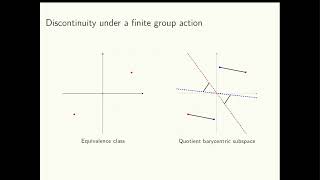
Towards Quotient Barycentric Subspaces
Explore advanced mathematical concepts of quotient barycentric subspaces, delving into their properties and applications in geometric data analysis.
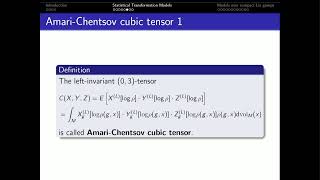
Geodesic Flows of Alpha Connections for Statistical Transformation Models on Compact Lie Groups
Explore geodesic flows of α connections in statistical transformation models on compact Lie groups, advancing understanding of geometric structures in statistics.
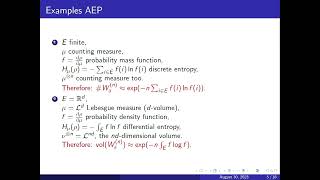
On the Entropy of Rectifiable and Stratified Measures
Explore entropy concepts for rectifiable and stratified measures, delving into mathematical intricacies and theoretical foundations.
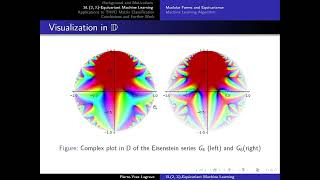
SL(2, Z)-Equivariant Machine Learning with Modular Forms - Theory and Applications
Explore SL(2, Z)-equivariant machine learning, delving into modular forms theory and its practical applications in advanced mathematical modeling.
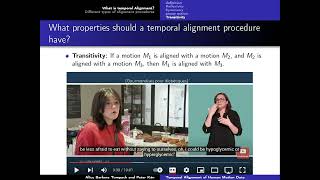
Temporal Alignment of Human Motion Data - A Geometric Point of View
Explore geometric approaches to temporally align human motion data, focusing on innovative techniques and their applications in motion analysis.

Test Time Compute: Sampling and Chain of Thought Techniques
Explore advanced inference techniques like sampling and chain of thought to enhance AI model performance. Learn to optimize test-time compute for improved accuracy and efficiency.
The Queue Continuum: Applied Queuing Theory - RailsConf 2022
Explore queuing theory, parallelism, and concurrency in Rails applications through Star Trek-themed examples, focusing on Sidekiq and Puma optimization.
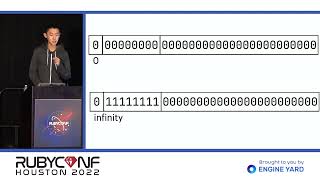
1.5 is the Midpoint Between 0 and Infinity - Binary Search on Floating-Point Ranges in Ruby
Explore binary search, IEEE 754 floating-point numbers, and Ruby's clever trick for binary search on floating-point ranges.
Unraveling the Web of Relationships: Understanding Graph Data
Explore graph theory basics, real-world applications, and the growing importance of graph databases in solving complex data challenges across industries.
Integration Algorithms
Master integration algorithms for solving complex mathematical problems and enhancing computational skills.
Karger's Mincut Algorithm - Introduction and Implementation
Explore Karger's mincut algorithm, its motivation, problem definition, and implementation through a practical example.

Linear Combinations and Span - Introduction to Vector Spaces
Explore linear combinations and span concepts through intuitive explanations and graphical illustrations. Master fundamental linear algebra principles.
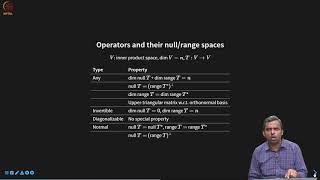
Classification of Operators
Learn about the classification of operators in mathematics, exploring different types and their properties.
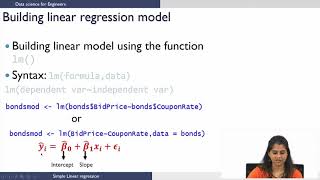
Simple Linear Regression Model Building
Build a simple linear regression model by loading data, exploring its structure, and fitting a regression line, with a comprehensive model summary.
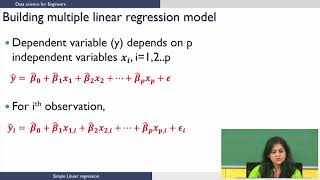
Multiple Linear Regression: Model Building and Selection
Build and select multiple linear regression models through data loading, visualization, and iterative model refinement using R.
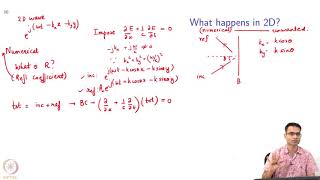
FDTD: Materials and Boundary Conditions - Absorbing Boundary Conditions in 2D
Explore absorbing boundary conditions in 2D for FDTD simulations of materials, enhancing understanding of electromagnetic wave propagation and computational techniques.

Introduction to Orthogonal Polynomials - Lecture 41
Explore orthogonal polynomials: definition, properties, examples, and mapping to standard intervals. Gain insights into this fundamental mathematical concept.
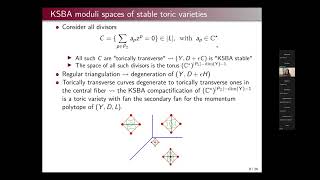
The KSBA Moduli Space of Stable Log Calabi-Yau Surfaces
Explore the KSBA moduli space of stable log Calabi-Yau surfaces, delving into its properties, connections to toric varieties, and recent developments in algebraic geometry and mirror symmetry.
From Materials to Minds: Nonlocal Approaches to Damage and Degeneration
Explore nonlocal analysis for modeling damage in materials, drawing parallels to neural networks and potential applications in cognitive degeneration research.
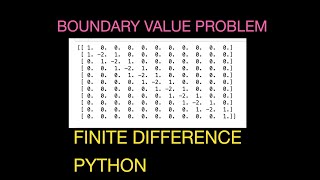
Differential Equation with Boundary Conditions Using Finite Difference in Python
Solve differential equations with boundary conditions using Python's NumPy and finite difference method. Master numerical techniques for complex mathematical problems.
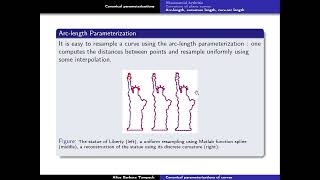
On Canonical Parameterizations of 2D Shapes
Explore canonical parameterizations of 2D shapes, delving into mathematical concepts and applications in geometry and computer graphics.