Improving Insights by Utilizing Causal Inference Methods
Explore causal inference methods to de-bias data, approximate incremental improvements, and accelerate insights using propensity score matching and regression discontinuity.

Proving the Impact: Using Synthetic Control to Evaluate Intervention Effectiveness
Explore Synthetic Control methodology for measuring intervention impact when A/B testing isn't feasible. Learn to construct "synthetic" units, estimate causal effects, and apply this innovative approach to real-world scenarios.
Score-based Generative Modeling of Graphs via the System of Stochastic Differential Equations
Explore score-based generative modeling for graphs using stochastic differential equations. Learn about graph diffusion, forward and reverse processes, and applications in molecule generation.

Weakly Supervised Causal Representation Learning
Explore weakly supervised causal representation learning, its theoretical foundations, and practical applications in disentangling causal variables from unstructured data like images for improved causal reasoning.
Linear Causal Representations from Interventions under General Nonlinear Mixing
Explore causal representation learning from latent interventions in nonlinear settings. Uncover geometric structures, analyze precision matrices, and evaluate a contrastive algorithm for identifying latent variables.
A Tutorial on Causal Representation Learning
Explore Causal Representation Learning: combining machine learning with causal assumptions to identify causal variables from low-level data. Gain insights into core problems and future directions in scientific discovery.
Likelihood Training of Schrödinger Bridge Using Forward-Backward SDEs Theory
Explore likelihood training of Schrödinger Bridge using Forward-Backward SDEs theory for deep generative modeling, offering mathematical flexibility and optimization principles.
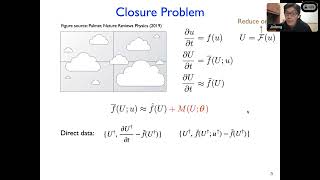
Data-Driven Closure Modeling Using Derivative-free Kalman Methods
Explore data-driven closure modeling for complex dynamical systems using derivative-free Kalman methods. Learn to improve predictions in turbulence and cloud dynamics with advanced machine learning techniques.
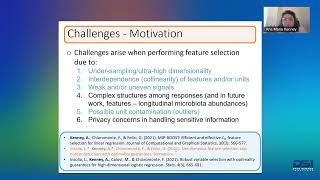
Simultaneous Feature Selection and Outlier Detection Using Mixed-Integer Programming
Explore mixed-integer programming for simultaneous feature selection and outlier detection in high-dimensional regressions, with applications to biomedical research and microbiome studies.
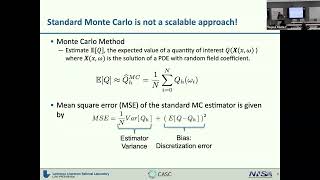
Uncertainty Quantification, Software Ecosystems, and Infrastructure Resilience - Technical Talk
Explore uncertainty quantification, exascale software ecosystems, and infrastructure resilience in this technical talk by Sarah Osborn at WiDS Livermore 2024.
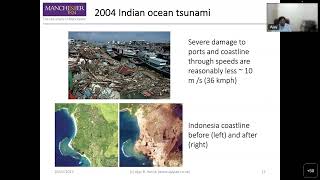
Uncertainty Quantification and Deep Learning for Water-Hazard Prediction
Explore uncertainty quantification and deep learning techniques for predicting water hazards, focusing on storm surge impacts and urban infrastructure damage assessment.

Virtual Origami: Mathematical Modeling and Computational Realization
Explore virtual origami using Mathematica, focusing on traditional techniques with mathematical formalism. Learn about fold rules, classical folds, and create a flying crane model.

Progress in Graphs and Networks
Explore advancements in graph theory and network analysis, uncovering applications in various fields and enhancing problem-solving skills.

New Algorithms: Numerical Solution of Large Systems of Nonlinear Equations Using Monodromy
Explore a novel algorithm using monodromy to solve large systems of analytic nonlinear equations, developed during a Wolfram internship.

Expanders in Higher Dimensions: From Local to Global Properties and Applications
Explore high-dimensional expanders, their local-to-global properties, and applications in coding theory, networking, and computational complexity.
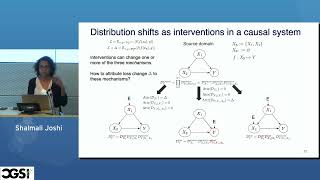
Observational Causal Inference for Improving and Auditing ML in Healthcare
Explore observational causal inference techniques to enhance and audit machine learning models in healthcare, focusing on distribution shifts, safe policy learning, and robust off-policy evaluation.
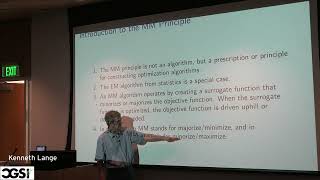
MM Principle of Optimization - CGSI 2023
Explore the MM Principle of Optimization in computational genomics, covering algorithms, applications in signal processing, and machine learning techniques.
Causal Discovery and Representation Learning - Day 4
Explore causal discovery and representation learning in machine learning for drug discovery with Jason Hartford's insightful presentation.

Learning Geometry and 3D Symmetries - Day 1
Explore geometry and 3D symmetries in machine learning for drug discovery, covering key concepts like tensor products and network equivalence.
Identifying Representations for Intervention Extrapolation
Explore identifiable representations for intervention extrapolation, improving generalizability in machine learning. Learn theoretical foundations and practical applications through simulations and Q&A.
Mathematical Games - Polygon Dissections - Episode 8
Explore mathematical games and puzzles involving polygon dissections with Ed Pegg Jr. Discover fascinating geometric concepts and their applications in this engaging presentation.