Mathematics at the Roots: Empowering Agriculture with Artificial Intelligence
Explore how AI revolutionizes agriculture, enhancing crop yields and sustainability through data-driven insights and innovative mathematical models.
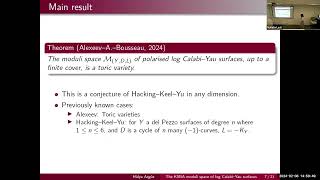
The KSBA Moduli Space of Log Calabi-Yau Surfaces - Part 1
Explore the KSBA moduli space of log Calabi-Yau surfaces, delving into its properties, conjectures, and recent developments in algebraic geometry and mirror symmetry.
Probabilistic Methods in Hyperbolic Geometry
Explore probabilistic approaches to solve geometric and topological questions in hyperbolic manifolds, bridging mathematics domains through innovative analytical techniques.
Dimer Models and Random Tilings - Part 1
Explore dimer models and random tilings with Cédric Boutillier. Learn about Kasteleyn's theory, combinatorial correspondences, and asymptotic methods for studying perfect matchings on lattices.

Complexity of Sparse Linear Regression
Explore new methods for solving sparse linear regression, overcoming limitations of traditional approaches and exploiting structural properties of covariance matrices in machine learning and statistics.
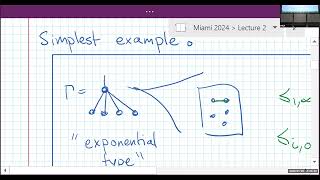
Dispatches from the Ends of the Stability Manifold - Part II
Explores noncommutative minimal model program, stability manifolds, and multi-scale decompositions in triangulated categories. Discusses augmented stability conditions and their potential implications for moduli spaces.
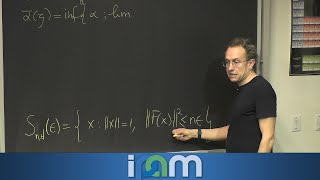
Solving Overparametrized Systems of Nonlinear Equations
Explore overparametrized nonlinear equation systems, their solutions, and implications for neural network optimization landscapes with Stanford's Andrea Montanari at IPAM's EnCORE Workshop.
Entropy, Isotropic Constant and Mahler's Conjecture
Explores connections between entropy, isotropic constant, and Mahler's conjecture in convex geometry. Discusses functional forms of Klartag's work and adaptations for log-concave functions.
Mathematical and Computational Modelling to Explore Various Potential Cancer Treatments
Explore mathematical and computational modeling approaches for cancer research, covering topics from age-structured populations to machine learning techniques for understanding disease progression and treatment.
Perfect t-embeddings of Uniform Aztec Diamond Graphs
Explores t-embeddings of uniform Aztec diamond graphs, providing new formulas and asymptotic analysis to prove convergence of dimer model height fluctuations to a Gaussian Free Field.
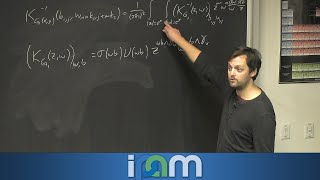
Dimer Models and Random Tilings - Part 2
Explore dimer models, perfect matchings, and tilings with advanced mathematical tools. Delve into Kasteleyn's theory, combinatorial correspondences, and asymptotic methods for large-scale limits.

On Variants of Specht Polynomials and Random Geometry
Explore connections between Specht polynomials, conformal field theory, and random geometry. Discover algebraic structures in statistical mechanics models and their geometric interpretations.
Fluctuations of Linear Eigenvalue Statistics in Sample Covariance Matrices - Tensor Product Data
Explore fluctuations in linear eigenvalue statistics of sample covariance matrices with tensor product data, comparing normal and uniform distributions on unit sphere.
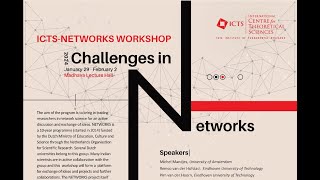
Asymptotics of Invariant Measures of Mean-field Markov Models on Countable State Spaces
Explore asymptotics of invariant measures in mean-field Markov models on countable spaces. Gain insights into network science, probability theory, and applications in complex systems and data analysis.
The Friendship Paradox for Sparse Random Graphs
Explore the friendship paradox in sparse random graphs, examining structural properties and implications for network analysis and social dynamics.
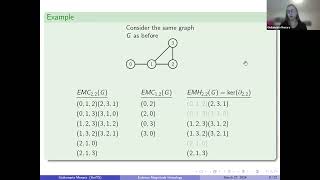
Eulerian Magnitude Homology - Subgraph Structure and Random Graphs
Explore connections between magnitude homology group ranks and graph substructures. Introduces eulerian and discriminant magnitude homology, relating them to subgraph counts and random graph models.
Geometric Bounds for Spanning Tree Entropy of Planar Lattices
Explores geometric bounds for spanning tree entropy in planar lattices, connecting hyperbolic geometry, number theory, probability, and graph theory. Discusses conjectures and recent progress.
Recent Progress on Submodular Function Minimization
Explore recent advancements in submodular function minimization algorithms, leveraging convex optimization methods to address open questions and improve efficiency in discrete optimization.
Sparsifying Generalized Linear Models
Explores sparsification of sums in generalized linear models, presenting algorithms for efficient computation and applications to optimization problems like regression.
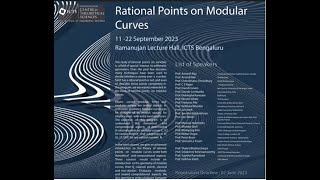
Introduction to Modular Forms, Elliptic Curves, and Modular Curves - Lecture 3
Explores advanced concepts in arithmetic geometry, focusing on modular forms, elliptic curves, and modular curves. Builds on previous lectures to deepen understanding of these fundamental objects.
Conquering Movement - How Math Can Help Us Become Musicians
Exploring the intersection of music and mathematics to revolutionize musician education and health through innovative analysis of physical motion and performance patterns.