The Chabauty-Coleman-Kim Method: From Theory to Practice - Lecture 4
Explore advanced techniques in arithmetic geometry, focusing on the Chabauty-Coleman-Kim method for studying rational points on modular curves. Gain insights into theoretical foundations and practical applications.
Classical and Quadratic Chabauty - Lecture 3
Explore advanced techniques in arithmetic geometry: Classical and Quadratic Chabauty methods for studying rational points on modular curves, with applications to elliptic curves.
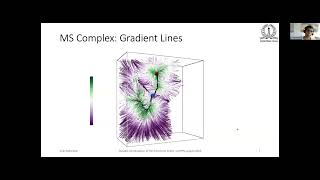
Scalable Computation of the Extremum Graph
Explore scalable computation of extremum graphs, a simplified topological descriptor for scalar functions, with applications in visualization and shape analysis. Learn efficient parallel algorithms for large datasets.
Small-Set Expansion in the 2-Degree Short-Code Graph - The Easier Version
Explore the intricacies of small-set expansion in the 2-degree short-code graph, focusing on an easier version of this complex mathematical concept.
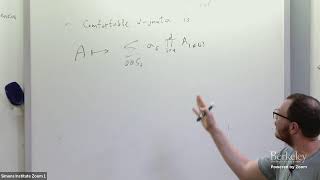
Product Mixing, Quantum Separation, and Comfortable Juntas
Explores product mixing in special unitary groups, solving Gowers' problem and its applications in quantum communication, with sharp results on subset distributions in SU_n.
Representation Theory in TCS and Extremal Combinatorics
Explore how Representation Theory extends Boolean function theory, leading to new insights in theoretical computer science and extremal combinatorics.
On Perfectly Friendly Bisections of Random Graphs
Explores vertex-isoperimetry expansion in random graphs, using boolean function tools to prove equipartition results with specific neighbor distribution properties across partitions.
Erdős and Shannon: A Story of Probability, Communication, and Combinatorics
Explore the interplay of probability, communication, and combinatorics through the lens of Erdős and Shannon's groundbreaking work in mathematics and information theory.
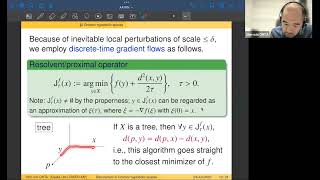
Barycenters and a Law of Large Numbers in Gromov Hyperbolic Spaces
Explore barycenters in Gromov hyperbolic spaces, examining contraction properties and a law of large numbers for convex optimization applications in metric spaces.
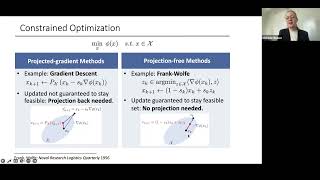
Exploiting Geometric Structure in Matrix-Valued Optimization
Exploring optimization on matrix manifolds, introducing Riemannian Frank-Wolfe methods for constrained problems, and discussing applications in machine learning and mathematics.
Structure of Communication - Richard M. Karp Distinguished Lecture
Explore communication complexity, its applications, and structural conjectures in theoretical computer science with Shachar Lovett. Gain insights into efficient communication and its connections to various mathematical domains.
Survival Analysis of Cancer Patients Using Machine Learning Technique by Shakuntala Baichoo
Explore machine learning techniques for survival analysis of cancer patients, focusing on predicting outcomes and analyzing clinical data to enhance patient care and treatment strategies.
Structure of Boolean Almost Low Degree Functions on the Biased Cube
Explores Boolean functions on biased cubes, extending FKN and Kindler-Safra theorems. Analyzes structures for functions close to low degree, including maximum coordinates and decision trees.
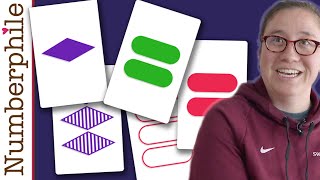
The Game of Set and Some Variations
Explore mathematical variations of the classic game Set with Catherine Hsu, including projective and non-abelian versions, offering new challenges and insights for puzzle enthusiasts.
Demystifying Latschev's Theorem for Manifold Reconstruction
Explores quantitative approaches to Latschev's theorem for topological manifold reconstruction, advancing finite sample analysis in data science and manifold learning applications.
Graph Linear Algebra Part 3 - Data Structures and Optimization for Fast Algorithms
Explore advanced graph linear algebra concepts and optimization techniques for fast algorithms in data structures, building on previous parts.
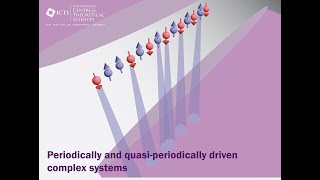
Quasi-Crystals, Fractals, and Other Beauties by Cristiane Morais Smith
Explore quasi-crystals, fractals, and related mathematical structures in this lecture by Cristiane Morais Smith, delving into their fascinating properties and applications in physics and beyond.

Queuing Theory and Poisson Process
Introduction to M/M/1 queue model and Poisson process, covering fundamental concepts of queuing theory. Explores key principles and applications in simple queuing systems.
Chaos Theory and Geometry - Can They Predict Our World? With Tim Palmer
Explore chaos theory's geometry to predict uncertain phenomena like weather, pandemics, and quantum physics. Discover insights into the universe and ourselves through fractal patterns and probabilistic approaches.
ChatGPT - What Is All the Chatter About? by Preethi Jyothi
Explore diverse scientific topics through engaging lectures by distinguished researchers, designed to inspire and educate women in mathematics and statistics.
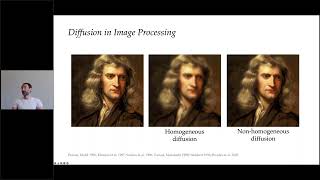
Physics-Inspired Learning on Graph - Michael Bronstein, PhD
Explore physics-inspired continuous learning models for graphs, challenging traditional message-passing paradigms. Discover new approaches using differential geometry, algebraic topology, and differential equations to revolutionize graph machine learning.